

Why Mortgage Refinancing Is Back in the Conversation
If you locked in a mortgage at 7.5% or higher during 2023 or 2024, you have probably been watching rates every week. As of July 14, 2026, the average 30-year fixed refinance rate sits at 6.78%, per Bankrate’s daily survey — down meaningfully from the cycle peak above 8%.
That gap matters. It is not yet the dramatic 1–2% drop that makes refinancing a slam dunk for everyone, but for borrowers with rates above 7.5%, it can already cross the threshold where the numbers work in your favor.
This guide walks you through exactly how to find out whether your specific situation makes sense — no guesswork, just the math.
The Two Rates You Need to Compare
Refinancing replaces your existing mortgage with a new one. The logic is simple: if your new rate is low enough to cover the closing costs before you sell or pay off the house, you win.
Here are the current benchmark rates as of July 14, 2026 (Bankrate daily survey):
| Loan Type | Today’s Avg. Rate | Best For |
|---|---|---|
| 30-yr fixed (purchase) | 6.64% | Buyers keeping payment low |
| 30-yr fixed (refinance) | 6.78% | Lower monthly payment, longer payoff |
| 15-yr fixed (refinance) | 6.23% | Faster payoff, less total interest |
| Freddie Mac weekly avg. (30-yr) | 6.49% | Benchmark; week ending July 9, 2026 |
Source: Bankrate, July 14, 2026; Freddie Mac Primary Mortgage Market Survey, week ending July 9, 2026.
Note that refinance rates typically run 0.1–0.2 percentage points higher than purchase rates. The rate you actually get depends on your credit score, loan-to-value ratio, and the lender you choose — the averages above are a starting benchmark.
How to Calculate Your Break-Even Point (Worked Example)
The break-even point is the moment your accumulated monthly savings equals what you paid in closing costs. Before that date, you’re technically “in the hole.” After it, every month is pure savings.
The formula:
- Calculate your new monthly payment at the new rate.
- Subtract it from your current monthly payment → that’s your monthly saving.
- Estimate total closing costs (typically 2–6% of the loan amount, per the CFPB and The Mortgage Reports, 2026).
- Divide closing costs by monthly saving → that’s your break-even in months.
Example: Sarah’s situation
Sarah bought her $450,000 home in October 2023, putting 10% down. She has a $405,000 loan at 7.75% with 27 years remaining. Her principal-and-interest payment is $2,894/month.
She is quoted a refinance at 6.78% on a new 30-year term. Her new payment would be $2,636/month — a saving of $258/month.
Her lender estimates closing costs at 2.5% of the remaining balance (~$380,000 at time of refi), which comes to $9,500.
Break-even: $9,500 ÷ $258 = 36.8 months, or about 3 years.
Sarah plans to stay in the house at least 7 more years. That means refinancing makes clear financial sense for her — she’d save roughly $258 × 48 months of net benefit = over $12,000 by year 7.
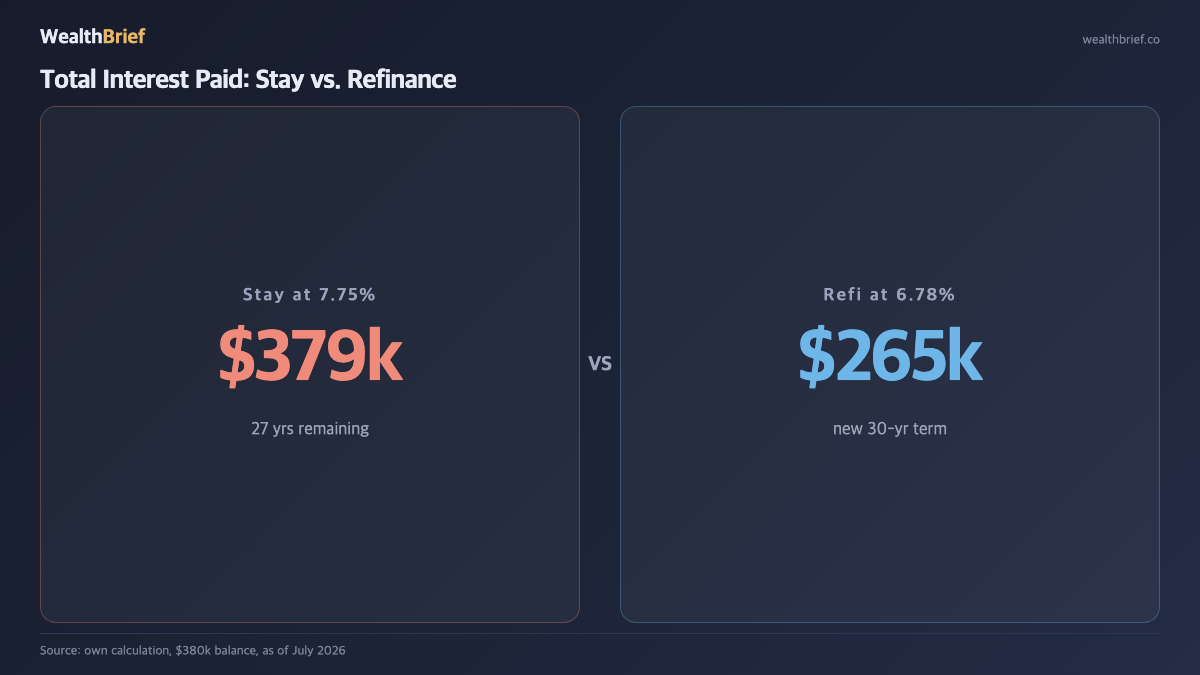
One catch: resetting to a 30-year loan means she pays more total interest over the life of the loan than if she’d stayed on her original timeline. We’ll cover that trade-off next.
Rate-and-Term vs. Cash-Out: Two Very Different Moves
Not all refinances have the same goal. It helps to be clear on what you’re actually trying to accomplish before you apply.
| Type | What It Does | Best When | Watch Out For |
|---|---|---|---|
| Rate-and-term refinance | Changes your rate and/or loan term; no cash out | You want a lower monthly payment or to pay off faster | Extending your term resets the clock and increases total interest paid |
| Cash-out refinance | Borrows against home equity; you receive the difference in cash | Home improvement, consolidating high-rate debt | You owe more on your home; rates are typically slightly higher than rate-and-term |
| Streamline refinance (FHA/VA) | Simplified process for government-backed loans; limited documentation | You have an FHA or VA loan and qualify for a lower rate | Only available for existing FHA/VA borrowers; no cash out |
If you choose a cash-out refinance, treat the cash as debt, not income. Using home equity to pay off credit cards only helps if you stop running up the cards again — otherwise you’ve converted unsecured debt into debt backed by your house.
When Refinancing Doesn’t Make Sense
The headlines focus on people who benefit. Here are the situations where it’s worth pausing.
You plan to sell in the next 2–3 years. If you won’t reach break-even before you move, you’re paying closing costs for nothing. The shorter your horizon, the higher the rate drop needs to be to justify the cost.
Your credit score has dropped since your original loan. A lower score means a higher rate quote — and you might not actually get the headline rate you’re chasing. Pull your free credit report at AnnualCreditReport.com (authorized by the CFPB) before you apply.
You’re deep into your existing loan. In the early years of a mortgage, most of your payment is interest. By year 20, most is principal. Refinancing to a fresh 30-year loan restarts that interest-heavy early phase — run the total-interest numbers carefully, not just the monthly payment.
Your loan balance is very small. If you owe $80,000 or less, closing costs eat up a larger percentage of the savings. The math often doesn’t work unless you get an unusually good rate or very low closing costs.
No-closing-cost refinance sounds tempting but isn’t free. Lenders who offer to roll costs into the loan simply charge a higher rate or add the costs to your balance. You still pay — just more slowly.
Your 5-Step Checklist Before You Apply
- Know your current rate and remaining balance. Pull your last mortgage statement or call your servicer. You can’t evaluate a refi without this baseline.
- Check your credit score. Aim for 740+ to get the best rates. Even improving from 680 to 720 can shave 0.25–0.5% off your rate quote, per CFPB guidance (see also: New Credit Scoring Changes 2026).
- Calculate your home equity. Most lenders require at least 20% equity for the best rates and to avoid PMI (private mortgage insurance). Check a recent home value estimate against your remaining balance.
- Get at least 3 quotes. Research by CFPB consistently shows that borrowers who compare multiple lenders save more than those who go with just their existing bank.
- Run the break-even math for your specific numbers — not the average. Use the formula above with your actual balance, rate, and closing cost quote.
In 3 Lines
- As of July 14, 2026, the average 30-year refinance rate is 6.78% (Bankrate) — attractive for borrowers locked in above 7.5%, but marginal for those already below 7%.
- The break-even point — how long it takes for monthly savings to cover closing costs (typically 2–6% of the loan) — is the single most important number to calculate before you apply.
- Rate-and-term and cash-out refinances serve different goals; resetting to a 30-year term may lower your payment but increases total interest paid, so always compare both metrics.
For information only, not financial advice. Mortgage rates change daily and your actual rate depends on your credit profile, loan-to-value ratio, and lender. Rules and eligibility requirements may change — confirm current guidelines at CFPB.gov. For other US personal-finance guides, see our Roth IRA 2026 guide and compare lenders at multiple institutions before applying.
Leave a Reply