

What the 2026 Roth IRA Limits Actually Mean for You
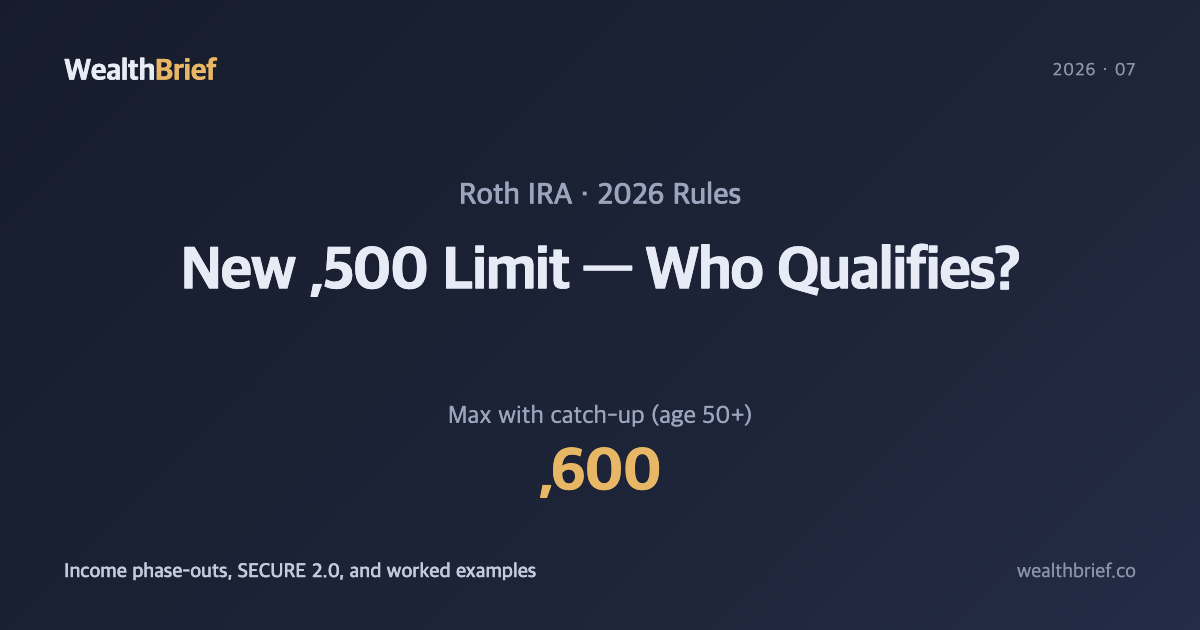
The IRS raised Roth IRA contribution limits for 2026. The new cap is $7,500 — up $500 from the $7,000 limit that applied in 2025, per the IRS annual cost-of-living adjustment announced in late 2025.
If you’re 50 or older, you can add a catch-up contribution on top. For 2026, that catch-up is $1,100, bringing your maximum to $8,600 total. (The catch-up amount is now indexed for inflation under the SECURE 2.0 Act, which is why it nudged above the old flat $1,000.)
One thing people often miss: that cap covers all your IRAs combined — Traditional and Roth together. You can split contributions between the two, but the combined total cannot exceed $7,500 ($8,600 if 50+).
Can You Contribute? Check the Income Phase-Out First
Roth IRAs have income limits. The IRS uses your Modified Adjusted Gross Income (MAGI) — roughly your total income before certain deductions — to decide how much you can contribute.
For 2026, the phase-out ranges are:
| Filing Status | Full Contribution (MAGI below) | Phase-Out Range | No Contribution (MAGI above) |
|---|---|---|---|
| Single / Head of Household | $153,000 | $153,000 – $168,000 | $168,000 |
| Married Filing Jointly | $242,000 | $242,000 – $252,000 | $252,000 |
| Married Filing Separately* | $0 | $0 – $10,000 | $10,000 |
*If you lived with your spouse at any point during the year and file separately, your phase-out range starts at $0. Source: IRS, as of 2026.
Within the phase-out range, your allowed contribution shrinks proportionally. If you earn right in the middle of the range, you can contribute roughly half the maximum.
Worked Example: How the Phase-Out Calculation Works
Say you’re a single filer aged 38 with a 2026 MAGI of $160,500. You’re inside the $153,000–$168,000 phase-out window.
- How far into the range are you? $160,500 − $153,000 = $7,500 into a $15,000 window.
- Percentage phased out: $7,500 ÷ $15,000 = 50%.
- Contribution reduction: 50% × $7,500 (full limit) = $3,750 reduced.
- Your allowed contribution: $7,500 − $3,750 = $3,750.
One IRS rule to know: the minimum allowed contribution is $200 (the IRS rounds up). If your calculation produces less than $200 but more than $0, you can still put in $200. If it hits $0, you’re fully phased out.
Earners above $168,000 (single) or $252,000 (married) cannot contribute directly to a Roth IRA in 2026. If that’s you, look into the backdoor Roth IRA strategy — a two-step process using a non-deductible Traditional IRA that keeps the Roth door open at any income. Our backdoor Roth guide walks through the steps.
The Age 50+ Catch-Up: What SECURE 2.0 Changed
If you’re 50 or older by December 31, 2026, you qualify for the catch-up contribution. In 2026, that’s $1,100 extra — up from the old flat $1,000, because SECURE 2.0 (the retirement reform law enacted in 2022) now indexes IRA catch-up amounts for inflation. The combined limit is $8,600.
SECURE 2.0 also introduced a super catch-up for ages 60–63, but that provision applies only to workplace plans like 401(k)s and 403(b)s — not to IRAs. If you’re 62 and also have a 401(k), you may be able to contribute up to $11,250 as an enhanced catch-up to that plan separately. For your Roth IRA, the limit remains $8,600 regardless of whether you’re 55 or 63.
Traditional IRA vs Roth IRA: Which Makes More Sense at Different Income Levels?
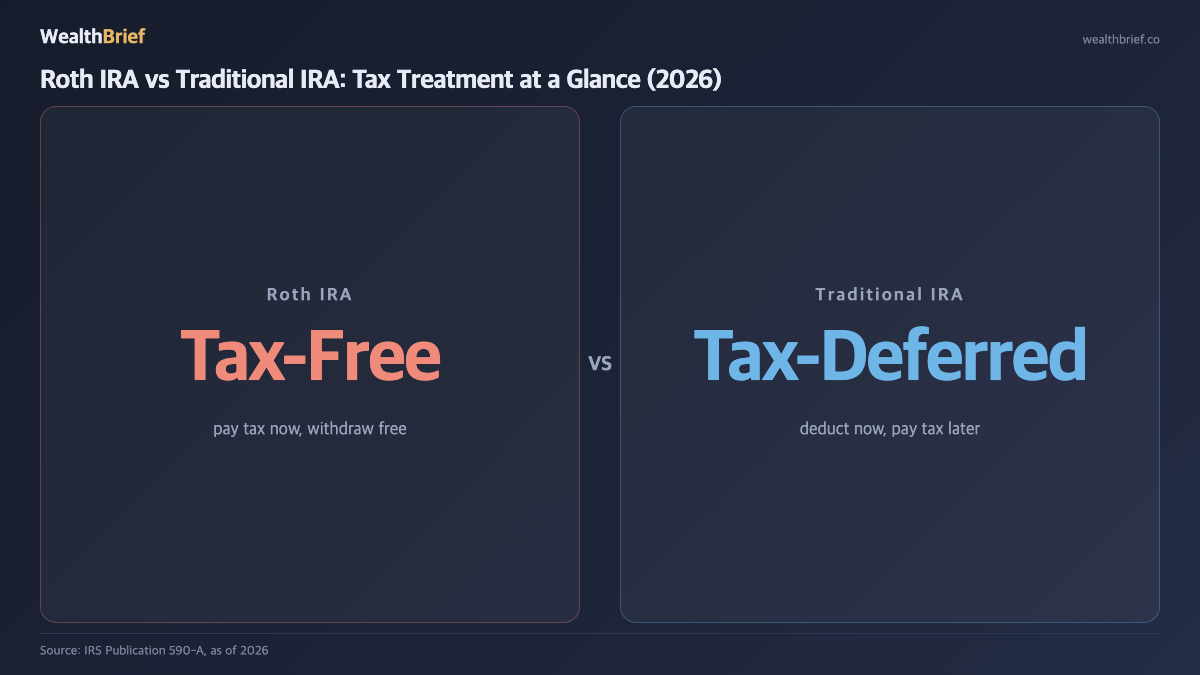
A Roth IRA grows tax-free and withdrawals in retirement are tax-free too — but contributions come from after-tax dollars. A Traditional IRA flips this: contributions may be tax-deductible now, but withdrawals are taxed as ordinary income later. The right choice depends heavily on your current vs future tax rate.
| Roth IRA | Traditional IRA | |
|---|---|---|
| Tax on contributions | After-tax dollars (no deduction) | May be deductible* |
| Tax on growth | None | Deferred |
| Tax on qualified withdrawals (59½+) | Tax-free | Taxed as ordinary income |
| Required Minimum Distributions | None (owner’s lifetime) | Starting at age 73 |
| 2026 income limit for contributions | $153k / $242k (single/married) | No limit — deductibility may be limited |
| 2026 contribution limit (under 50) | $7,500 | $7,500 |
| Early withdrawal of contributions | Any time, penalty-free | 10% penalty before 59½ (with exceptions) |
*Traditional IRA deductibility phases out if you or your spouse has a workplace plan. Source: IRS, as of 2026.
General rule of thumb: If you expect to be in a higher tax bracket in retirement than you are today, Roth wins. If you’re in your peak earning years now and expect lower income in retirement, Traditional may save more overall. Many people contribute to both over time to hedge.
Deadlines, Common Mistakes, and Quick Reminders
The deadline to contribute for the 2026 tax year is April 15, 2027 — you don’t have to do it by December 31. This gives you extra time to calculate your MAGI after the tax year closes.
A few mistakes to avoid:
- Over-contributing. If you earn less than your contribution limit in a year, you can only contribute up to your earned income. If you put in $7,500 but only earned $5,000 freelancing, you’ve over-contributed — the IRS charges a 6% excise tax annually on the excess until it’s corrected.
- Forgetting to account for both spouses. The $7,500 limit is per person. A married couple can each contribute up to $7,500, for a potential household total of $15,000 (or $17,200 if both are 50+).
- Ignoring the spousal IRA. If one spouse has little or no earned income, the working spouse’s income can fund contributions for both — as long as the couple files jointly and total contributions don’t exceed combined earned income.
- Assuming MAGI equals W-2 income. MAGI adds back items like student loan interest deductions, foreign earned income exclusions, and certain retirement contributions. Check IRS Publication 590-A or ask a tax professional if you’re near a phase-out threshold.
In 3 Lines
- For 2026, you can contribute up to $7,500 to a Roth IRA ($8,600 if you’re 50 or older), per IRS cost-of-living adjustments announced late 2025.
- Direct contributions phase out between $153,000–$168,000 MAGI for single filers and $242,000–$252,000 for married couples filing jointly; above those ceilings, the backdoor Roth strategy is the alternative.
- The SECURE 2.0 Act’s super catch-up (up to $11,250) applies only to 401(k)-type workplace plans — for IRAs, the limit stays at $8,600 regardless of age beyond 50.
For information purposes only, not financial or tax advice. Contribution limits and income phase-out ranges can change; confirm current figures at IRS.gov/retirement-plans/roth-iras and review IRS Publication 590-A. If you are near an income threshold, consult a qualified tax professional before contributing.
Leave a Reply