
Why Does the Same Dollar Cost a Different Amount Every Time?
Open a currency app on your phone and you’ll see “1 USD = 1,380 KRW.” But walk into a bank branch with 1,000,000 won and you’ll walk out with only 703 dollars — about 21 dollars short of what the calculator suggests. Those missing dollars aren’t a mistake. They’re the bank’s cut, baked into something called the exchange rate spread.
Even people who follow exchange rates closely often misunderstand what “90% preferential rate” actually means, or whether a foreign currency account truly charges zero fees. This guide unpacks the structure from first principles and runs the actual numbers.
What the Spread Actually Is
The standard rate (매매기준율) is the benchmark exchange rate set by Seoul Money Brokerage Services — the number you see quoted in the news. Banks don’t sell dollars to customers at this rate. Instead, they add a margin when selling (the “buy” rate for customers) and subtract the same margin when buying back (the “sell” rate for customers). That gap is the spread — the bank’s implicit commission on every currency transaction.
For Korean commercial banks, the standard spot cash spread on USD is approximately 1.75%. Brokerage firms typically charge around 1.00%. When a bank advertises “90% preferential rate,” it means they’re discounting 90% of that spread — not discounting the benchmark rate itself.
The core formula:
Effective exchange rate = Standard rate + (Spread × (1 − Preferential rate))
Running the Numbers: 1,000,000 KRW Conversion
The following simulation uses a benchmark rate of 1,380 KRW per USD (approximate mid-July 2026 reference). The goal here is the structure, not the exact figures — rates change daily.
| Method | Spread | Preferential Rate | Effective Rate | USD from 1,000,000 KRW |
|---|---|---|---|---|
| Bank branch (cash) | 1.75% | 0% | 1,404.15 KRW | 711.9 USD |
| Bank mobile app (standard) | 1.75% | 70% | 1,387.25 KRW | 720.8 USD |
| Bank mobile app (max pref.) | 1.75% | 90% | 1,382.45 KRW | 723.3 USD |
| Brokerage app (90% pref.) | 1.00% | 90% | 1,381.38 KRW | 724.0 USD |
| Toss Bank foreign currency account | 0% | 100% | 1,380.00 KRW | 724.6 USD |
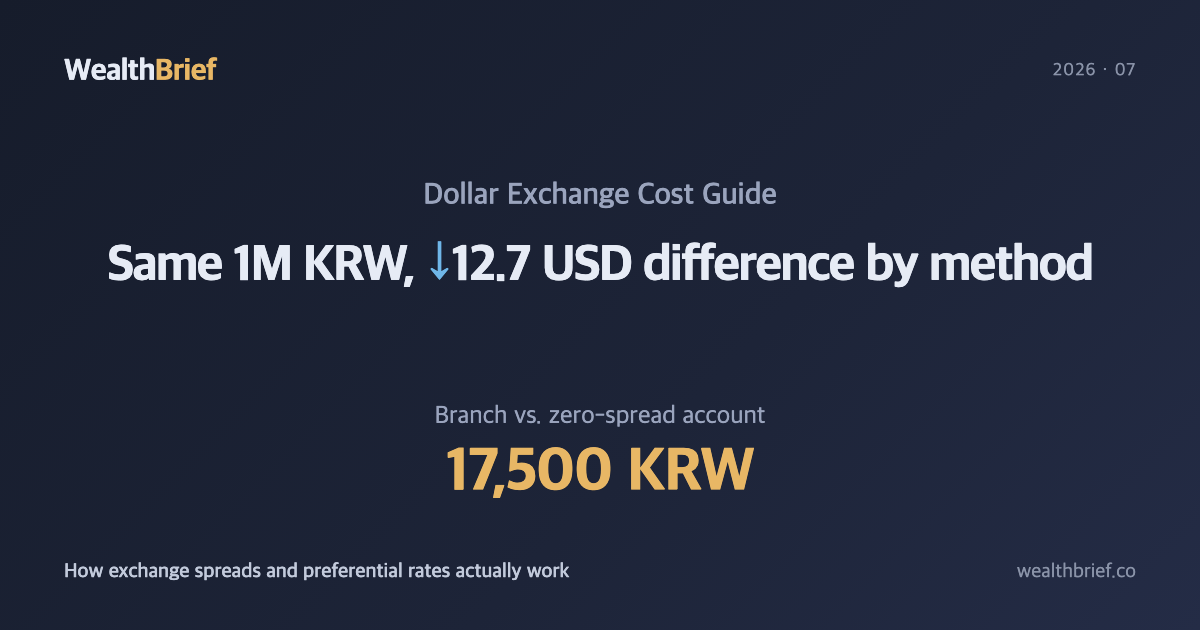
The difference between a bank branch and a Toss Bank foreign currency account: about 12.7 USD — roughly 17,500 KRW on a single 1,000,000 KRW exchange. Scale that to 10,000,000 KRW and it’s 175,000 KRW that quietly disappears.
Sources: Spread figures from Korea Federation of Banks Consumer Portal and Bank of Korea financial statistics (as of July 2026). Brokerage spread is an approximate industry average. Toss Bank 100% preferential rate per official Toss Bank website (updated May 2026).
Three Foreign Currency Account Options, Compared
Internet-only banks have disrupted this space by offering zero-spread accounts. But “100% preferential” doesn’t mean identical conditions across providers.
Toss Bank Foreign Currency Account
Supports 17 currencies including USD, EUR, and JPY with 100% preferential rates on both buy and sell sides. Open to Korean nationals aged 14 and above who already hold a Toss Bank KRW account. Linking the Toss Bank debit card eliminates point-of-sale foreign transaction fees abroad — though local ATM fees at the destination may still apply. (Source: Toss Bank official website, July 2026)
KakaoBank Foreign Currency Account
KakaoBank’s “Dollar Box” service was discontinued in June 2026 after two years, replaced by a formal foreign currency account supporting 9 currencies with preferential exchange rates. Specific preferential conditions should be verified in the KakaoBank app before opening. (Source: ZDNet Korea, June 16, 2026)
Traditional Banks: Mobile Pre-Order Exchange
Major commercial banks (Kookmin, Shinhan, Hana, Woori, IBK) typically offer 70–90% preferential rates through their mobile apps for pre-ordered exchange (as of 2026; conditions vary by event and customer tier). For those wanting to earn interest on dollar holdings alongside favorable exchange rates, foreign currency time deposits at commercial banks are an option — rates typically track U.S. Fed Funds Rate levels. Compare options at the FSS Financial Products Portal (finlife.fss.or.kr).
Three-Step Guide to Opening and Using a Foreign Currency Account
- Open the account — Any of the above providers can be set up via smartphone in under five minutes if you already have a KRW account with them.
- Set a rate alert — Naver Finance and most banking apps allow you to configure a push notification when USD/KRW hits a target rate. Set a floor (e.g., “alert me when it drops below 1,370”) so you don’t have to watch the rate manually.
- Buy in tranches — Split your target amount across three to five purchases over time. Nobody — including professional traders — reliably calls exchange rate bottoms. Cost-averaging removes the pressure to time perfectly.
One thing worth keeping front of mind: holding dollars is itself a currency position. If USD/KRW falls, you lose on the exchange rate even if the dollars sit untouched. That’s a manageable risk for travel funds — a bigger consideration for speculative positions.
Fine Print: What “100% Preferential” Doesn’t Cover
- Verify the sell-side rate too. Some products offer 100% preferential only when buying foreign currency, not when converting back to KRW. Check the account terms for the “매도 환율” (sell rate) conditions.
- International wire transfer fees are separate. At Toss Bank, for example, the conversion spread is zero but outbound international transfers carry a 0.5% transaction fee. Exchange and remittance fees are different line items.
- Deposit insurance covers KRW equivalent up to 50,000,000 KRW across all accounts at one institution (Korea Deposit Insurance Corporation rules). Exchange rate losses on the underlying foreign currency are not covered.
Quick Checklist: Cutting Exchange Costs
- ☑ Reserve branch cash exchange for emergencies — full 1.75% spread applies
- ☑ Use your bank’s mobile pre-order for 70–90% preferential rates on travel cash
- ☑ Open a zero-spread foreign currency account for regular or larger exchanges
- ☑ Confirm that sell-side preferential rate matches buy-side terms
- ☑ Budget overseas ATM and wire transfer fees separately from exchange costs
- ☑ If buying dollars as an investment, factor in the risk that KRW strengthens
Exchange fees are invisible until you do the math — and once you do, the difference between methods is hard to ignore.
This article is for informational purposes only and does not constitute investment advice or a recommendation to purchase any financial product. Exchange rate spreads, preferential rate conditions, and account terms are subject to change at any time. Always verify current terms directly with the financial institution before opening an account. Foreign exchange losses due to rate movements are not covered by deposit insurance.
Leave a Reply