

The “Double Inverse” Is a Different Beast
KODEX 200 Futures Inverse 2X (ticker: 252670) is Korea’s most-traded bearish ETF — colloquially called gop-beo-seu (곱버스), meaning “double-short.” It targets –2× the daily return of the KOSPI 200 Futures Index. That word “daily” is where everything gets complicated.
A plain –1× inverse ETF moves in lock-step opposite to the index. The 2× version rebalances every single day to maintain –2× exposure. That mechanism creates a compounding drag known as volatility decay when the market oscillates instead of trending cleanly.
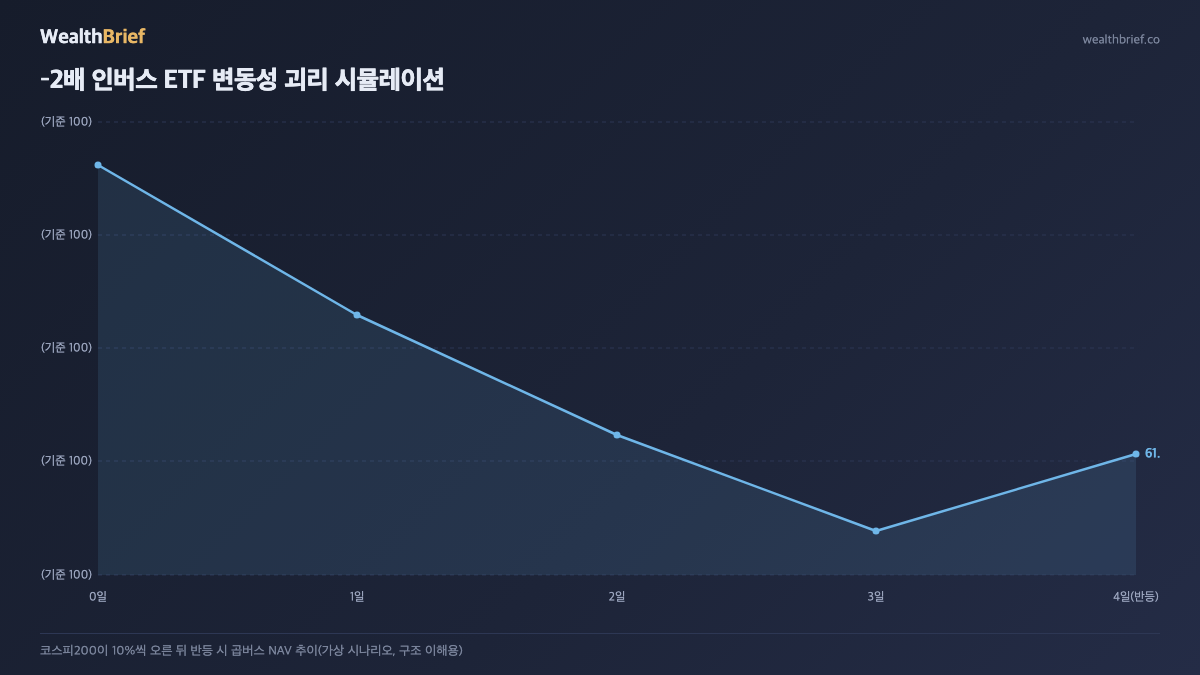
A simplified example illustrates the effect:
| Day | KOSPI 200 Move | –1× ETF (cumulative) | –2× ETF (cumulative NAV, base 100) |
|---|---|---|---|
| Day 1 | +10% | 90 | 80 |
| Day 2 | +10% | 81 | 64 |
| Day 3 | +10% | 72.9 | 51.2 |
| Day 4 | –10% | 80.2 | 61.4 |
After four days the index is only slightly above its starting point, yet the 2× inverse has shed nearly 39%. This is not a bug — it is how the product is designed. KODEX 200 Futures Inverse 2X is a short-term trading and hedging vehicle, not a “hold and wait for the market to fall” instrument.
Roll-Over Costs: The Silent Monthly Drain
Because this ETF uses futures contracts, it must periodically “roll” expiring positions into the next contract — a process called roll-over. The stated total expense ratio (TER) is 0.64% per year (Samsung Asset Management disclosure, as of July 2026). That is not the whole cost.
KOSPI 200 futures expire on the second Thursday of March, June, September, and December. When the fund rolls from the near-month to the far-month contract, it sells cheap and buys expensive whenever the market is in contango (far-month priced higher than near-month). At –2× leverage, even a 0.5% roll slip becomes a 1% hit to the fund NAV.
| Cost Component | Estimated Annual Impact | Notes |
|---|---|---|
| Stated TER | 0.64% | Fixed, per Samsung AM disclosure (July 2026) |
| Roll-over slippage | ~2–4% | Highly variable; worst in strong bull markets |
| Total drag estimate | ~3–5% per year | Can be higher in sustained contango |
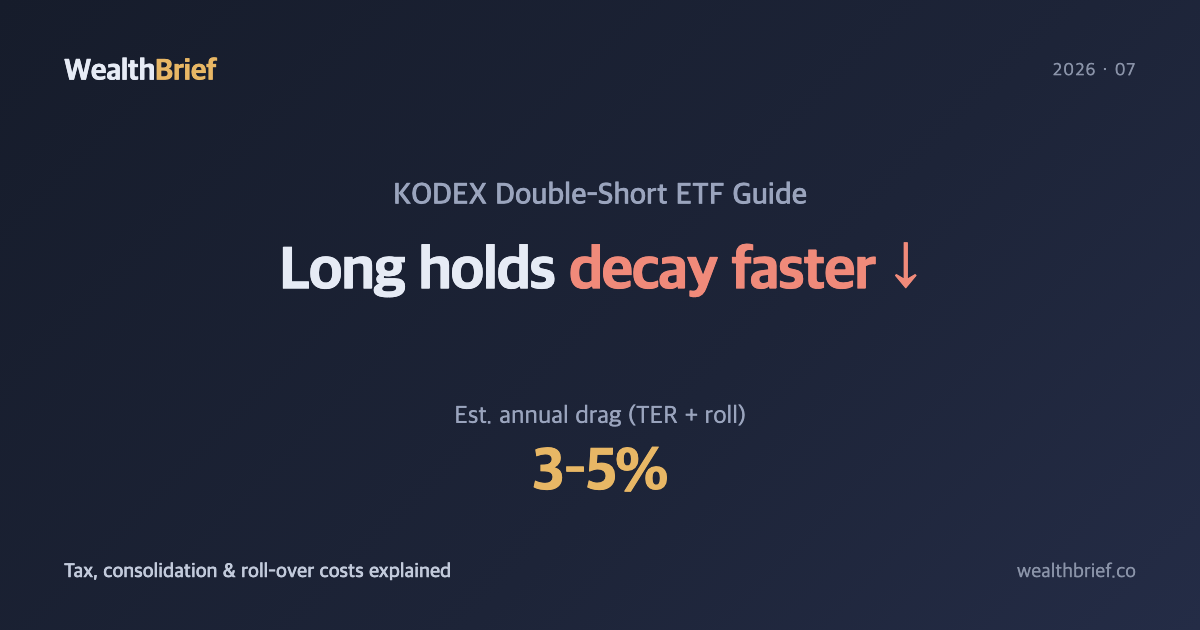
The takeaway: in a bull market — exactly the scenario where you might want to short — roll-over costs are at their highest and volatility decay is at its worst. Both forces work against a long-hold short position simultaneously.
The Share Consolidation Problem
KODEX 200 Futures Inverse 2X launched in September 2016 at a base price of ₩10,000. By mid-2026, after years of KOSPI gains, the price had fallen to around ₩100 — effectively a penny stock (Chosunbiz, June 2026; Yonhap Infomax, January 2026).
Korean exchange regulations currently restrict ETF issuers from conducting voluntary share consolidations (reverse splits) in the same way ordinary stocks can. This has trapped the fund in “coin stock” territory, where even a ₩1 move represents a 1% price swing and the bid-ask spread becomes proportionally enormous (E-Today, March 2026; Sisajournal-E, April 2026).
If a consolidation is ever approved, watch for these risks:
- Trading halt: The ETF will be suspended for one to several trading days during the consolidation process. You cannot cut losses during this window.
- Fractional shares: If the ratio is 10:1 and you hold 95 shares, you end up with 9 shares and receive cash for the leftover 5. The cash payout is at the pre-suspension closing price.
- Tax treatment: The consolidation itself is not a taxable disposal event. Your cost basis transfers in full to the new, fewer shares.
- Tick-size shift: A higher share price means a wider minimum price increment. Execution costs rise for small orders.
As of July 2026, no regulatory change formally authorizing ETF consolidations has been enacted. Do not hold this ETF expecting a consolidation to rescue its price.
Korean ETF Tax Rules: What You Actually Owe
Korean domestic ETFs are often described as “capital gains tax exempt.” That is true — but it does not mean tax-free profits.
| ETF Type | Tax on Gains? | Rate | Loss Offset? | Counted in Financial Income Cap? |
|---|---|---|---|---|
| Pure domestic equity ETF | Distributions only | 15.4% withholding | No | Yes |
| Futures / Leveraged / Inverse ETF | Trading gains + distributions | 15.4% withholding | No | Yes |
| Overseas-index ETF (Korean-listed) | Trading gains + distributions | 15.4% withholding | No | Yes |
| Directly held foreign ETF (e.g., SPY on NYSE) | Capital gains tax | 22% (basic) | Yes (foreign equities) | No |
KODEX 200 Futures Inverse 2X falls into the futures-based / inverse category: trading gains are subject to 15.4% withholding tax at the time of sale, treated as dividend income under Korean tax law. Critically, you cannot offset gains here against losses in another ETF. If you made ₩1M on this ETF and lost ₩1M on a different fund, you still owe 15.4% on the ₩1M gain.
Practical timing considerations:
- If your total annual financial income (interest + dividends + ETF gains) is close to ₩20M (about US$15,000), even modest gains from this ETF can push you over the threshold that triggers global financial income aggregation — your marginal rate can jump well above 15.4%. Spreading large sales across two calendar years is worth considering.
- Holding this ETF inside an ISA (Individual Savings Account) insulates gains from this tax. ISA accounts allow up to ₩20M/year in contributions and provide tax exemption or favorable separation taxation on gains.
- Retirement accounts (연금저축펀드, IRP) prohibit leveraged and inverse ETFs by regulation — do not attempt to hold KODEX 200 Futures Inverse 2X in these accounts.
3-Line Summary
- KODEX 200 Futures Inverse 2X resets to –2× exposure daily, causing volatility decay that can erode value even in sideways markets — it is a short-term tool, not a long-term hedge.
- Beyond the stated 0.64% TER, quarterly roll-over costs add an estimated 2–4% drag per year, most severe during strong bull markets.
- Gains are taxed at 15.4% withholding as dividend income with no loss-offset — use an ISA account to reduce the tax burden, and spread large sales across two tax years if your financial income is near the ₩20M threshold.
This article is for informational purposes only and does not constitute investment or tax advice. Consult a licensed financial adviser or tax professional before making investment decisions.
Leave a Reply