
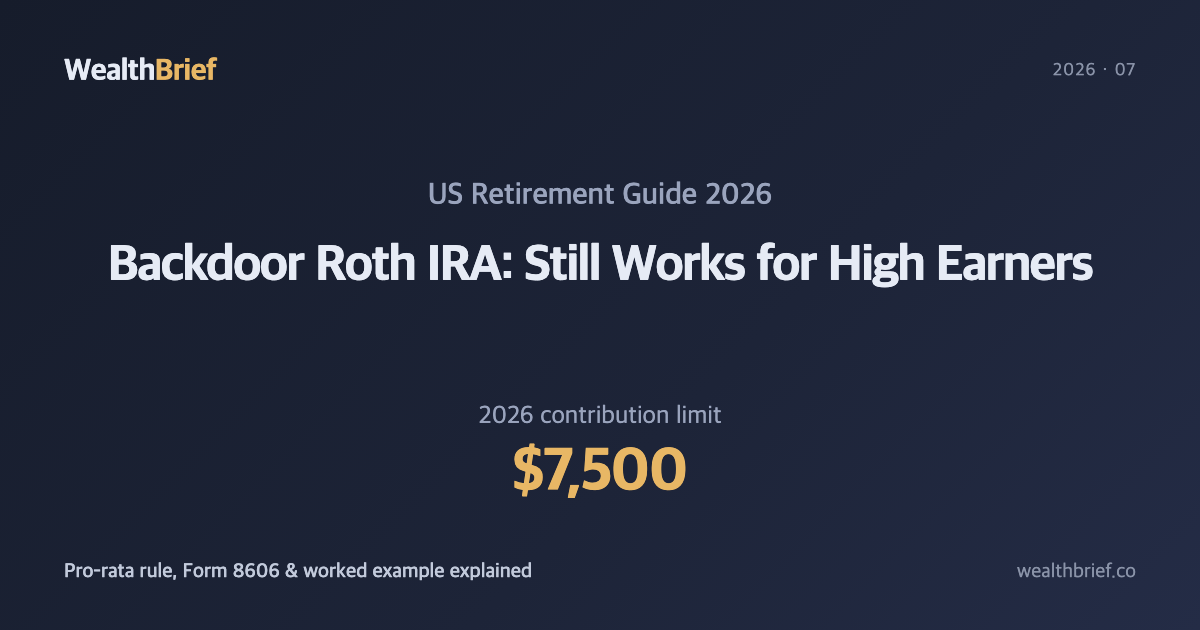
What Is a Backdoor Roth IRA — and Why High Earners Need It
A Roth IRA is one of the best deals in the US tax code: your money grows tax-free, and qualified withdrawals in retirement are tax-free too. The catch is that the IRS phases out direct contributions once your income passes a certain level. In 2026, single filers lose the ability to contribute directly once their Modified Adjusted Gross Income (MAGI) — roughly, your adjusted gross income with certain deductions added back — tops $168,000. Married filing jointly? The door closes at $252,000. (Phase-outs begin at $153,000 and $242,000 respectively, per IRS 2026 guidance reported by Fidelity and CNBC, November 2025.)
If you earn above those ceilings, a backdoor Roth IRA is a two-step workaround that has become standard practice for high-income households. You make a non-deductible contribution to a traditional IRA — there is no income limit for this — and then convert that traditional IRA to a Roth IRA. The result is functionally the same as a direct Roth contribution, just with an extra administrative step.
This guide walks through the 2026 rules, the pro-rata trap that catches people off guard, a concrete worked example, and what the IRS currently says about the strategy’s legality.
2026 Contribution Limits at a Glance
| Age | IRA contribution limit (2026) | Catch-up addition |
|---|---|---|
| Under 50 | $7,500 | — |
| 50 or older | $8,600 | +$1,100 |
Source: IRS 2026 contribution limits, per Charles Schwab and Vanguard guidance updated June 2026. The catch-up amount rose from $1,000 in 2025 to $1,100 in 2026 under SECURE 2.0 Act indexing.
These limits apply across all your traditional and Roth IRAs combined — you cannot contribute $7,500 to each. The contribution deadline for the 2026 tax year is April 15, 2027.
The Two-Step Process: How to Actually Do It
The mechanics are straightforward. You will need a brokerage or bank that holds IRAs — Fidelity, Vanguard, Schwab, and most major custodians all support this.
- Open a traditional IRA (if you do not already have one). This takes about 10 minutes at most major brokerages.
- Make a non-deductible contribution. In 2026, contribute up to $7,500 (or $8,600 if you are 50 or older) in cash. Do not invest the money yet — keep it in cash or a money-market fund so the value stays flat. This makes the conversion cleaner.
- Convert to Roth. Within a few days — once the contribution clears — instruct your brokerage to convert the traditional IRA balance to your Roth IRA. Most custodians have a “convert to Roth” option in their online interface. This can usually be done in minutes.
- File Form 8606 with your tax return. This is the part people forget. IRS Form 8606 (Nondeductible IRAs) is how you tell the IRS that your original contribution was made with after-tax dollars — which prevents you from being taxed again on the same money at withdrawal. Never skip this form.
One practical note: convert promptly after the contribution settles. The longer you wait, the more investment gains accumulate in the traditional IRA. Those gains are taxable when you convert, whereas the original after-tax contribution is not. Converting within a few days typically means the taxable gain is pennies.
The Pro-Rata Rule: The Trap That Bites Unwary Savers
Here is where the backdoor strategy gets complicated. The IRS does not treat each IRA in isolation. Under the pro-rata rule, if you have any other pre-tax money sitting in traditional IRAs — including rollover IRAs from old 401(k)s or SEP-IRAs — the IRS lumps all of that together when calculating how much of your conversion is taxable.
Why this matters: suppose you have $93,500 in a pre-tax rollover IRA from a former employer, and you now add a $6,500 non-deductible backdoor contribution (under a slightly earlier year’s limit for illustration). Your total traditional IRA pool is $100,000, of which only $6,500 (6.5%) is after-tax. When you convert $6,500 to Roth, only 6.5% of it — about $423 — is tax-free. You owe income tax on the other $6,077. That is not what you intended.
The fix: Before doing a backdoor Roth, roll any pre-tax traditional IRA balances into your current employer’s 401(k) plan (if the plan accepts incoming rollovers). Once those pre-tax dollars are out of your IRA universe, you can do a clean backdoor conversion with no pro-rata problem. Not all 401(k) plans accept rollovers, so check your plan’s Summary Plan Description first.
Source: pro-rata rule mechanics per IRS Form 8606 instructions; practical guidance from Vanguard Investor Education, 2026, and SDO CPA (March 2026).
Worked Example: Sarah, 38, Software Engineer, MAGI $210,000
Sarah earns $210,000 MAGI as a single filer in 2026 — well above the $168,000 Roth IRA income ceiling. She has no existing traditional IRA balances (she moved her old 401(k) rollover into her current employer’s 401(k) last year). Here is what her backdoor Roth looks like:
- January 5, 2027 (still within the April 15, 2027 deadline for 2026 tax year): Sarah contributes $7,500 in cash to a traditional IRA at her brokerage. She does not take a deduction — her income is too high for a deductible contribution anyway, and she marks it as non-deductible.
- January 9, 2027: The contribution clears. The balance is $7,500 — no investment gains because it sat in a money-market fund for four days.
- January 9, 2027: She uses her brokerage’s online conversion tool to convert the full $7,500 to her Roth IRA. Since there are no other traditional IRA balances, 100% of the conversion is after-tax. Zero income tax owed on the conversion.
- April 2027: She files her 2026 tax return and attaches Form 8606, showing a $7,500 non-deductible contribution and a $7,500 conversion. Taxable amount on Form 8606: $0.
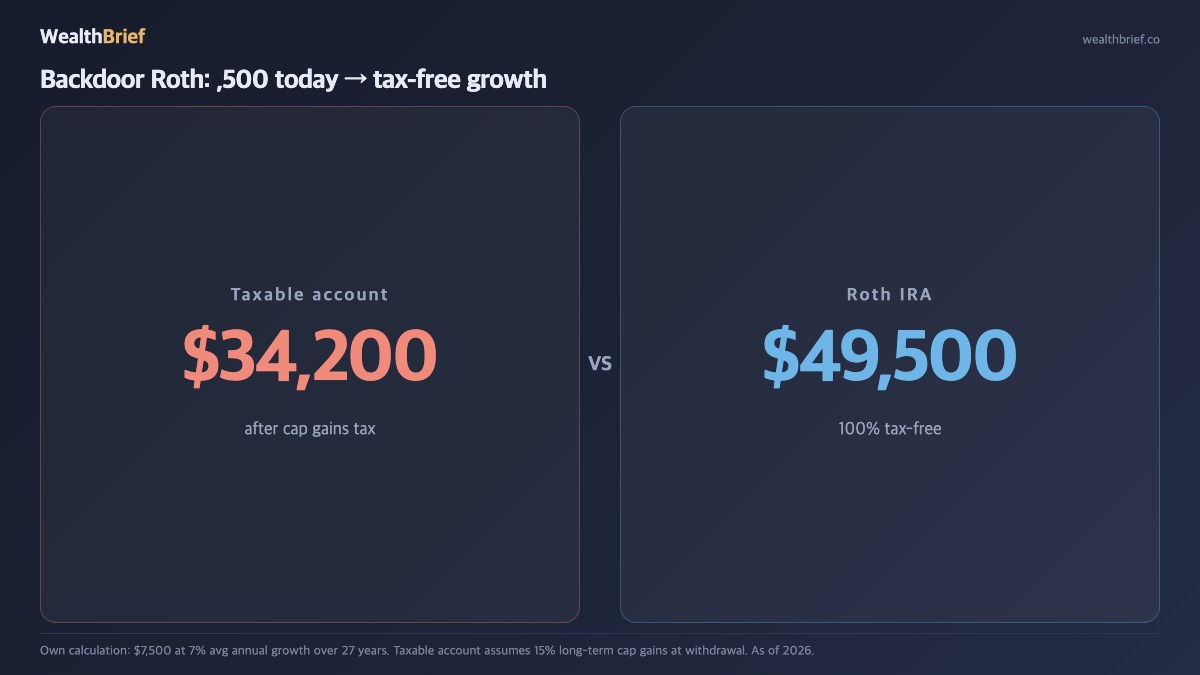
Result: Sarah now has $7,500 in a Roth IRA that will grow tax-free. Over 27 years to age 65, assuming 7% average annual growth, that single $7,500 contribution becomes roughly $49,500 — all withdrawable tax-free in retirement. Do this every year for a decade and the numbers become significant.
What About the “Mega” Backdoor Roth?
If your employer’s 401(k) plan allows after-tax contributions and in-plan Roth conversions (or in-service withdrawals), there is a much larger version of this strategy. In 2026, the total 401(k) contribution limit under IRC Section 415(c) is $72,000 per the IRS (rising to $80,000 if you are 50 or older, or $83,250 for those aged 60–63 under SECURE 2.0’s enhanced catch-up). Your employee pre-tax deferral and employer match count toward this total. The gap — after those contributions — can potentially be filled with after-tax dollars, which you then convert to Roth inside the plan.
Example: if you defer $23,500 (the 2026 elective deferral limit) and your employer matches $10,000, you have up to $38,500 of potential after-tax room. If your plan rules allow the mega backdoor route, that is a dramatically larger Roth contribution than the standard $7,500 IRA path.
The caveat: most 401(k) plans do not support in-plan Roth conversions. Check your Summary Plan Description or ask your HR department. Per Vanguard’s 2026 guidance, after-tax 401(k) contributions must be tracked carefully alongside your employee deferrals to avoid exceeding the overall limit.
Source: IRS Section 415(c) limits for 2026, per SDO CPA (April 2026) and Vanguard Investor Resources, 2026.
Is the Backdoor Roth Still Legal in 2026?
Yes — as of mid-2026, the backdoor Roth IRA is a legitimate planning strategy. Congress has periodically discussed closing the loophole (the Build Back Better Act of 2021 proposed ending it, but that provision did not become law). The IRS has published guidance that implicitly acknowledges non-deductible IRA contributions followed by Roth conversions as permitted under current law.
One concern sometimes raised is the step-transaction doctrine — the idea that combining two steps that individually are fine might be challenged if the only purpose is tax avoidance. In practice, the IRS has not challenged backdoor Roth conversions, and the prevailing view among tax practitioners is that converting promptly after contribution is acceptable. National Tax Tools (June 2026) and Oak Road Wealth (June 2026) both note that the IRS has signaled it views the strategy as sanctioned.
That said, tax law can change. If Congress revisits this issue, it could limit or eliminate the strategy — possibly without grandfathering existing accounts. Consult a CPA or enrolled agent annually to make sure the strategy still makes sense for your situation.
Key Checklist Before You Act
- ✅ Confirm your 2026 MAGI exceeds the Roth IRA income limit ($168,000 single / $252,000 MFJ). If not, just contribute directly to a Roth IRA — simpler.
- ✅ Check whether you have pre-tax balances in any traditional, SEP, or SIMPLE IRAs. If yes, evaluate rolling them into your 401(k) before converting.
- ✅ Verify your employer’s 401(k) accepts incoming rollovers if you need to clear your IRA ballast.
- ✅ Keep the contributed amount in cash until you convert — minimise taxable gains.
- ✅ File Form 8606 every year you make a non-deductible contribution, even if it seems trivial. Missing this form creates headaches for future withdrawals.
- ✅ Keep copies of Form 8606 indefinitely — you will need them decades later to prove your basis when you take withdrawals.
For information only, not financial or tax advice. Rules, limits, and income thresholds change annually. The backdoor Roth IRA strategy involves specific tax reporting requirements. Confirm current figures at IRS.gov and consult a qualified tax professional (CPA or enrolled agent) before acting. As of 2026, the strategy is legal, but legislative changes could affect future years.
Leave a Reply