

Why Your 401(k) Limit Just Got a Raise
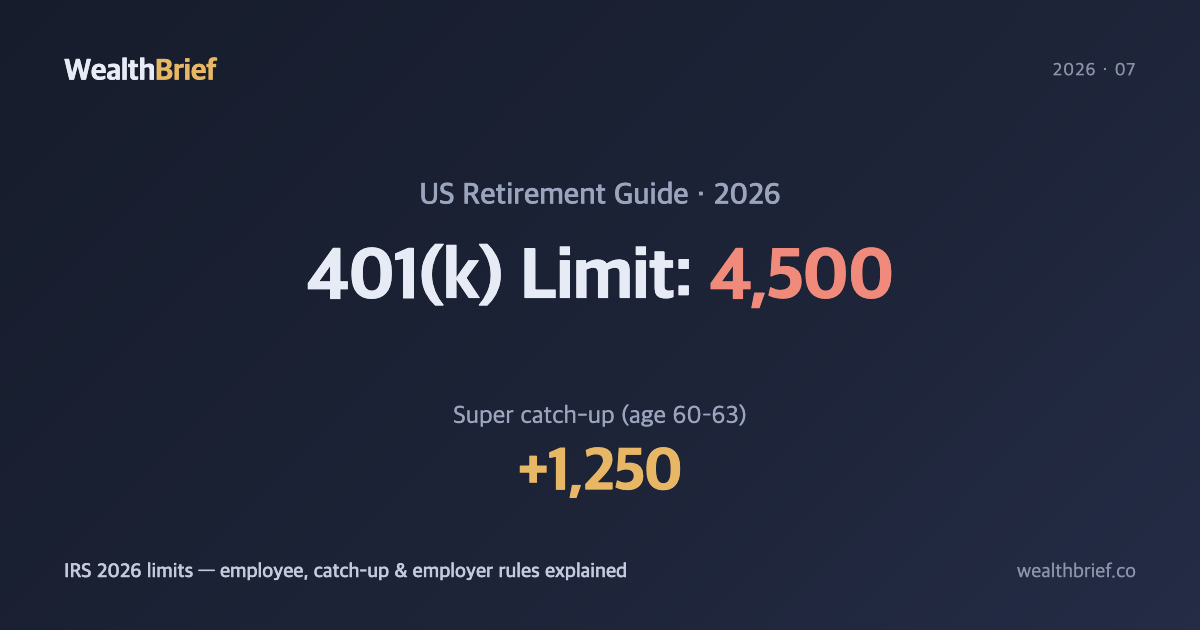
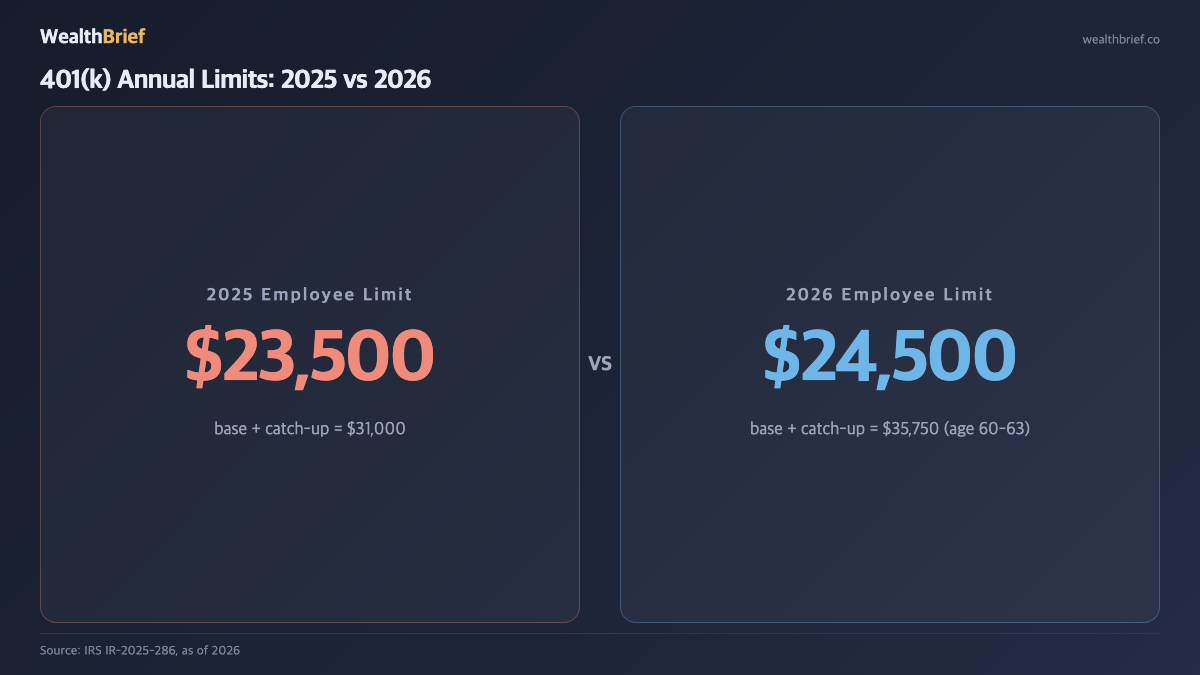
Every autumn the IRS adjusts retirement account limits for inflation, and for 2026 workers got a meaningful bump. The employee contribution limit for 401(k), 403(b), and most 457 plans rose to $24,500 — up $1,000 from the 2025 cap of $23,500 (per the IRS, November 2025). If you have been auto-contributing a fixed dollar amount since last year, you may already be leaving room on the table without realizing it.
This guide breaks down every layer of the 2026 limits — standard, catch-up, and the new SECURE 2.0 super-catch-up for workers in their early sixties — plus a worked example showing exactly what a realistic contribution plan could look like for a mid-career saver.
The 2026 Limit Stack — All the Numbers in One Place
| Contribution type | 2026 limit | 2025 limit | Source |
|---|---|---|---|
| Employee elective deferral (401k/403b/457) | $24,500 | $23,500 | IRS IR-2025-286 |
| Catch-up — age 50 to 59 | $8,000 | $7,500 | IRS, same release |
| Catch-up — age 60, 61, 62, or 63 (SECURE 2.0) | $11,250 | $11,250 | IRS retirement topics, as of 2026 |
| Total cap (employee + employer contributions) | $72,000 | $70,000 | IRC §415; IRS, as of 2026 |
| Total with age 50–59 catch-up | $80,000 | $77,500 | IRS retirement topics, as of 2026 |
| Total with age 60–63 super-catch-up | $83,250 | $81,250 | IRS retirement topics, as of 2026 |
| Traditional/Roth IRA (separate account) | $7,500 | $7,000 | IRS IR-2025-286 |
All figures apply to tax year 2026. Confirm current limits at IRS.gov/retirement-plans before filing.
The SECURE 2.0 “Super Catch-Up”: Age 60–63 Gets a Bonus
One of the bigger changes in recent years is the special enhanced catch-up provision introduced under the SECURE 2.0 Act of 2022. If you turn 60, 61, 62, or 63 at any point during 2026, you can contribute $11,250 in catch-up contributions — not the standard $8,000 that applies to those 50–59 or 64 and older. That extra $3,250 headroom might not sound enormous, but invested and compounded over a decade it adds up fast.
At age 64 and beyond, the enhanced rate drops back to the standard $8,000 catch-up. So for many people, the four-year window of 60–63 is a genuinely valuable last sprint before standard retirement age — worth planning around deliberately.
Employer Match: The Free Money You Should Never Leave Behind
Your own contributions are only part of the story. Most employer matches follow one of two formulas:
- Dollar-for-dollar up to a percentage of salary — for example, 100% match on the first 3% of your compensation. On a $75,000 salary, that is $2,250 in free money per year.
- Partial match over a wider range — for example, 50% match on the first 6% of salary. Same $75,000 salary: $2,250 again, but you have to put in 6% ($4,500) yourself to unlock it.
Your employer’s contributions do not count against your $24,500 employee limit, but they do count toward the overall $72,000 annual addition cap. Until you reach that ceiling, every dollar your employer adds is effectively on top of what you can put in yourself.
One important caveat: employer contributions are often subject to a vesting schedule — meaning the money is only fully yours after you have stayed with the company for a set number of years. Always check your plan documents.
Worked Example: How to Reach $24,500 in 2026
Say you earn $90,000 a year, get paid every two weeks (26 pay periods), and your employer matches 100% of the first 4% of salary.
- Per-paycheck contribution target: $24,500 ÷ 26 = $942.31 per pay period. Most payroll systems let you round to $942 or $943 and will cap at the annual limit automatically.
- Your employer’s match: 4% of $90,000 = $3,600 per year, or $138.46 per pay period. You must be contributing at least 4% ($3,600/year, $138.46/period) to unlock this. At $942 per period you are well above that threshold.
- Total going into your account: $24,500 (you) + $3,600 (employer) = $28,100 in 2026.
- Tax savings estimate (federal only): At the 22% bracket, $24,500 in pre-tax deferrals saves roughly $5,390 in federal income tax for the year. State taxes vary — check your state’s rules.
If you are 62 and using the super catch-up, replace $24,500 with $35,750 ($24,500 + $11,250). Your per-paycheck target becomes $1,375 — ambitious, but within reach for high earners who have trimmed other spending.
Traditional vs. Roth 401(k): Which Makes Sense in 2026?
Many employers now offer a Roth 401(k) option alongside the traditional pre-tax version. The contribution limits are identical ($24,500 employee cap, same catch-ups), but the tax treatment flips:
- Traditional 401(k): Contributions reduce your taxable income now. You pay income tax on withdrawals in retirement.
- Roth 401(k): Contributions are made with after-tax dollars. Qualified withdrawals in retirement are tax-free, including all growth.
As a rule of thumb, the Roth tends to win if you expect to be in a higher (or equal) tax bracket in retirement than you are today. Traditional wins if you expect a lower bracket later. Many financial planners suggest splitting contributions across both to hedge against future tax rate changes — a strategy sometimes called “tax diversification.”
Note: unlike Roth IRAs, Roth 401(k)s historically required minimum distributions (RMDs) starting at age 73. SECURE 2.0 eliminated this requirement for Roth 401(k) accounts starting in 2024 — another point in the Roth column for those who want to let the account grow longer. Always confirm with your plan administrator and a tax professional, as plan rules vary.
Five Steps to Lock In Your 2026 Strategy Right Now
- Log into your plan portal and check your current deferral rate. Many people set a percentage years ago and never revisited it. Calculate whether your current rate hits $24,500 by year-end.
- Increase your contribution if you got a pay raise. Even a 1% increase in deferral rate can bridge a meaningful gap. Mid-year raises are a natural trigger to do this.
- Confirm you are capturing the full employer match. If your match requires, say, contributing at least 5%, make sure you are there.
- Check your vesting status before changing jobs. Leaving before you are fully vested means forfeiting some or all of your employer’s contributions.
- If you turn 60, 61, 62, or 63 this year, update your deferrals to capture the super catch-up. Most plans allow this mid-year. The extra $3,250 is use-it-or-lose-it.
If you earn too much for a direct Roth IRA contribution, you may still be able to contribute via the backdoor Roth IRA strategy — a separate guide walks through how that works for 2026 high earners.
For information only, not financial or tax advice. Retirement plan rules, contribution limits, and tax law change regularly — always confirm figures at IRS.gov and consult a qualified financial or tax professional before making decisions. As of 2026.
Leave a Reply