
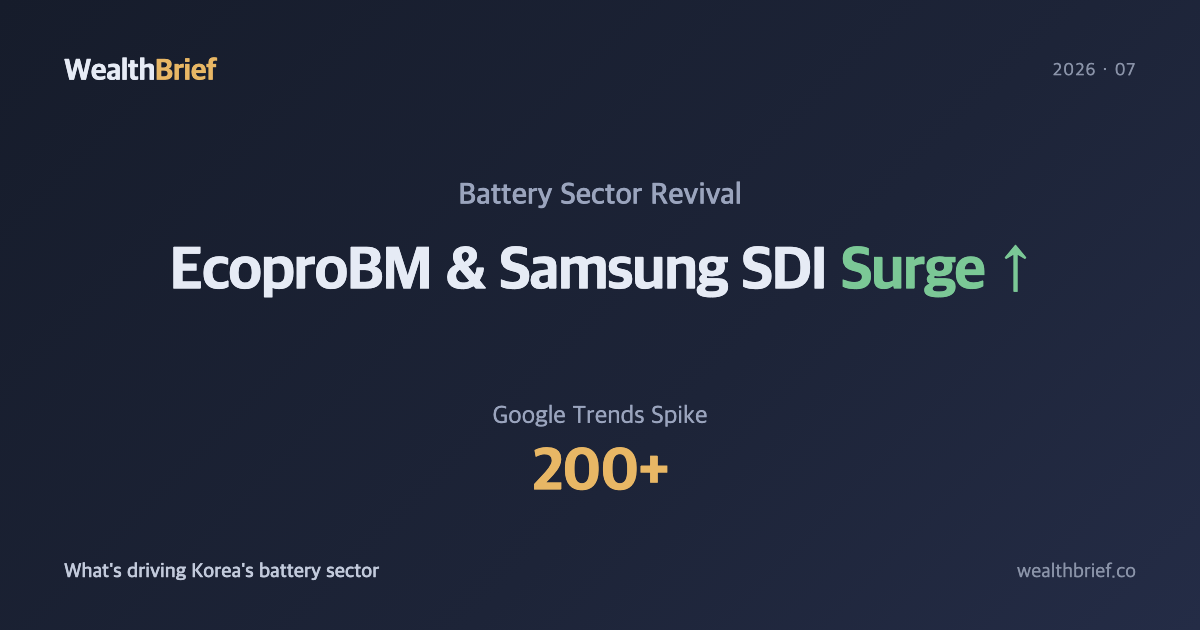
Why Two Battery Stocks Moved Together
On July 13, EcoproBM and Samsung SDI surged in tandem on the Korea Stock Exchange. Samsung SDI climbed 8.99% intraday, touching 473,000 won (TopStarNews, July 13, 2026), while EcoproBM and its group affiliates staged a broad recovery — triggering a wave of retail investor searches.
Coincidence? Not this time. The simultaneous move signals something more structural: fresh capital is rotating back into Korea’s battery sector.
Three Real Drivers Behind the Sector’s Comeback
Driver 1: The ESS boom. Energy Storage Systems (ESS) — industrial-scale batteries that store power generated from renewables and release it on demand — are seeing a sharp spike in orders. Rising U.S. grid investment and surging AI data center electricity demand are two catalysts. Samsung SDI’s strength in large-format cells positions it directly in the path of this demand surge (Senmoney, July 13, 2026).
Driver 2: EV recovery expectations. After two years of demand anxiety, European EV sales are showing signs of stabilization, and clearer guidance from the U.S. Inflation Reduction Act (IRA) on battery sourcing rules has reduced a key uncertainty for Korean battery makers. EcoproBM’s nickel strategy — focused on high-nickel cathode materials, which boost battery energy density — is designed to capitalize on exactly this recovery (bntnews, July 2026).
Driver 3: Rights offering shock absorbed. Last week, EcoproBM announced a 1.2 trillion won rights offering, sending its stock down roughly 18% in after-market trading (MSN, July 2026). But when it emerged that the controlling shareholder would personally take up 44% of the new shares, market sentiment shifted — the dilution was seen as priced in, and the management’s skin-in-the-game read as a vote of confidence (Dailian, July 2026).
Individual Stocks vs. Battery ETFs: Structuring the Choice
There are two main ways to gain exposure to Korea’s battery sector revival. You can buy individual names like EcoproBM or Samsung SDI, or you can access the sector through a battery ETF — an exchange-traded fund that holds a basket of battery-related stocks and trades just like a regular share.
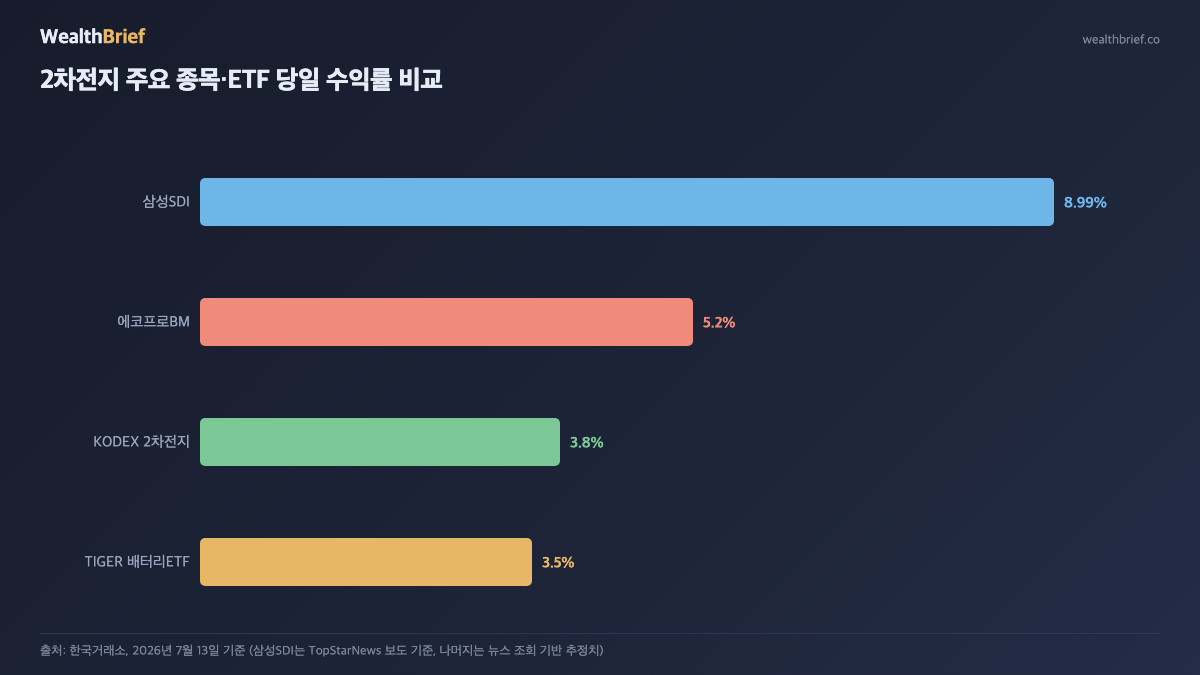
| Metric | EcoproBM | Samsung SDI | Battery ETF (e.g. KODEX Secondary Battery) |
|---|---|---|---|
| Sector role | Cathode materials (upstream) | Battery cells (midstream) | Diversified (materials + cells + equipment) |
| Key catalysts | High-Ni cathode demand, EV ramp | ESS demand surge, cylindrical cell edge | Broad sector momentum, auto-rebalanced |
| Volatility | Very high (supply/demand + rights risk) | High (EV sales linkage) | Moderate (single-stock risk diluted) |
| Return profile | Sharp upside possible; steep drawdowns too | Earnings growth + modest dividend | Tracks sector direction; limits alpha |
| Ease of management | Low (requires daily news monitoring) | Medium (large-cap relative stability) | High (fund manager handles rebalancing) |
| Cost | Brokerage commission only | Brokerage commission only | Annual expense ratio ~0.45–0.55% |
The short version: concentrated bets in individual names can amplify gains — but also losses. ETFs let you ride the sector trend without exposing yourself to company-specific blowups like a surprise rights offering.
Three Checkpoints Before You Chase the Rally
Fast-moving stocks attract buyers who regret it two weeks later. Before adding exposure here, run through these three checks.
Checkpoint 1 — Volume staying elevated for 2+ days. A single-day volume spike often reflects short-term positioning. If average daily volume remains at least double the trailing 20-day average for two or more sessions, institutional and foreign money is likely genuinely re-entering the sector.
Checkpoint 2 — 52-week high breakout. Clearing a 52-week high removes a major overhead resistance zone. A stock hovering just below that level without breaking through may face persistent selling from investors who have been waiting to exit.
Checkpoint 3 — Earnings and price moving in the same direction. A rising stock price alongside declining operating profit is a classic overvaluation warning. For both EcoproBM and Samsung SDI, watching 2026 H2 earnings guidance will be key. If revenue estimates are being revised upward, the rally has a fundamental floor. If not, it’s purely sentiment-driven.
Two out of three positive signals is generally the threshold traders use to distinguish sustainable trends from short-lived bounces. None of this is a forecast — it’s a filter.
Where Is This Cycle, Exactly?
Anyone who remembers EcoproBM’s 2023 blow-off top — when shares briefly exceeded 1 million won before collapsing — has reason to be cautious. But this move has a different texture.
The 2023 rally was driven almost entirely by EV adoption optimism and growth-multiple expansion. The 2026 backdrop includes ESS as a genuine new demand category, greater regulatory clarity under the IRA, and a structural push by global automakers to reduce exposure to Chinese battery supply chains. Order book growth is backing the current move in a way that the 2023 rally never really had.
Still, cathode material prices are tightly coupled to lithium, cobalt, and nickel spot prices — all of which remain volatile. And Chinese battery makers continue to undercut on price. “It’s different this time” is the most dangerous phrase in investing; the right posture is: the conditions are more favorable, but verification is still required.
3-Line Summary
- Samsung SDI surged 8.99% on July 13 driven by ESS demand; EcoproBM rallied as the market absorbed its 1.2 trillion won rights offering, with the controlling shareholder taking 44% of new shares (TopStarNews, MSN, July 2026).
- Individual stock picks offer higher upside in a rally but concentrate risk; battery ETFs trade that potential alpha for sector-level diversification at a low annual cost.
- Before entering, check three signals: sustained volume lift, 52-week high breakout, and earnings guidance moving in the same direction as price.
This article is for informational purposes only and does not constitute investment advice or a recommendation to buy or sell any security. All investment decisions and their outcomes are the sole responsibility of the investor. Figures and market conditions reflect information available at the time of writing and are subject to change.
Leave a Reply