
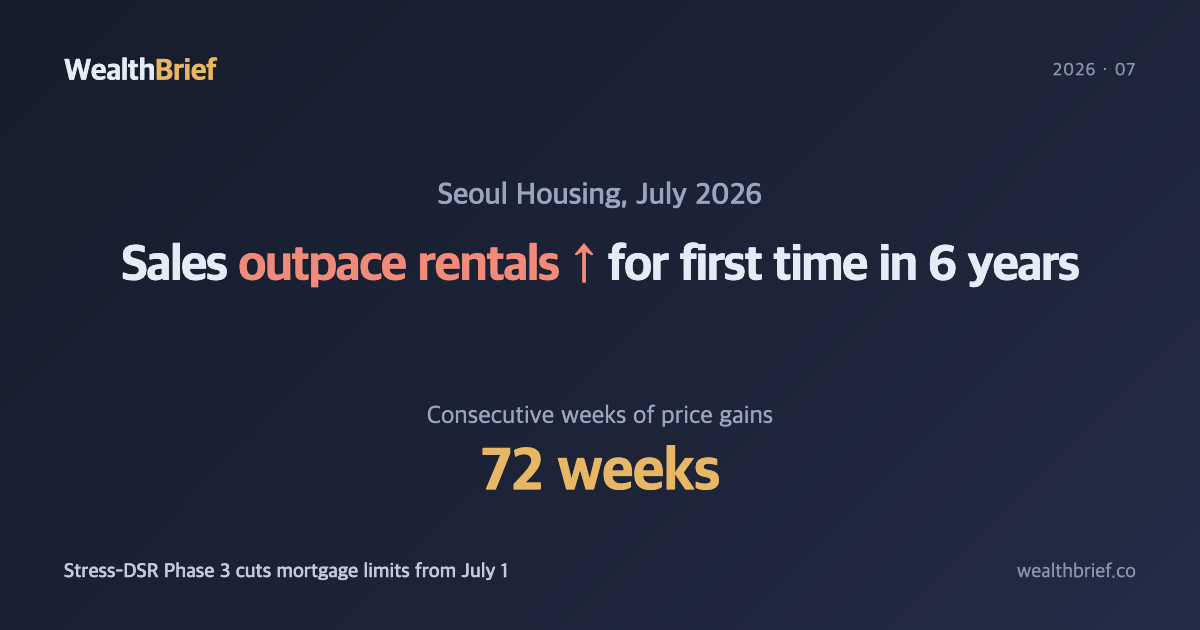
A Six-Year Flip: Seoul Apartment Sales Have Overtaken Rentals
Something unusual happened in Seoul’s housing market in June 2026: monthly apartment purchase transactions exceeded rental (jeonse) transactions for the first time in six years. Reports from multiple property data outlets, including Business Plus and Korea Public Policy News (July 1, 2026), confirm the shift. As jeonse supply tightens and deposit prices climb, a growing number of actual end-users are converting from renters to buyers — not because they want to, but because the math is starting to tip that way.
The broader data tells the same story. Seoul apartment prices posted gains for 72 consecutive weeks as of late June 2026 (Maeil Business Newspaper, June 29, 2026). For the first time in four months, every one of Seoul’s 25 districts recorded a price increase in the same period (Alpha Economy, June 29, 2026). Even traditionally quieter outer districts are moving: Dongdaemun-gu led all districts in monthly appreciation rate for June.
Why People Are Buying Instead of Renting
The phrase circulating in Seoul’s housing circles right now is: “Can’t find jeonse, so just buying.” Jeonse is South Korea’s unique deposit-based rental system where a tenant pays a large lump sum — often 60–80% of the apartment’s value — instead of monthly rent, and gets it back at the end of the lease. When jeonse deposits rise sharply, or when available jeonse units dry up, some tenants find that ownership math starts looking more viable than another round of deposit negotiations.
Compounding this: persistent fears about a supply cliff. Years of declining construction permits and housing starts have fueled expectations that new apartment completions will stay scarce through the late 2020s. That narrative, whether fully accurate or not, has given buyers a reason to act now rather than wait. As always, any individual calculation depends heavily on one’s own income, existing debt, location preference, and liquidity — conditions that vary too widely to generalize.
Tighter Lending: Stress-DSR Phase 3 Kicks In
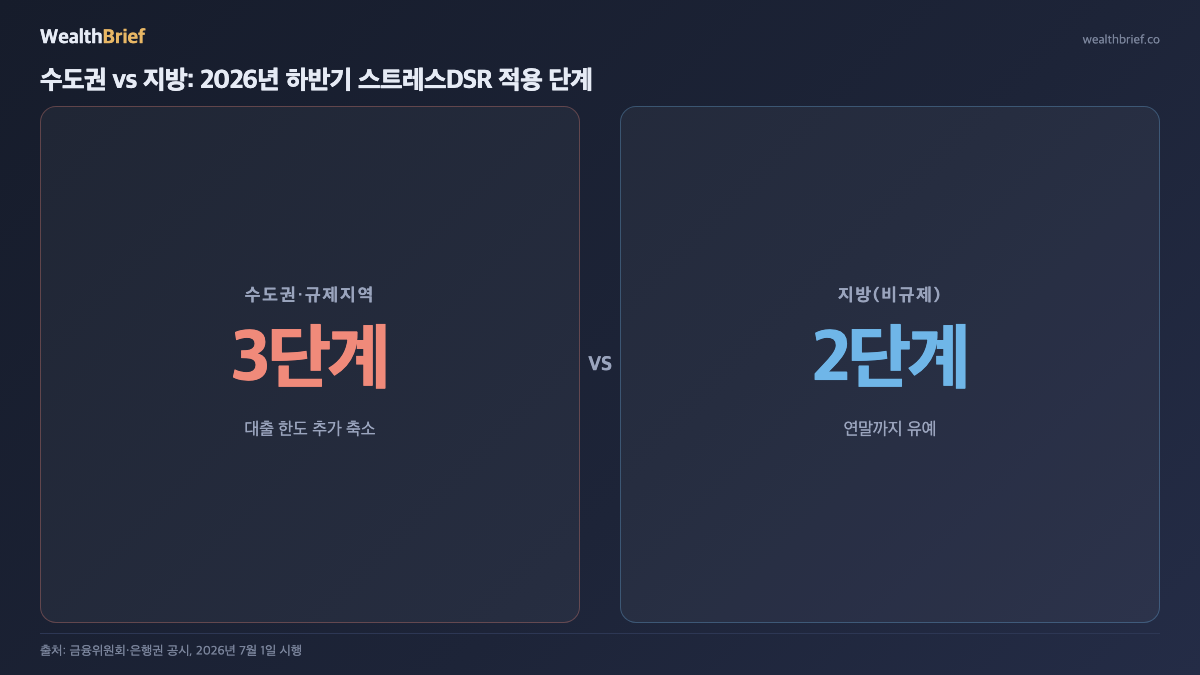
Right into this buy-heavy market, regulators introduced another layer of lending restrictions. Starting July 1, 2026, South Korean banks began applying Stress-DSR Phase 3 to mortgages in the Seoul metro area and newly designated regulated zones (Pointdaily, July 1, 2026).
DSR (Debt Service Ratio) caps total annual loan repayments — across all debts — at a percentage of gross income. The “stress” version applies a hypothetical rate increase scenario on top of the current rate, meaning the bank assumes you’re borrowing at a higher rate than you actually are, and sizes your limit accordingly. Phase 3 tightens that stress assumption further, reducing how much a borrower can take out even if their income hasn’t changed.
Regional lenders got different treatment. For mortgages in non-regulated provincial areas, regulators extended the Phase 2 (less restrictive) standards through year-end 2026 (Yonhap, June 30, 2026). The logic: the provinces are already struggling, and forcing Phase 3 standards onto a cold market could make things worse.
| Region | Stress-DSR Standard (from July 2026) | Note |
|---|---|---|
| Seoul Metro & Regulated Zones | Phase 3 (strictest) | Reduced borrowing cap |
| Non-regulated Provinces | Phase 2 (extended) | Through December 2026 |
Simultaneously, three districts — Dongtan, Guri, and Giheung — were designated regulated zones, causing their LTV (Loan-to-Value) ceiling to drop from 70% to 40% overnight (v.daum.net, June 30, 2026). LTV caps how much you can borrow relative to the property’s appraised value: at 40%, a ₩1 billion apartment that once allowed a ₩700 million mortgage now allows only ₩400 million.
Does Tighter Credit Translate to Lower Prices?
In textbook terms, reducing loan availability should dampen buying power and ease price pressure. The real world is messier. When credit conditions tighten, the advantage shifts toward cash-heavy buyers, while middle-income households relying on mortgages face steeper barriers. Critics have already noted the “too late, too little” problem: regulations rolled out after prices have surged 72 straight weeks may contain the next leg of appreciation but do little for those who already missed the window (Yonhap, June 30, 2026).
A property tax hike has also come up in policy discussions. The theory is that raising the cost of holding multiple properties will push multi-unit owners to sell, increasing supply. Historical data from earlier tightening cycles in Korea shows some sell-off response — though the correlation with sustained price relief is less clear. No single policy instrument has proven consistently sufficient on its own.
What This Means for Buyers, Renters, and Owners Right Now
- Check your revised mortgage limit: If you were pre-approved or modeled a purchase based on earlier borrowing assumptions, run the numbers again. Phase 3 stress-DSR changes the ceiling, sometimes materially. Confirm current limits directly with your bank before signing anything.
- Verify your target area’s regulatory status: Dongtan, Guri, and Giheung’s sudden designation shows how quickly the map can change. The Ministry of Land, Infrastructure and Transport publishes current regulated zone designations — worth checking before committing to a purchase.
- Jeonse renewals coming up: If your jeonse contract renews in the next six to twelve months, the current market doesn’t favor tenants. Model both the renewal scenario and a purchase scenario ahead of time; don’t leave the decision to the last week of your lease.
- Track local supply pipelines: Planned completions in your target district over the next two to three years are one of the more reliable near-term price signals. Korea’s public housing portal (Cheongyanghome) and platforms like Apartment2You carry completion schedules by area.
Reading the Market Without Predicting It
A six-year reversal in the ratio of purchase to rental transactions is not a trivial data point. It reflects thousands of individual decisions made under genuine financial pressure — people who couldn’t find affordable jeonse and decided ownership was the more manageable path. At the same time, Phase 3 DSR and LTV cuts mean the next buyer faces harder conditions than the one who bought six months ago.
Whether Seoul prices continue climbing, flatten out, or eventually pull back is genuinely uncertain. What is knowable — right now — is the regulatory environment you’d be entering, the state of supply, and your own financial position. Those three pieces of the puzzle are more actionable than any forecast, regardless of which direction the market moves next.
This article is for informational purposes only and does not constitute financial, legal, or investment advice. Real estate and mortgage decisions should be made in consultation with qualified professionals who can assess your individual circumstances.
Leave a Reply