
Today’s Summary
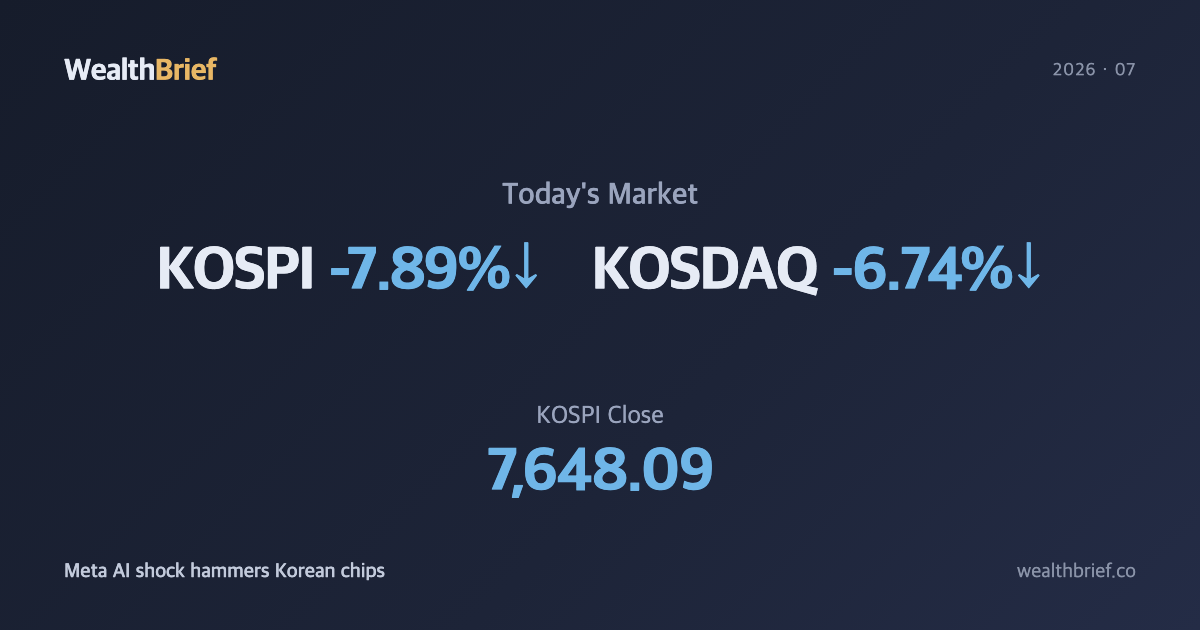
South Korea’s stock market took a severe blow on July 2, 2026. The KOSPI plunged 655.32 points (7.89%) to close at 7,648.09, while the KOSDAQ shed 62.63 points (6.74%) to finish at 866.72. Circuit breakers (매도 사이드카) were triggered on both markets during the session — a rare and jarring sign of just how badly investors wanted out. The catalyst: a single statement from Meta, the night before.
What Drove the Selloff — Meta’s GPU Announcement and Foreign Selling
On July 1 (US time), Meta announced plans to rent out idle computing capacity from its AI data centers to external customers. Markets interpreted this as a signal that Big Tech’s voracious appetite for AI hardware may be easing — or at least pausing. For Korean chipmakers, which have heavily staked their recent rally on surging HBM (High Bandwidth Memory) demand, the implication was jarring.
The selloff was reinforced by Microsoft’s announcement — also the day prior — that it would cut approximately 5,000 jobs, citing rising AI infrastructure costs. Even as MSFT stock climbed ~3% on efficiency hopes, the broader message spooked semiconductor investors globally.
On the demand side, foreign investors dumped an estimated 4.5 trillion won in Korean equities in a single session (preliminary figures from the Korea Exchange, July 2, 2026). The USD/KRW exchange rate stood at 1,552.60 won, near yearly highs, making Korean assets less attractive to dollar-denominated funds and accelerating the outflow.
Sector Breakdown
Semiconductors — Freefall
Samsung Electronics dropped 28,500 won (9.06%) to close at 286,000 won. SK Hynix — more exposed to HBM cycles — fell a stunning 373,000 won (14.57%) to 2,187,000 won. These two stocks alone account for a significant chunk of KOSPI weighting, so their combined collapse dragged the broader index into panic territory. A sell-side circuit breaker was triggered minutes into the morning session.
Defense — The Countertrend
While semiconductors collapsed, defense stocks quietly moved the other way. Hanwha Aerospace rose 25,000 won (2.29%) to 1,116,000 won; Hyundai Rotem gained 7,600 won (4.00%) to 197,400 won — in part boosted by news that the company was selected as the preferred negotiating partner for the KDDX next-generation destroyer program. Hanwha Ocean edged up 1.16% to 104,500 won. Persistent geopolitical tension continued to underpin defense demand expectations.
Financials — Safe Haven
With tech in freefall, money rotated into banks. KB Financial rose 6,500 won (4.10%) to 165,000 won; Hana Financial Group climbed 4,400 won (3.78%) to 120,800 won; Kakao Bank surged 1,150 won (5.50%) to 22,050 won. The weaker won supported net interest margin (NIM) expectations for banks, while dividend-focused investors found shelter amid the broader chaos.
K-Beauty — Record Exports as Shield
Amorepacific jumped 5,800 won (5.11%) to 119,400 won on continued momentum from record-high K-beauty export figures. Cosmax added 1.21% to close at 167,300 won. The sector’s independence from semiconductor cycles made it a go-to refuge for domestic retail investors during the session.
Biotech — Relative Stability
Celltrion rose 2,100 won (1.20%) to 176,600 won, while Samsung Biologics gained modestly at 1,406,000 won (+0.72%). Biotech’s low correlation to AI hardware concerns gave it relative breathing room, though the moves were far from dramatic.
EV Batteries & Autos — Mixed
Hyundai Motor dipped 5,500 won (1.13%) to 482,000 won. LG Energy Solution managed a 1.72% gain to 354,000 won. POSCO Holdings edged up 0.79% to 317,500 won. The battery sector found partial support, though the overall tone remained risk-off.
Global Context — AI Cycle Fears and a Strong Dollar
Today’s selloff fits into a broader pattern of re-evaluation around the AI investment supercycle. After two years of surging orders for AI servers, HBM chips, and data center infrastructure, cracks in demand visibility are beginning to show. Meta’s move to monetize idle compute — rather than keep ordering more — is being read by some analysts as a demand plateau signal, though it is far too early to call this a structural reversal.
The dollar’s continued strength (USD/KRW at 1,552.60) reflects expectations that the Federal Reserve will hold rates higher for longer, with strong US labor market data deferring rate cut bets. This structural dollar tailwind adds friction to any near-term recovery in Korean equities, particularly for foreign-heavy positions in large caps.
What to Watch Next
- US Jobs Report (around July 4): A stronger-than-expected payrolls print would push Fed rate cut expectations further out, sustaining dollar strength and foreign selling pressure on Korean equities.
- Big Tech AI Capex Guidance: Any company presenting updated AI spending plans — particularly around data center or chip procurement — will be closely scrutinized. Nvidia’s commentary at upcoming industry events could reset expectations either way.
- USD/KRW at 1,560: If the exchange rate breaches this level, it may amplify import-driven inflation concerns and further deter foreign equity inflows.
- Technical Rebound After Circuit Breaker: Historically, Korean markets have shown short-term technical bounces after sidecar triggers. Whether that holds amid a structural demand shift in semis remains to be seen.
Disclaimer: This article is prepared for informational purposes based on publicly available data as of the July 2, 2026 market close (KST). It does not constitute investment advice, nor does it recommend the purchase or sale of any specific security. All investment decisions involve risk and should be made at your own discretion, ideally with the guidance of a licensed financial professional.
Leave a Reply