
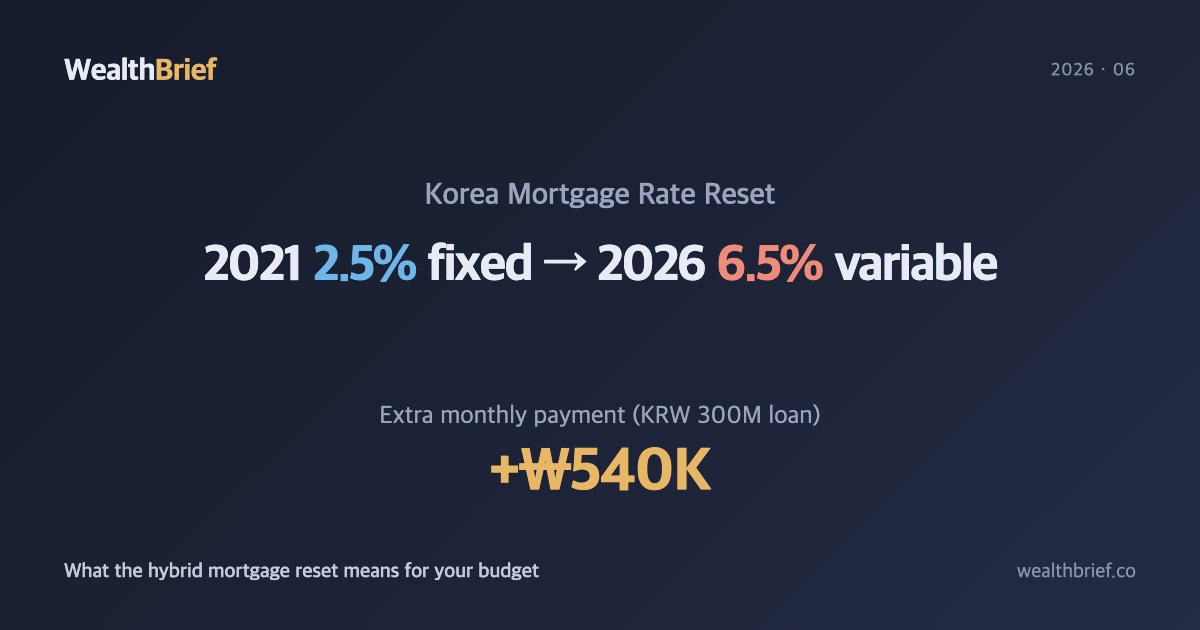
The 2021 “Lucky Rate” Is Sending a 2026 Bill
In 2021, Korean homebuyers locked into mortgage rates that look almost fictional today. With the Bank of Korea’s benchmark rate sitting at 0.5–1.0%, mixed-rate (hybrid) mortgages—the most common product offering five years of fixed interest before switching to a floating rate—were priced at roughly 2.0–3.5% per annum. Those five years are up.
By June 2026, fixed-rate segments on new hybrid mortgages at major commercial banks have broken through 6–7% in many products, according to multiple South Korean news sources including Maeil Business Newspaper and NewsWire (June 25, 2026). Borrowers who took out five-year fixed loans in 2021 are now rolling into variable rates benchmarked to COFIX—the Cost of Funds Index—which tracks the average funding cost of Korean banks. The rate they face when switching is widely cited at 6% to 6.5% territory.
COFIX (Cost of Funds Index) is published monthly by the Korea Federation of Banks and measures the weighted-average interest cost that domestic banks pay to raise funds (deposits, bonds, etc.). It serves as the reference rate for variable-rate home loans. When COFIX rises, so does the monthly payment for borrowers on floating-rate mortgages.
The Math: How Much More Are We Talking?
Consider two representative borrowers who took out a 30-year, principal-and-interest mortgage in early 2021. All figures below are estimates using the standard annuity repayment formula; actual payments will vary based on individual loan terms.
| Loan Scenario | Rate (annual) | Monthly Payment (est.) | Change After Reset |
|---|---|---|---|
| KRW 300M, 30yr — Fixed period (2021–2026) | 2.5% | ~KRW 1.18M | — |
| Remaining ~KRW 255M, 25yr — Variable (2026–) | 6.5% | ~KRW 1.72M | +~KRW 540,000/mo |
| KRW 500M, 30yr — Fixed period (2021–2026) | 2.5% | ~KRW 1.97M | — |
| Remaining ~KRW 425M, 25yr — Variable (2026–) | 6.5% | ~KRW 2.87M | +~KRW 900,000/mo |
※ Estimated using the standard annuity repayment formula. Remaining principal reflects approximate 5-year amortization. Actual payments depend on individual contract terms and the applicable floating rate at reset.
For many households, an extra KRW 540,000 to 900,000 per month isn’t a rounding error—it’s a grocery budget, a school tuition installment, or a retirement contribution gone.
Tighter Lending Rules Are Compounding the Pressure
South Korean banks haven’t sat still. As part of ongoing household debt management—highlighted by the one-year anniversary of the government’s “June 27 Measures” tightening consumer credit (Daily An, June 26, 2026)—several major lenders are raising mortgage eligibility hurdles.
- KB Kookmin Bank has restricted enrollment in MCI (Mortgage Credit Insurance), effectively capping LTV ceilings for many borrowers.
- Hana Bank announced plans to tighten mortgage conditions further from July (Today’s Economy, June 2026).
DSR (Debt Service Ratio) is the total annual principal-and-interest payment on all debts divided by annual income. Korean Tier-1 banks cap new lending at a 40% DSR. The catch: when a floating-rate reset lifts a borrower’s monthly payment, their DSR rises automatically—potentially blocking access to refinancing or additional credit at the very moment they need it most.
LTV (Loan-to-Value) measures the loan amount as a percentage of the property’s assessed value. With MCI and MCG (Mortgage Credit Guarantee) restrictions tightening, the practical LTV ceiling shrinks, constraining borrowers’ options for loan restructuring.
Policy Mortgages: A Lifeline—But Not for Everyone
Multiple outlets reported renewed interest in the government-subsidized Sinheung Huimang Taun (New Hope Town) program, which offers fixed rates as low as 1.3% annually for qualifying young couples (Maeil Business, RealCast, June 25, 2026). With the gap between policy and market rates exceeding 5 percentage points, the attraction is obvious. The problem: eligibility is strict—no prior homeownership, marriage or pre-marriage status, income ceilings—and supply is limited. For borrowers already facing a rate reset on an existing loan, this program doesn’t directly apply.
Borrowers hitting the reset can broadly consider three paths:
- ① Refinance comparison: Rate comparison platforms can surface options at competing banks. DSR and LTV requirements must be re-met; check for early repayment penalty clauses before acting.
- ② Transfer to a policy mortgage: Products like Bogeumjari Loan (Korea Housing Finance Corporation) are available for homes valued below KRW 900M, with household income ceilings around KRW 70M/year (2026 guidelines, subject to change). Eligibility should be confirmed directly with KHFC.
- ③ Voluntary principal prepayment: If a prepayment penalty waiver period is approaching or has passed, reducing outstanding principal directly lowers the interest burden proportionally.
The Other Side of the Ledger
The picture isn’t only bleak—it’s complicated. If the Bank of Korea resumes rate cuts, COFIX-linked variable rates could ease over time; some future relief may already be priced into market expectations. What’s harder to predict is the timing and magnitude.
A Bank of Korea Financial Stability Report (June 2026) highlighted that among low-income multi-property owners, some spend up to 73% of income on debt repayment (Newsian, June 2026). This is a subset figure for the most stretched borrowers, not the average—but it illustrates that rate sensitivity isn’t uniform across the population.
There’s also a counterintuitive phenomenon worth noting: Asia Economy reported (June 2026) that some borrowers, unfazed by higher interest costs, are leveraging additional credit lines to invest in an appreciating market. Risk appetite tends to expand in rising markets—the same psychology was visible in 2021.
One Practical Step Before the Bill Arrives
If your mortgage includes a five-year fixed-to-variable reset, pull out the loan contract now. Two things to confirm: the exact reset date and the index your rate will track (New Balance COFIX, New Transaction COFIX, or a bank-specific financial bond rate). The difference between COFIX types alone can be 0.2–0.5 percentage points. Knowing your floor lets you plan—waiting until the first inflated statement arrives doesn’t.
This article is for informational purposes only and does not constitute investment advice, financial planning guidance, or a recommendation to buy, sell, or refinance any financial product. Individual mortgage terms vary; consult your lender or a licensed financial advisor for guidance specific to your situation. Estimated monthly payment figures are illustrative calculations based on standard annuity formulas and may not reflect your actual loan conditions.
Leave a Reply