

Why Your Regular Savings Account Is Working Against You
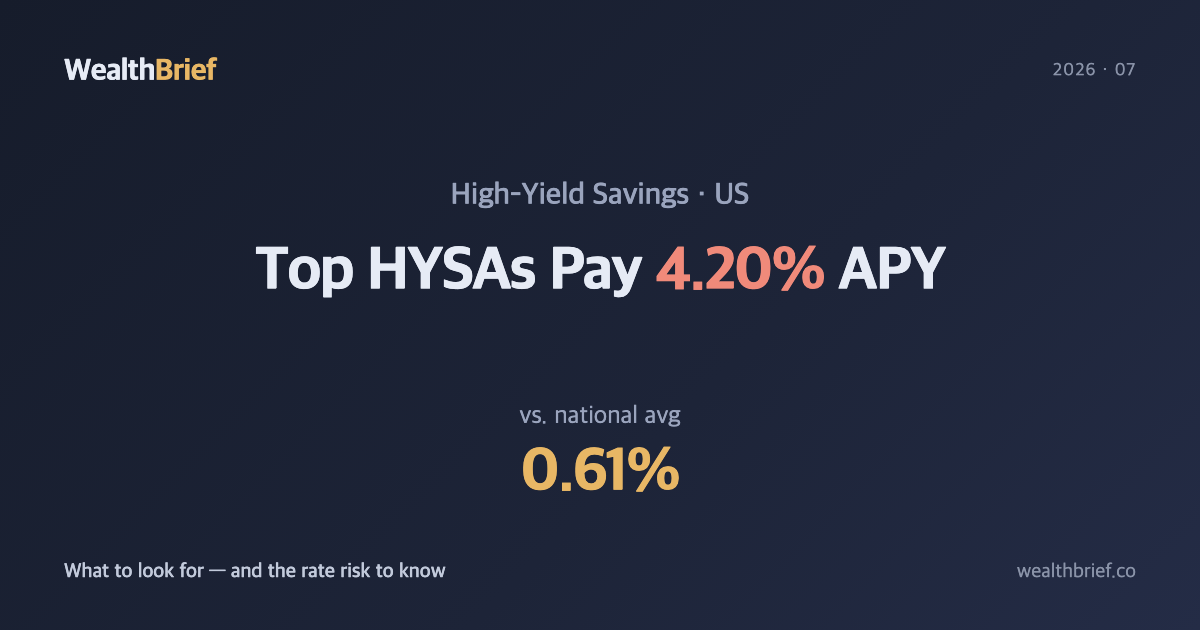
The national average savings account rate sits at 0.61% APY — that’s the figure Bankrate pulled from its survey of banks on July 14, 2026.
Meanwhile, the best high-yield savings accounts (HYSAs) are paying 4.15% to 4.20% APY right now, at federally insured banks, with no minimum balance requirements to speak of.
The math on keeping $20,000 parked at 0.61% is brutal. After a year you’ve earned $122. At 4.15%, that same balance earns $830 — a difference of $708 for doing nothing more than opening a different account.
That gap exists because most big traditional banks have little incentive to compete on savings rates. Online banks and fintechs, with far lower overhead, pass the Fed’s rate environment straight through to depositors. This guide explains how HYSAs work, what the current rate picture looks like, what to watch for as the Fed’s next meeting approaches, and how to pick an account that fits your situation.
How a High-Yield Savings Account Works
A high-yield savings account is, mechanically, a standard FDIC-insured savings account — it just pays a substantially higher interest rate than you’d get at a big brick-and-mortar bank.
A few things to know up front:
- APY vs. APR: APY (Annual Percentage Yield) reflects compound interest, including the effect of interest being credited to your account periodically (often daily or monthly). APR does not. When comparing accounts, always use APY.
- Variable rate: HYSA rates are not fixed. They move with the federal funds rate and can change any time — sometimes with little notice. If the Fed cuts rates, your APY will likely follow.
- FDIC insurance: Your deposits are insured up to $250,000 per depositor, per institution by the FDIC (per FDIC.gov, as of 2026). Some fintech accounts use a “sweep” structure that distributes your money across multiple partner banks, extending coverage to $1 million or more — check the fine print before assuming any amount above $250k is covered.
- Withdrawal limits: Federal Regulation D used to cap HYSA withdrawals at six per month. The Fed removed that rule in 2020, but some banks still enforce their own limits. Know the terms before you park a large sum.
Where Rates Stand Right Now (July 2026)
The Federal Reserve held its benchmark federal funds rate steady at 3.50%–3.75% at the June 16–17, 2026 FOMC meeting — the fourth consecutive hold under new Fed Chair Kevin Warsh. The next meeting is scheduled for July 28–29, 2026.
That rate environment means online banks can still afford to pay well. Here’s a snapshot of where the market stood as of mid-July 2026, per Bankrate and NerdWallet editorial surveys:
| Account / Bank | APY (as of July 2026) | Min. Opening Deposit | Notes |
|---|---|---|---|
| Forbright Bank — Growth Savings | 4.15% | $0 | No monthly fee; FDIC insured |
| Newtek Bank — Personal HYSA | 4.20% | Varies | Temporarily not accepting new accounts as of July 13, 2026 due to demand |
| National average (traditional banks) | 0.61% | — | Source: Bankrate, July 14, 2026 |
Rates change frequently. Always verify the current APY directly on the bank’s website before opening an account.
The broader competitive market sits in the 4.00%–4.20% APY range among top-tier online banks as of mid-July 2026, per Bankrate and NerdWallet editorial reviews. Rates were touching 5.00% in May 2026 according to some trackers, so the trend has been modestly downward — reflecting market expectations that the Fed will eventually cut.
The Rate Risk You Need to Understand
This is the part most articles bury, so let’s address it directly: a 4.15% APY today is not guaranteed for a year.
If the Fed cuts by 0.25% at the July 28–29 meeting, most HYSAs will drop by a similar margin within days — often without sending you a notice beyond a brief email. Markets as of mid-July 2026 are pricing in possible cuts later in 2026, though the Fed has held firm through four straight meetings.
This doesn’t mean HYSAs are a bad idea. It means you should:
- Use a HYSA for money you want liquid — your emergency fund, a home-purchase down payment you’ll need in 12–24 months, a sinking fund for a car or vacation.
- Think about whether you want to lock in a higher rate with a short-term CD (certificate of deposit) if you can afford to tie up the money. A 6-month CD paying 4.5% secures that rate regardless of what the Fed does.
- Check your account rate quarterly. Rates can drift down quietly.
A Worked Example: Emergency Fund of $15,000
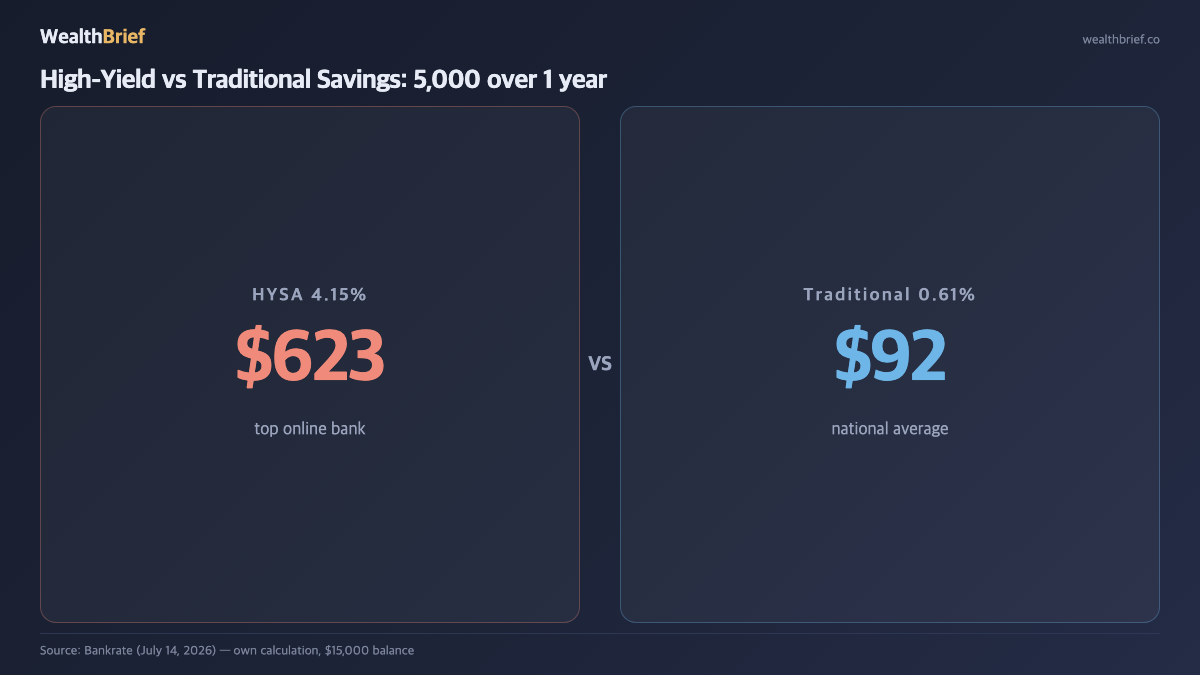
Say you have a three-month emergency fund of $15,000 sitting in a traditional savings account earning 0.61% APY.
Traditional savings account (0.61% APY):
Year 1 interest = $15,000 × 0.0061 = $91.50
Top HYSA (4.15% APY, compounded daily):
Year 1 interest ≈ $15,000 × 0.0415 ≈ $622.50
The difference: $531 per year — from the same $15,000, with the same FDIC protection, and no lockup period.
Over three years, assuming rates hold roughly flat, a HYSA puts an additional ~$1,590 in your pocket compared with leaving money at a big bank. That’s not investing, not risking a cent — it’s just using the right account.
How to Choose the Right High-Yield Savings Account
Not all HYSAs are created equal. Here’s what to run through before you open one:
- Confirm FDIC or NCUA insurance. If the account is at a bank, look for FDIC membership. Credit unions are insured by the NCUA. Both provide the same $250,000 per-depositor coverage. If it’s a fintech “pass-through” account, verify exactly which partner banks hold your deposits and what the total coverage ceiling is.
- Check for rate tiers or conditions. Some accounts only pay the top rate on balances above a threshold, or require a direct deposit. Read the fine print.
- Understand the transfer timeline. Online banks typically take 1–3 business days to transfer money to a linked external account. If you need same-day access to emergency funds, make sure your account allows instant transfers — or keep a small cushion in a checking account you can tap immediately.
- Look at the full rate history. A bank that slashed its rate from 5% to 2% six months after attracting deposits is showing you something about how it treats customers. Bankrate and NerdWallet publish rate histories for major accounts.
- Avoid monthly fees. There’s no good reason to pay a monthly maintenance fee on a HYSA in 2026. Dozens of strong competitors charge nothing.
HYSA vs. Other Cash-Equivalent Options
| Option | Typical July 2026 Yield | Liquidity | Federal Insurance? |
|---|---|---|---|
| High-Yield Savings Account | 4.00%–4.20% APY | High (1–3 day transfer) | Yes (FDIC, up to $250k) |
| 6-Month CD | ~4.30%–4.50% APY | Low (early withdrawal penalty) | Yes (FDIC, up to $250k) |
| Money Market Account (bank) | ~3.50%–3.90% APY | High (check/debit access) | Yes (FDIC, up to $250k) |
| Treasury Bills (3-month) | ~4.20%–4.40% yield | Medium (sell on secondary market) | Backed by US government |
| Traditional savings account | 0.61% APY (national avg) | High | Yes (FDIC, up to $250k) |
CD and T-Bill yields are approximate figures for July 2026; confirm with your broker or bank. Money market yields per Bankrate, July 2026.
The HYSA occupies a sweet spot: competitive yields with full liquidity. A CD edges it on rate, but you give up flexibility. T-Bills are compelling and government-backed, but require a brokerage account and carry slightly more friction. For most people building an emergency fund or saving toward a goal 12–24 months out, a HYSA is the cleanest answer.
In 3 Lines
- The best high-yield savings accounts are paying 4.15%–4.20% APY in July 2026 — roughly seven times the national average of 0.61% — with no lockup and full FDIC insurance up to $250,000.
- Rates are variable and tied to the Fed funds rate (currently 3.50%–3.75%); a Fed cut at the July 28–29 FOMC meeting could reduce APYs shortly after, so act now if you’re still in a low-rate account.
- A HYSA is ideal for cash you need liquid — emergency funds, near-term savings goals — while short-term CDs suit savers who can afford to lock money away and want to lock in a guaranteed rate.
For information only, not financial advice. Interest rates change frequently and are not guaranteed. FDIC insurance limits and rules are accurate as of 2026 — verify at FDIC.gov. For personalized savings guidance, consult a licensed financial advisor. Always confirm current APYs directly with the bank before opening an account.
Leave a Reply