
Today’s Market at a Glance
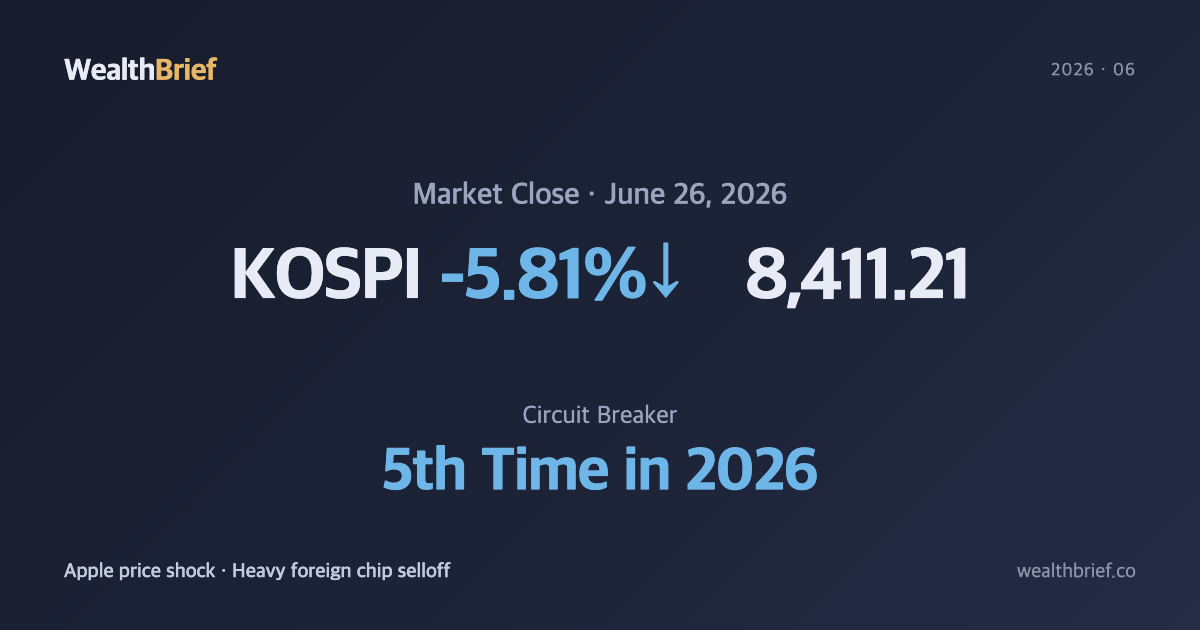
South Korea’s KOSPI plunged 5.81% to close at 8,411.21 on Friday, June 26, 2026, in what became one of the worst single-session drops this year. Trading was halted mid-session as the index triggered a circuit breaker for the fifth time in 2026 after falling more than 8% intraday — a stark reversal from the record highs just days earlier when the benchmark had crossed 9,100 points. The catalyst: Apple’s announcement of major price hikes across its product lineup, which immediately raised fears about weakening memory chip demand from the world’s most valuable consumer electronics company.
Market Overview: When the AI Rally Met a Hard Stop
Korea’s extraordinary bull run — driven by foreign buying into chipmakers riding the global AI infrastructure wave — ran headlong into profit-taking and fresh anxiety on Friday. The won-dollar exchange rate climbed as high as 1,547.3 won at the open before settling around 1,537.80 won per dollar at the close (Businesskorea, June 26, 2026), still near a 17-year high. That level of won weakness would ordinarily help exporters, but on a day defined by panic selling, the currency move did little to support sentiment.
Foreigners moved aggressively to the sell side, reportedly offloading trillions of won worth of blue-chip equities — primarily Samsung Electronics and SK hynix. Yonhap News Agency described the session as “profit hunting after AI-led rallies” (June 26, 2026). Chosunbiz noted that US tech weakness combined with caution ahead of the US PCE inflation print drove the selling wave (June 26, 2026). The circuit breaker, when it kicked in, gave trading floors a brief pause — but not a change in direction.
Sector by Sector
Semiconductors: Ground Zero of the Selloff
Apple’s price hike announcement hit Korea’s chip giants hardest. The logic was straightforward if painful: higher device prices risk softer consumer demand, which eventually translates to lower memory orders for Samsung and SK hynix. Both companies fell as much as 12% intraday, directly triggering the circuit breaker (TradingKey, June 26, 2026). The irony was sharp — Micron had just reported blowout earnings the night before, briefly boosting optimism, only for the Apple shock to arrive and overwhelm any positive read-through. On the other end, semiconductor equipment makers PSK and TES bucked the trend with gains of around 9%, suggesting upstream capital expenditure expectations remain intact despite the demand-side jitters (Seoul Economic Daily, June 26, 2026).
Bio & Pharma: A Safe Harbor in the Storm
While the broader market crumbled, select biotech names on the KOSDAQ found buyers. Rokit Healthcare and AprilBio each hit daily upper limits, while HanAll Biopharma jumped on its own clinical catalyst (Market-In, June 26, 2026). These were stock-specific stories driven by pipeline momentum, not macro flows — which is precisely what made them resilient on a day defined by macro fear. That said, this strength was narrow; the wider KOSDAQ biotech sector did not share in the gains.
EV Batteries: Dragged Down with the Market
Secondary battery stocks offered little shelter. Without fresh positive catalysts, names in the lithium-ion cell and materials space tracked the broader index lower. Structural headwinds — persistent Chinese competition and softer global EV demand growth — remain in the background, and foreign selling left little room for defensive positioning within the sector.
Automakers: Currency Tailwinds Not Enough
A weaker won should, in theory, lift the competitiveness of Hyundai Motor and Kia overseas. But theory gave way to sentiment Friday: both names finished in the red, swept up by the broader wave of selling. The currency benefit may show up in future earnings, but it provided zero protection against a day of coordinated foreign divestment.
Financials: Relative Outperformance
Banks and financial holding companies — KB Financial, Shinhan, Hana — saw narrower declines relative to the semiconductor heavyweights. With US PCE data looming, the rate outlook remained in flux, keeping financial stocks in a cautious holding pattern rather than freefall. Their insulation from the chip demand narrative helped.
The Global Picture: Apple, AI Uncertainty, and the Looming PCE Print
The proximate trigger for Friday’s Asia selloff was Apple. Its price hike announcement — reportedly in response to rising component costs — sent shockwaves through the global tech supply chain. SoftBank fell more than 12%, and Kioxia tumbled over 15% (TradingKey, June 26, 2026). The Nikkei 225 breached the 70,000 level. Across Asia, markets opened lower and stayed there.
The macro backdrop was already edgy. Wall Street had spent most of the prior week digesting conflicting AI signals — Nvidia hitting $5 trillion in market cap while broader tech names showed profit-taking pressure. The Nasdaq had given back ground, and Asia opened Friday in no mood to fight that trend. The global AI chip rout dragged the Nasdaq nearly 4% lower in early trading, compounding the pressure on Seoul (Investorideas, June 26, 2026).
Looming over all of this: the US core PCE price index, the Federal Reserve’s preferred inflation gauge, due for release. A hotter-than-expected reading would push back expectations of rate cuts, strengthening the dollar further and likely prolonging foreign selling in Korean equities.
What to Watch Going Forward
- US Core PCE Data: The inflation reading will set the tone for Fed rate expectations. A surprise to the upside raises tightening fears; downside surprise could bring some relief to beaten-down tech and chip stocks globally.
- Apple Consumer Demand Response: Price hikes may slow iPhone and Mac sales, which feeds directly back to memory chip order volumes at Samsung and SK hynix. Early demand signals in the coming weeks matter.
- Foreign Flow Patterns: May 2026 saw foreigners sell over $30 billion in Korean equities — ten times the outflow of 2025 (Aju Press, June 26, 2026). Whether this week’s selling is tactical profit-taking or the beginning of a structural rotation away from Korean tech remains the key question.
- Circuit Breaker Count: Five activations in 2026. Elevated volatility often precedes regulatory responses — monitor whether authorities signal any market stabilization measures.
- US Chip Stock Direction: Micron’s beat was overshadowed by the Apple shock. How Nvidia, Broadcom, and other AI infrastructure names trade in the coming sessions will directly influence sentiment for KOSPI’s semiconductor complex.
Disclaimer
This article is provided for informational purposes only and does not constitute investment advice or a solicitation to buy or sell any securities. All price data and figures cited are sourced from news reports and data collected at the time of writing; actual closing values may differ. Past market performance does not guarantee future results. Investors should conduct their own due diligence and consult a qualified financial advisor before making investment decisions. WealthBrief assumes no legal liability for investment outcomes based on this content.
Leave a Reply