
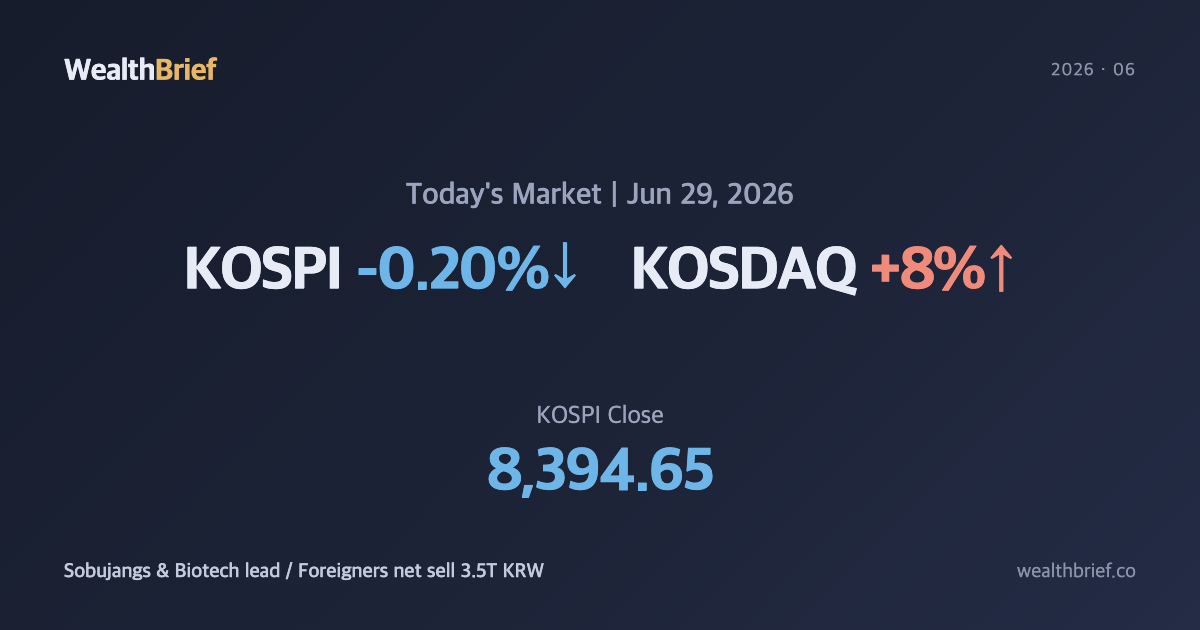
KOSPI Slips While KOSDAQ Surges 8% — Chips Cool, Small-Caps Soar
Korean markets delivered a strikingly split verdict on June 29, 2026. The KOSPI edged down roughly 0.20% to close at 8,394.65, weighed by heavy foreign selling in blue-chip semiconductor stocks. Meanwhile, the KOSDAQ rocketed more than 8%, reclaiming the 920 level — its strongest single-day gain in recent memory — driven by a rotation into semiconductor materials, components, and equipment stocks (so-called “sobujangs”) and biotech names. The USD/KRW exchange rate was quoted at approximately 1,541.80 (collected at 4:00 p.m. KST, June 29, 2026).
Market Overview — Foreign Selling Caps KOSPI; Rotation Fuels KOSDAQ
The KOSPI opened lower, with the index sliding toward the 8,300 range in early trade as foreign investors offloaded an estimated 3.5 trillion KRW on a net basis — a figure described as a “sell bomb” by Dong-A Ilbo (June 29, 2026). Domestic institutions provided partial support, limiting the final decline. The VKOSPI (Korea’s volatility index) surged to near all-time highs during the session, signaling heightened anxiety among market participants.
The KOSDAQ told a different story. Institutional buyers scooped up semiconductor equipment and biotech stocks aggressively, triggering a buy-side sidecar mechanism early in the session. The rally was broadly attributed to two factors: policy expectations surrounding a government-linked semiconductor investment plan, and a rotation away from the concentrated positions in Samsung Electronics and SK Hynix that have dominated the KOSPI’s gains since late 2025 (Newsis; Yonhap Infomax, June 29, 2026).
Sector Breakdown — Divergence Was the Story of the Day
Semiconductors (Large-Cap) — Selling Pressure After a Long Run
Samsung Electronics fell roughly 3% at the open, and SK Hynix dropped approximately 1.95% in early trade, according to Yonhap News (June 29, 2026). The Korea Economic Daily framed the weakness as “high-valuation fatigue” following a sustained rally. Spillover from weakness in U.S. AI hardware names — particularly Nvidia — was cited as a key trigger. Both stocks pared losses somewhat by the close but remained in negative territory.
Semiconductor Equipment & Materials (KOSDAQ) — Policy Catalyst Ignites Gains
KOSDAQ-listed sobujangs stole the show. Reports indicated that Samsung Electronics was set to unveil a 1,000-trillion-KRW semiconductor cluster investment roadmap the following day (June 30), and speculation around the announcement lit a fire under component and equipment makers (Blooming Bit, June 28; InvestChosun, June 29, 2026). Names such as PSK Holdings were singled out as beneficiaries of the pre-announcement excitement.
Biotech & Healthcare — Riding the KOSDAQ Wave
Biotech stocks joined the rally broadly. Digital Daily reported that buy-side sidecars were triggered on the KOSDAQ, with biotech shares “rising across the board” (June 29, 2026). The sector benefited from the same rotation dynamic: money that had been concentrated in the KOSPI’s semiconductor giants appears to have dispersed into smaller, growth-oriented names.
Power Infrastructure — Gradual Re-Rating
Power equipment and energy-related stocks also attracted attention. Maeil Business Newspaper Market flagged on June 29 that “bio and power stocks — long neglected — are starting to get noticed.” The AI data center buildout narrative continues to underpin interest in domestic power infrastructure names, as electricity demand projections rise alongside computing capacity.
Cosmetics, Shipbuilding & Defense — On Watch
Ahead of the session, Chosun Ilbo (June 28) quoted analysts who recommended watching “cosmetics, shipbuilding, and defense” as candidate sectors once semiconductor momentum moderates. These groups are on investors’ radars as potential next-rotation plays, though they did not deliver breakout moves on this particular day.
Global Context — U.S. Tech Pullback and the Jobs Report Ahead
On Wall Street, Nvidia and other AI hardware leaders faced profit-taking pressure, creating a headwind for their Korean counterparts. The VKOSPI’s spike to near-record levels echoed anxiety that the semiconductor-led rally may be entering a consolidation phase.
Currency dynamics added another layer of complexity. The KRW traded near 1,541.80 per dollar — a level that benefits exporters on paper but also reflects underlying concerns about capital outflows and global dollar strength. All eyes now turn to the U.S. nonfarm payrolls and unemployment rate data due in the first week of July, which will influence Fed rate expectations and, by extension, global risk appetite.
What to Watch — Key Variables Ahead
- Samsung Electronics’ 1,000-Trillion-KRW Investment Announcement (June 30): The specifics of the semiconductor cluster plan will be pivotal for KOSDAQ sobujangs. Concrete details could extend the rally; vague messaging could prompt profit-taking.
- U.S. Nonfarm Payrolls (first week of July): A hotter-than-expected print could push yields higher and revive dollar strength, pressuring emerging-market equities including Korean stocks.
- KOSDAQ Rotation Durability: Yonhap posed the key question — will the volatility-heavy June give way to a more earnings-driven July as Q2 reporting season approaches? Investors will be watching whether today’s KOSDAQ surge is the start of a sustained re-rating or a one-day squeeze.
- VKOSPI Normalization: A pullback in Korea’s fear gauge from near-record levels would be an early signal that institutional confidence is returning to the broader market.
⚠️ Disclaimer: This article is published by WealthBrief for informational and market-commentary purposes only. Nothing in this content constitutes investment advice or a solicitation to buy, sell, or hold any specific security or asset class. All investments carry the risk of loss, including the potential loss of principal. Figures cited are sourced from publicly available news reports and may differ from official finalized data; please refer to Korea Exchange (KRX) official disclosures for confirmed statistics.
Leave a Reply