

Capital gains tax doesn’t apply to everything you receive from a sale — it applies only to the profit. But translating that profit into an actual tax bill requires several steps: figuring out whether the gain is short-term or long-term, stacking it on top of your ordinary income, applying the right rate, and checking for any special exclusions.
This guide walks through the full calculation in plain steps, with worked dollar and pound examples for 2026. For the rate tables alone, see our Capital Gains Tax 2026 Brackets overview. Here, the focus is on the arithmetic — how to get from “I sold something at a gain” to a real number.
Capital Gains Tax Rate 2026: US and UK Side by Side
The two systems work very differently. In the US, the rate depends on how long you held the asset; in the UK, it depends on which income tax band your gain lands in. Both countries start by taxing only the gain, not the sale price.
| Feature | United States | United Kingdom |
|---|---|---|
| Tax-free allowance | None on investments (home sale exclusion separate) | £3,000 Annual Exempt Amount (2026/27, per HMRC) |
| Short-term rate | Ordinary income rate (up to 37%) | N/A — all gains taxed at same rate regardless of holding period |
| Long-term rate (or main rate) | 0% / 15% / 20% (held >1 year) | 18% (basic-rate band) / 24% (above basic-rate band) |
| Investment surtax | 3.8% NIIT on MAGI above $200k (single) / $250k (MFJ) | None |
| Official source | IRS Rev. Proc. 2025-32 | GOV.UK, updated 6 April 2026 |
Everything that follows uses these figures as of 2026. Rates and thresholds change — always confirm at IRS.gov (US) or GOV.UK (UK) before filing.
Capital Gains Tax Calculator on Sale of Stock (US Worked Example)
The first question is always: short-term or long-term? Assets held one year or less are short-term and taxed as ordinary income. Assets held more than one year qualify for the lower long-term rates.
Here are the 2026 long-term capital gains (LTCG) thresholds for two common filing statuses (IRS Rev. Proc. 2025-32):
| Rate | Single — taxable income up to | Married Filing Jointly — up to |
|---|---|---|
| 0% | $49,450 | $98,900 |
| 15% | $545,500 | $613,700 |
| 20% | Above $545,500 | Above $613,700 |
Your gain stacks on top of your ordinary income. The rate that applies is determined by where the top of your combined income lands.
Worked example — single filer selling stock:
- Earned income (wages, after deductions): $62,000
- Stock purchased two years ago for $38,000, sold today for $68,000
- Long-term gain: $68,000 − $38,000 = $30,000
- Combined income for rate-bracket test: $62,000 + $30,000 = $92,000
- $92,000 sits between $49,450 and $545,500 → rate is 15%
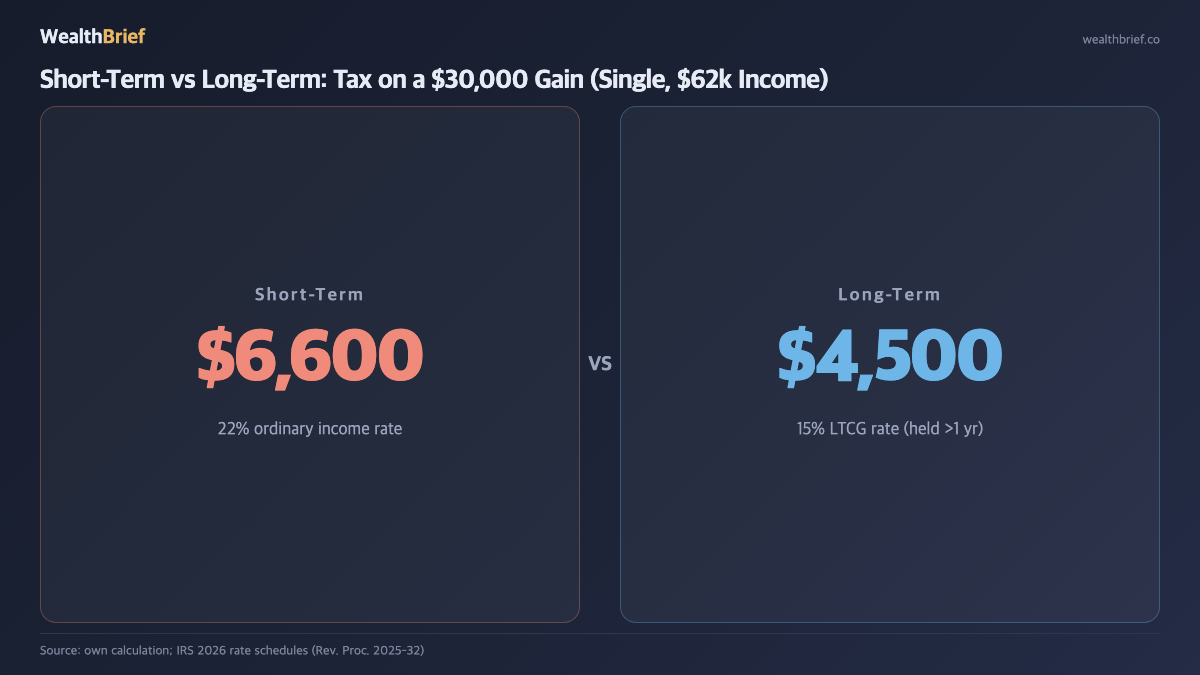
- Tax owed on the stock gain: $30,000 × 15% = $4,500
If that same $30,000 gain had been short-term (stock held 11 months), it would be added to ordinary income and taxed at the marginal income rate — likely 22% at this income level, costing $6,600 instead of $4,500. Waiting past the one-year mark saved $2,100 on this trade alone.
One more layer to check: the Net Investment Income Tax (NIIT). If your Modified Adjusted Gross Income (MAGI) exceeds $200,000 (single) or $250,000 (MFJ), an additional 3.8% applies on top of the LTCG rate. Those thresholds are set by statute and have not been inflation-adjusted since 2013. At $92,000 income, this example doesn’t trigger it.
Capital Gains Tax Calculator on Sale of Rental Property (US)
Rental property adds a twist: depreciation recapture. When you own a rental, the IRS lets you deduct a portion of the building’s cost each year (not the land — land doesn’t wear out). When you sell, those deductions come back as ordinary income taxed at up to 25%, not at the lower LTCG rate.
Worked example — selling a rental held 8 years:
- Purchase price: $250,000 (land value $50,000; building value $200,000)
- Annual depreciation: $200,000 ÷ 27.5 years = $7,273/yr
- Total depreciation claimed over 8 years: $7,273 × 8 = $58,182
- Adjusted cost basis: $250,000 − $58,182 = $191,818
- Sale price: $320,000
- Total gain: $320,000 − $191,818 = $128,182
That $128,182 gain splits into two buckets:
- Depreciation recapture: $58,182 × 25% = $14,546
- Long-term capital gain: ($128,182 − $58,182) = $70,000 × 15% = $10,500
Total federal tax on this sale: $25,046. (State tax would add more in most states.) That’s roughly 19.5% effective rate on the total gain — well above the headline 15% LTCG rate most people expect. The gap comes entirely from depreciation recapture.
Arithmetic check: $14,546 + $10,500 = $25,046 ✓. Effective rate: $25,046 / $128,182 = 19.5% ✓.
Capital Gains Tax on Home Sale: The Exclusion (Including What Seniors Need to Know)
Your primary residence gets special treatment. Under IRC § 121, you can exclude up to $250,000 of gain (single) or $500,000 (married filing jointly) from federal tax entirely — provided you’ve lived in the home as your primary residence for at least two of the last five years.
Many people search for a “senior exemption” on home sales. There is no longer a separate over-55 rule — that was repealed in 1997. Seniors use the same § 121 exclusion as everyone else. The one age-related consideration: if you’ve lived in a home for decades, you might have a very large gain. The exclusion has not been increased for inflation since it was set in 1997.
Worked example — single seller, large gain:
- Home purchased in 2008 for $200,000, sold in 2026 for $500,000
- Gross gain: $300,000
- § 121 exclusion (single): $250,000
- Taxable gain: $300,000 − $250,000 = $50,000
- Rate (assuming single filer, $70,000 ordinary income): 15%
- Tax owed: $50,000 × 15% = $7,500
Worked example — married couple, full exclusion covers the gain:
- Home purchased for $400,000, sold for $750,000
- Gross gain: $350,000
- § 121 exclusion (MFJ): $500,000
- Taxable gain: $0 — the full gain is sheltered
Important: if you rented part of the home, or claimed home-office deductions, the exclusion is prorated. And if you’ve also claimed depreciation on a portion of the property, that depreciation is still subject to recapture regardless of the § 121 exclusion. See IRS Publication 523 for the full rules.
UK Capital Gains Tax Calculator 2026/27
In the UK, every individual gets a £3,000 Annual Exempt Amount (AEA) for 2026/27 — per HMRC, unchanged from 2025/26. Gains below that are tax-free. Above it, the rate depends on which income tax band your gain falls into, not on how long you held the asset.
The calculation uses four steps:
- Work out your taxable income (gross income minus Personal Allowance of £12,570 and any reliefs)
- Total your capital gains for the tax year
- Subtract the £3,000 AEA
- Stack the remaining gain on top of your taxable income. Any part within the basic-rate band (up to £37,700 above the Personal Allowance) is taxed at 18%; any part above pays 24%.
Both rates now apply to all assets — shares, residential property, cryptoassets. The separate higher property rate was abolished in October 2024 (per GOV.UK).
Worked example — basic-rate taxpayer:
- Employment income: £28,000. Taxable income: £28,000 − £12,570 = £15,430
- Remaining basic-rate band: £37,700 − £15,430 = £22,270
- Capital gain on shares: £18,000
- After AEA: £18,000 − £3,000 = £15,000 taxable gain
- £15,000 fits entirely within the remaining £22,270 band → taxed at 18%
- Tax: £15,000 × 18% = £2,700
Worked example — higher-rate taxpayer:
- Employment income: £65,000. Taxable income: £65,000 − £12,570 = £52,430
- That exceeds £37,700, so the basic-rate band is already full
- Capital gain on shares: £20,000
- After AEA: £20,000 − £3,000 = £17,000 taxable gain
- All at 24% (band is exhausted)
- Tax: £17,000 × 24% = £4,080
Spouses each get their own £3,000 AEA. If you jointly own an asset and sell it, you can each claim the allowance against your share of the gain — a legitimate way to shelter up to £6,000 of gains as a couple without any trust or tax-avoidance scheme.
UK residents must report and pay CGT on UK residential property within 60 days of completion, using HMRC’s online reporting service. Gains on other assets are reported through Self Assessment by 31 January following the tax year end.
In 3 Lines
- In the US, holding an asset longer than one year cuts your rate from your ordinary income rate down to 0%, 15%, or 20% — determined by where the gain stacks on top of your income (IRS Rev. Proc. 2025-32).
- Rental property sellers face depreciation recapture taxed at up to 25%, not the LTCG rate — a tax cost that surprises many landlords who’ve claimed years of deductions.
- UK taxpayers get a £3,000 annual exempt amount in 2026/27 and pay 18% or 24% depending on their income tax band, with no distinction between how long they held the asset (HMRC, 6 April 2026).
For information only — not financial or tax advice. Tax rules are complex and change frequently. Confirm all figures with a qualified tax professional and at the official sources: IRS.gov and IRS Publication 544/523 (US); GOV.UK/capital-gains-tax (UK). Figures as of 2026.
Leave a Reply