


Selling your home can be one of the biggest financial transactions of your life — and one of the best-taxed ones, if you know the rules. The IRS lets most homeowners exclude up to $250,000 of gain ($500,000 if married filing jointly) from their taxable income when they sell their primary residence. That exclusion, under Internal Revenue Code §121, can wipe out the entire federal tax bill on a typical home sale — but only if you meet the ownership and use tests.
This guide walks through how the §121 exclusion works, what happens when you sell before two years, what it means for seniors and inherited properties, and how to calculate what you actually owe. All figures are as of the 2026 tax year per IRS Rev. Proc. 2025-32 and IRS Publication 523.
What Is the §121 Exclusion — and How Much Can You Keep Tax-Free?
The short answer: up to $250,000 of profit (single filer) or $500,000 (married filing jointly) can come off your tax return completely. The gain above those thresholds is taxed as long-term capital gain, subject to the 0%/15%/20% brackets described later.
To claim the full exclusion, you must pass two tests — both measured against the five-year window ending on your sale date, per IRS Topic No. 701:
- Ownership test: You owned the home for at least 24 months (2 years) out of the last 5 years.
- Use test: You lived in it as your main residence for at least 24 months out of the last 5 years. The two 24-month periods don’t have to overlap.
One more limit: you can only use the exclusion once every two years. If you sold another home and claimed §121 within the prior two years, you’re disqualified for the full amount (a partial exclusion may still apply).
| Filing status | Maximum §121 exclusion | Requirement |
|---|---|---|
| Single | $250,000 | 2-of-5-year ownership & use |
| Married filing jointly | $500,000 | Both spouses meet use test; at least one meets ownership test |
| Surviving spouse (sold within 2 years of death) | $500,000 | Not yet remarried; meets standard tests |
| Married filing separately | $250,000 each | Each spouse must meet both tests individually |
Capital Gains Tax on Home Sale Less Than 2 Years
If you haven’t lived there for two years, you don’t automatically lose all protection — you may qualify for a partial exclusion. The IRS allows this when the early sale is caused by one of three qualifying reasons (per IRS §1.121-3):
- Change in employment — a new job or job transfer that moves your workplace at least 50 miles farther from the home than your previous workplace
- Health reasons — a physician-recommended move to care for yourself, a family member, or a household member
- Unforeseen circumstances — divorce, natural disaster, death, multiple births from one pregnancy, or other events the IRS deems outside your control
The partial exclusion is prorated: divide the shorter of your time of residence or ownership by 24 months, then multiply by $250,000 (or $500,000 for MFJ). If you lived there 15 months and had to move for work, your maximum exclusion is 15/24 × $250,000 = $156,250.
If you sell early for personal reasons (upgraded to a bigger place, didn’t like the neighborhood), there’s no partial exclusion and the full gain is taxable. The holding period still matters: gains on a home held more than one year qualify for long-term capital gains rates; gains on a home held one year or less are taxed as ordinary income.
Capital Gains Tax on Home Sale If You’re Buying Another Home
There is no “rollover” exemption in the modern tax code. Many homeowners believe that reinvesting their proceeds into a new home defers or eliminates the tax — that rule existed before 1997 but was repealed when §121 was expanded. Today, you either meet the exclusion tests or you don’t. What you do with the sale proceeds is irrelevant to your tax liability.
What does matter is whether you’ve used the §121 exclusion in the prior two years. If you sold a home last year and claimed the exclusion, you can’t claim it again on a sale this year — not until the two-year window resets. Plan accordingly if you’re upgrading or downsizing on a tight timeline.
Capital Gains Tax on Home Sale for Seniors
There’s a persistent myth that seniors get a one-time capital gains exemption. That tax break was eliminated in 1997. Since then, everyone — regardless of age — uses the same §121 rules.
What seniors often do have on their side: more years of appreciation, which can push gains well above the exclusion. If your gain exceeds $250,000 (single) or $500,000 (MFJ), the excess is taxable at long-term capital gains rates — which may be 0% if your income is modest enough (see the worked example below).
The one genuine senior-specific break is the surviving-spouse rule. If your spouse dies and you sell the home within two years, before you remarry, you may still claim the $500,000 married exclusion rather than the $250,000 single exclusion — per IRS Pub. 523. That window closes on the second anniversary of your spouse’s death or when you remarry, whichever comes first.
One more nuance: if you’ve moved to a nursing home or assisted-living facility and can no longer live at the property independently, the IRS gives you a reduced use-test threshold of just one year (instead of two) to qualify — per §121(d)(7). You still need to have owned the home for two years.
Capital Gains Tax on an Inherited Home Sale
Inherited property works differently from property you bought yourself. When you inherit a home, your cost basis is “stepped up” to the fair market value on the date of the original owner’s death — not what they originally paid. This stepped-up basis is one of the most valuable provisions in the tax code.
In practice: if your mother bought a house in 1990 for $80,000, and it was worth $450,000 when she died, your basis is $450,000. If you sell it for $465,000 shortly after, your taxable gain is only $15,000 — not $385,000.
All gains on inherited property are automatically treated as long-term, regardless of how long you’ve actually held it, per IRC §1223(11). That means you’re in the 0%/15%/20% long-term bracket from day one — not the higher ordinary-income rate that applies to short-term gains.
The §121 exclusion generally doesn’t apply to an inherited home unless the inheritor also lives in the property and meets the ownership and use tests in their own right. Confirm your situation with a CPA; estate and inheritance tax rules vary by state and can interact with the federal basis rules in ways that aren’t intuitive.
How to Calculate Capital Gains Tax on Home Sale: A Worked Example
Let’s run the full math for a typical scenario so you can see exactly how the exclusion and brackets interact.
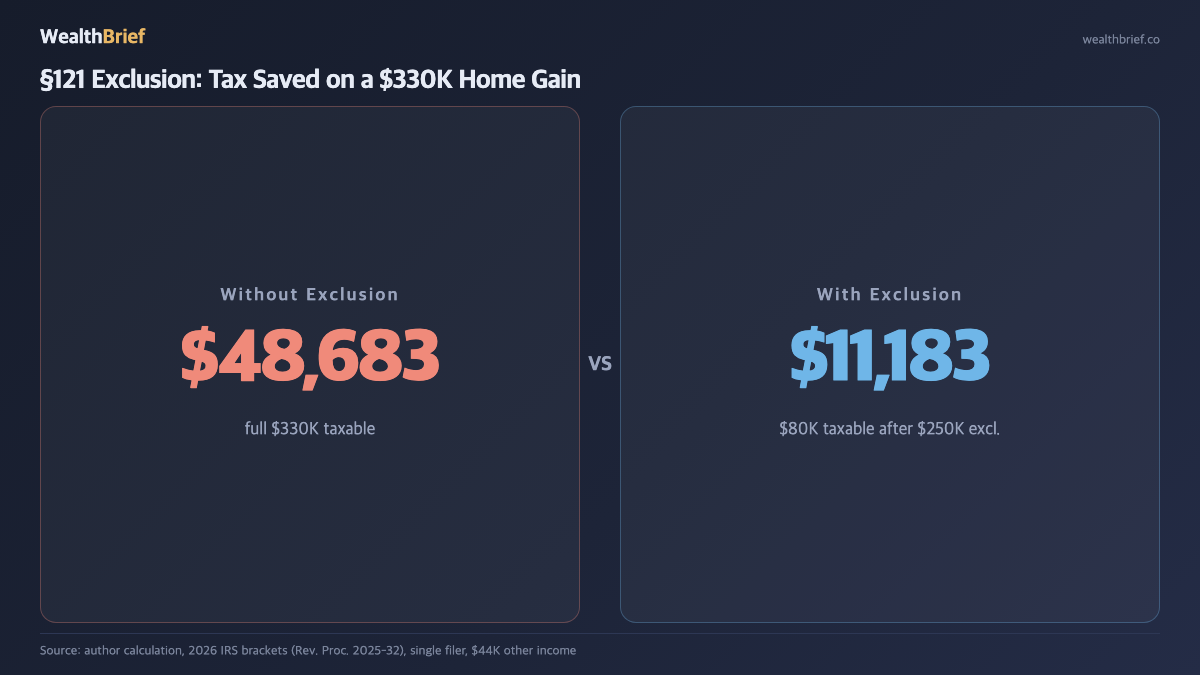
The situation: Rachel is single. She bought her house in 2020 for $280,000 and sold it in November 2026 for $610,000. She lived there the whole time, so she meets the ownership and use tests. Her other taxable income for 2026 (wages minus standard deduction of $16,100) is $44,000.
- Calculate the raw gain: $610,000 − $280,000 = $330,000
- Apply the §121 exclusion: $330,000 − $250,000 = $80,000 taxable gain
- Find the room left in the 0% bracket: The 2026 0% ceiling for single filers is $49,450. Rachel’s ordinary taxable income is $44,000, leaving $49,450 − $44,000 = $5,450 of room.
- Stack the gain: First $5,450 of gain = 0% tax. Remaining $80,000 − $5,450 = $74,550 taxed at 15% = $11,183.
- Check NIIT: Rachel’s modified AGI is well below $200,000, so the 3.8% Net Investment Income Tax does not apply.
- Total federal tax on the sale: roughly $11,183 — on $330,000 of raw profit. Without the §121 exclusion, the same math would yield about $42,083 in federal tax.
| Without §121 exclusion | With §121 exclusion | |
|---|---|---|
| Taxable gain | $330,000 | $80,000 |
| 0% rate applied | $5,450 | $5,450 |
| 15% rate applied | $324,550 | $74,550 |
| Federal tax on sale | ~$48,683 | ~$11,183 |
| Tax saved by §121 | ~$37,500 | |
Source: author calculation using IRS §121 exclusion limits and 2026 capital gains brackets from IRS Rev. Proc. 2025-32. State income taxes not included — many states have their own capital gains rules.
When NIIT hits: If Rachel’s total modified AGI (including the taxable gain) exceeded $200,000, she would owe an additional 3.8% on the taxable gain amount, per IRC §1411. At $200,000+ income, the NIIT on $80,000 would add $3,040 to her bill.
In 3 Lines
- If you’ve lived in your home for at least 2 of the last 5 years, you can exclude up to $250,000 of gain from federal tax ($500,000 married) — the §121 exclusion covers most typical home sales entirely.
- Selling before 2 years? A partial exclusion is available if the move was driven by a job change, health reason, or unforeseen circumstance — otherwise the full gain is taxable.
- Inherited homes get a stepped-up basis to date-of-death value, automatically qualify for long-term rates, and rarely owe much tax unless the property has appreciated significantly since inheritance.
→ Use our Capital Gains Tax Calculator to run the numbers for your specific situation.
This article is for general information only and does not constitute tax or financial advice. Tax rules change — verify current limits and your specific situation at IRS.gov (Topic 701) and consult a licensed CPA or tax professional. The §121 exclusion rules described here reflect U.S. federal tax law as of the 2026 tax year per IRS Rev. Proc. 2025-32 and IRS Publication 523. State capital gains taxes are separate and not covered here.
Leave a Reply