

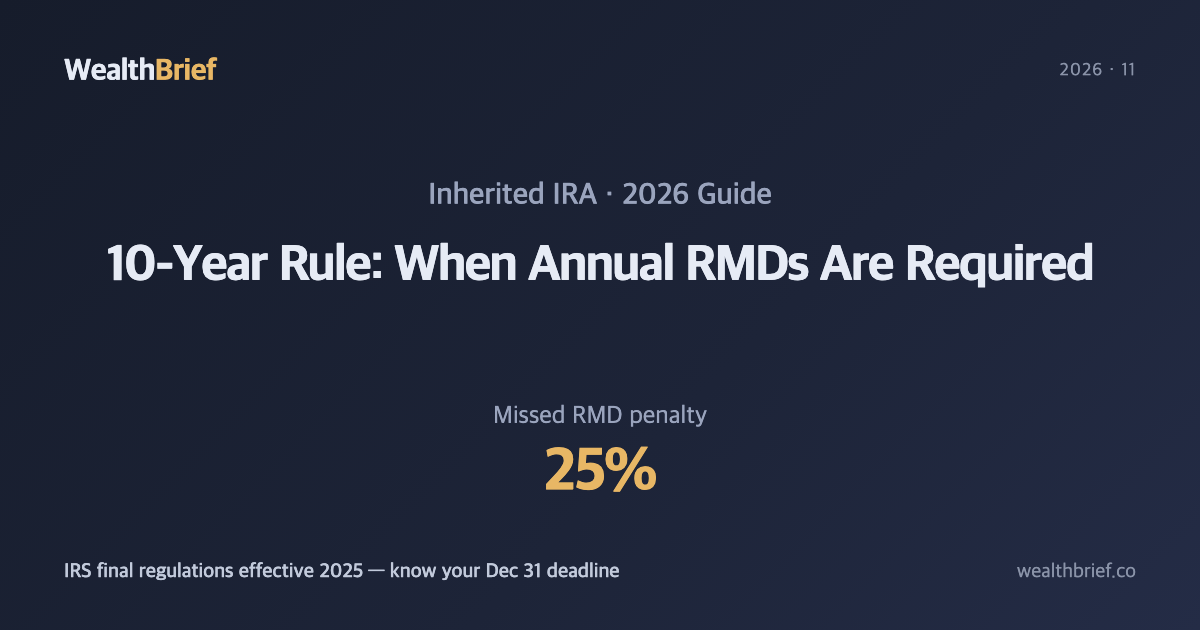
RMD Requirements for Inherited IRA: What Changed in 2025 and Why It Matters Now
If you inherited an IRA after 2019, the rules changed in ways that catch a lot of people off guard. The old “stretch IRA” — where beneficiaries could spread withdrawals over their own lifetime — is largely gone. Most non-spouse heirs are now working against a 10-year clock, and as of 2025, annual distributions are mandatory during that period for many of them.
The confusion stems from a five-year limbo: the IRS issued a string of notices (most recently Notice 2024-35, per the IRS) waiving annual distribution requirements from 2020 through 2024. That relief ended. 2025 was the first year annual required minimum distributions (RMDs) became fully enforceable for affected inherited IRA beneficiaries — and December 31 is the hard deadline each year.
This guide lays out exactly who must take annual RMDs, who doesn’t, and what the Dec 31 deadlines look like in practice.
RMD Requirements for Beneficiary IRA: The Two-Tier System
Not everyone who inherits an IRA faces the same rules. The IRS (per final regulations issued July 2024, T.D. 10001) divides beneficiaries into two main groups:
| Beneficiary Type | Annual RMDs in Years 1–9? | Must Empty by Year 10? | Can Still Use Life-Expectancy Stretch? |
|---|---|---|---|
| Eligible Designated Beneficiary (EDB) | Yes — based on own life expectancy | No (may use stretch) | Yes |
| Non-Eligible Designated Beneficiary (NEDB) — owner died before RBD | No annual RMDs required | Yes — Dec 31 of Year 10 | No |
| Non-Eligible Designated Beneficiary (NEDB) — owner died after RBD | Yes — annual RMDs in years 1–9 | Yes — Dec 31 of Year 10 | No |
| Non-designated beneficiary (estate, charity, most trusts) | Yes (per owner’s remaining schedule) | 5-year rule applies if before RBD | No |
Who qualifies as an Eligible Designated Beneficiary? Per the IRS, the five categories are: (1) the surviving spouse, (2) a minor child of the deceased (until the age of majority, then a 10-year clock kicks in), (3) a disabled individual, (4) a chronically ill individual, and (5) any person not more than 10 years younger than the original owner.
Everyone else — adult children, siblings, most other relatives, friends — falls into the non-eligible bucket and faces the 10-year rule.
The Inherited IRA 10-Year Rule Deadline, Explained
The 10-year rule means the entire inherited account must be fully withdrawn by December 31 of the 10th calendar year following the year of the original owner’s death.
So if someone died in 2022, the 10-year clock started in 2022, and the account must be empty by December 31, 2032.
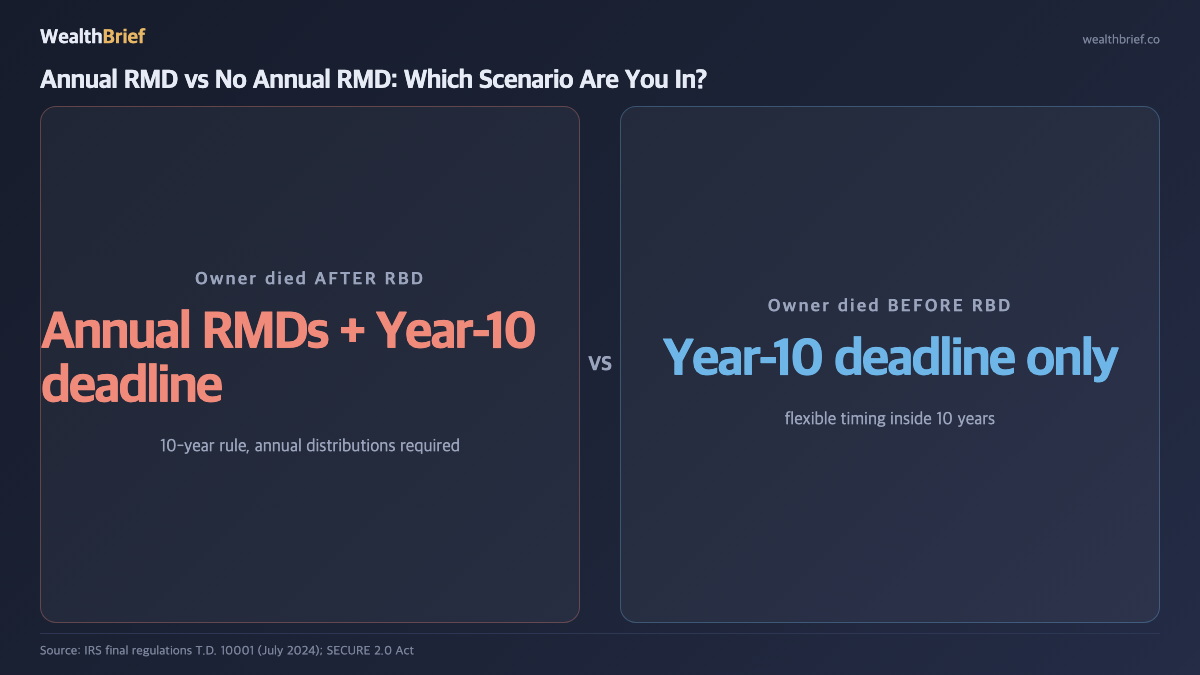
The key twist — the part that tripped people up for years — is whether annual distributions are also required inside that window. The answer depends on whether the original owner had already hit their Required Beginning Date (RBD) before they died.
What is the Required Beginning Date? Per SECURE 2.0 (effective for those who turned 72 after December 31, 2022), the RBD is April 1 of the year after the owner turns 73. If the owner died before reaching their RBD, they had not yet been required to take RMDs themselves. If they died on or after their RBD, they were already in the RMD phase.
- Owner died before RBD: No annual RMDs in years 1–9. Take nothing, everything, or any amount — just empty the account by year 10.
- Owner died after RBD: Annual RMDs are required each year (years 1–9), calculated using the beneficiary’s own life expectancy table. Plus, the account must be fully empty by year 10.
RMD for First Year Inherited IRA: When Is the First Distribution Due?
Your first annual RMD (for those subject to them) is due December 31 of the calendar year after the year of death. There is no April 1 extension that applies to inherited IRA beneficiaries — that grace period is only for the original owner’s own RMDs.
Example: The original owner died in September 2023, past their RBD. Your first annual RMD was due December 31, 2024. The IRS waiver (Notice 2024-35) covered that year, so it was not penalized. But your 2025 RMD was due December 31, 2025 — no waiver, fully enforceable.
How to calculate the annual RMD amount: Divide the prior December 31 account balance by the life expectancy factor from IRS Publication 590-B, Table I (Single Life Expectancy). Use your own age in the year of the first distribution, then reduce the factor by 1.0 each subsequent year.
Worked Example — Annual Inherited IRA RMD
Suppose your father, age 77, died in June 2022 (past his RBD). He left you a traditional inherited IRA worth $180,000 (balance as of December 31, 2022). You are 48 years old in 2023 — the year of your first RMD.
- Per IRS Table I (Publication 590-B), the life expectancy factor for age 48 is 36.0
- First annual RMD (due Dec 31, 2023): $180,000 ÷ 36.0 = $5,000
- Second year (you’re 49, reduce factor to 35.0): Use December 31, 2023 balance ÷ 35.0
- Continue annually through 2031 (year 9), then drain the remaining balance by December 31, 2032 (year 10)
Arithmetic check: $180,000 ÷ 36.0 = $5,000. ✓ This is a minimum — you can always take more.
RMD Requirements for Inherited Roth IRA: The Key Difference
Inherited Roth IRAs follow the same 10-year rule for non-eligible designated beneficiaries — but with one important distinction. Because a Roth IRA owner is never required to take RMDs during their lifetime, they are always treated as dying before their Required Beginning Date.
That means: a non-spouse who inherits a Roth IRA faces the 10-year window but owes no annual RMDs in years 1 through 9. The only requirement is that the account be fully withdrawn by December 31 of year 10. And if the account was held for at least 5 years by the original owner, all those distributions come out completely tax-free.
The flexibility here is real. A beneficiary who inherits a Roth could leave the entire account invested for 9 years, let it grow tax-free, and take a single lump-sum withdrawal in year 10 — with zero federal income tax. That’s very different from a traditional inherited IRA, where every dollar pulled out is ordinary income.
Penalty for Missing an Inherited IRA RMD
Missing a required annual distribution triggers a 25% excise tax on the amount that should have been withdrawn but wasn’t, per SECURE 2.0 (which lowered the rate from the prior 50%). If you self-correct within the IRS correction window — generally two years — the penalty drops to 10%.
The correction process runs through Form 5329 and the IRS waiver process, which we cover in depth in our companion guide. But the simplest move is to avoid the situation entirely: calendar December 31 as a hard deadline each year, and confirm your RMD calculation in October or November to leave time to execute it.
One point that sometimes gets missed: missing the year-10 final distribution is a separate penalty event from missing an annual RMD in years 1–9. Each missed distribution generates its own 25% excise tax. If you go three years without taking required annual distributions and then miss the year-10 deadline too, you’re looking at four penalty events.
Strategies to Manage the Tax Hit
Annual distributions from a traditional inherited IRA are ordinary income — they stack on top of your salary, business income, or other taxable income for the year. That means timing matters.
- Front-load in low-income years. If you anticipate moving into a higher bracket in a few years — a promotion, a business sale, Social Security kicking in — taking larger distributions now may cost less in taxes than waiting.
- Smooth the distributions. Even if you’re not required to take annual RMDs (owner died before RBD), voluntarily spreading withdrawals over 10 years often beats a large year-10 lump sum that could push you into the 32% or 35% bracket.
- Consider Roth conversions in your own accounts. Large inherited IRA distributions can erode the value of a Roth conversion in the same year. Plan both moves together.
- Check state taxes. Several states tax retirement distributions. Some offer partial exclusions for inherited accounts. Confirm your state’s rules at your state’s department of revenue.
In 3 Lines
- Most non-spouse heirs must fully drain an inherited IRA within 10 years of the owner’s death; if the owner had already started taking RMDs, annual distributions are also required in years 1–9 (per IRS final regulations, July 2024).
- Inherited Roth IRAs follow the same 10-year clock but carry no annual RMD requirement inside that window, since Roth owners have no Required Beginning Date.
- Missing an annual or year-10 distribution triggers a 25% excise tax per shortfall; self-correcting within two years reduces it to 10% — confirm your December 31 deadline each year and do the math in October.
For information purposes only. This is not legal or financial advice. Inherited IRA rules are complex and depend on your specific relationship to the deceased, the type of account, and when the owner died. Confirm the rules that apply to you at IRS.gov or with a qualified tax advisor. Rules can change — always verify current figures at the IRS.
Try it with your own numbers
The calculator below uses the same rules explained in this article. Change the inputs to see your own result.
Leave a Reply