

Why Korea’s Mortgage Refinancing Has Hit a Wall
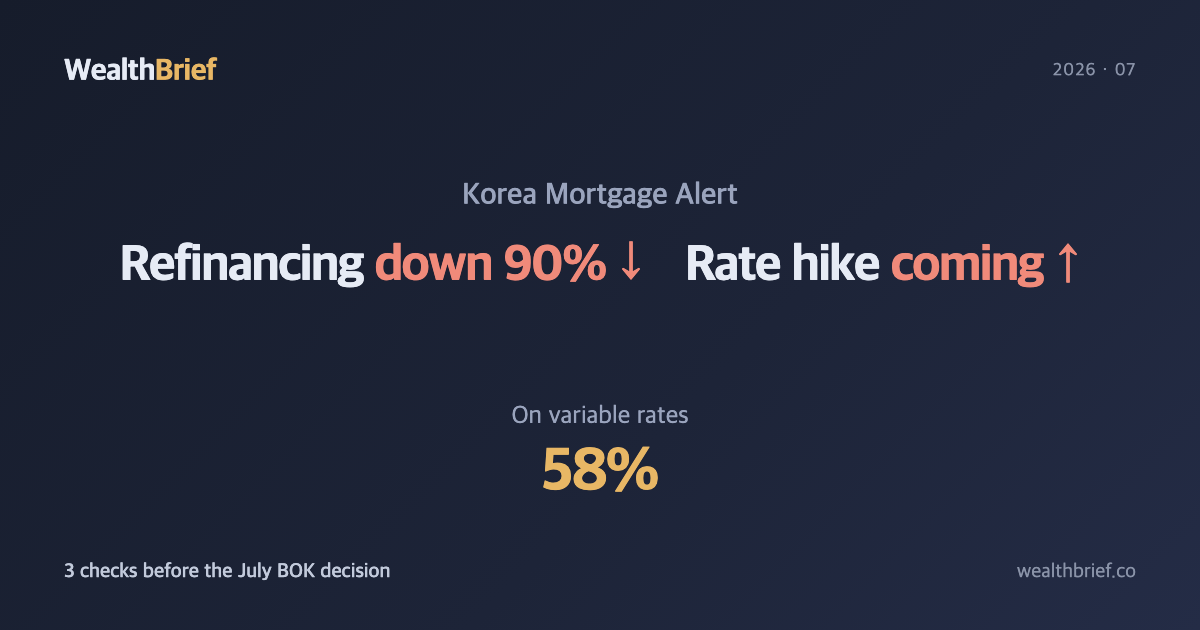
When it launched in 2023, the mortgage refinancing platform was hailed as a genuine win for borrowers — a digital marketplace where homeowners could switch to a cheaper loan in minutes. Three years later, transaction volumes have collapsed to roughly one-tenth of last year’s levels, according to a report by the Korea Economic Daily published July 2, 2026.
Two forces strangled it. First, as rate-hike expectations gathered steam, banks lifted their lending rates in advance, eliminating most of the spread that made switching worthwhile. Second, regulators tightened household credit limits, and banks responded by quietly restricting the product: Nonghyup Bank, for instance, suspended refinancing linked to mortgage credit insurance (MCI) for loans outside the Seoul metro area starting May 2026. The platform still exists. The deals mostly don’t.
The timing is particularly awkward, because July 2026 may be exactly when Korean borrowers most need an escape valve.
July Rate Hike: From Rumor to Near-Consensus
Woori Financial Research published a note on July 3, 2026 forecasting that the Bank of Korea (BOK) will raise its benchmark rate at the July Monetary Policy Committee meeting — from the current 3.00% to 3.25%. The same report projects further hikes ahead, with the terminal rate reaching around 3.5% by 2027.
The data supports the hawkish bias. Korea’s consumer price index rose 3.2% year-on-year in June 2026, the steepest gain in 30 months (Statistics Korea, July 1, 2026). The won averaged around ₩1,528 per dollar in June — a 28-year high in quarterly average terms. Both numbers push the BOK toward tightening.
A June 30 Bloomberg-style poll conducted by Yonhap Infomax among bond market professionals showed “July hike likely, upside rate pressure” as the dominant view. One counterargument: the U.S. June nonfarm payrolls miss (57,000 vs. ~150,000 expected) sent the dollar lower, which takes some pressure off the won. The BOK could theoretically hold. But most analysts aren’t betting on it.
The Variable-Rate Trap Taking Shape
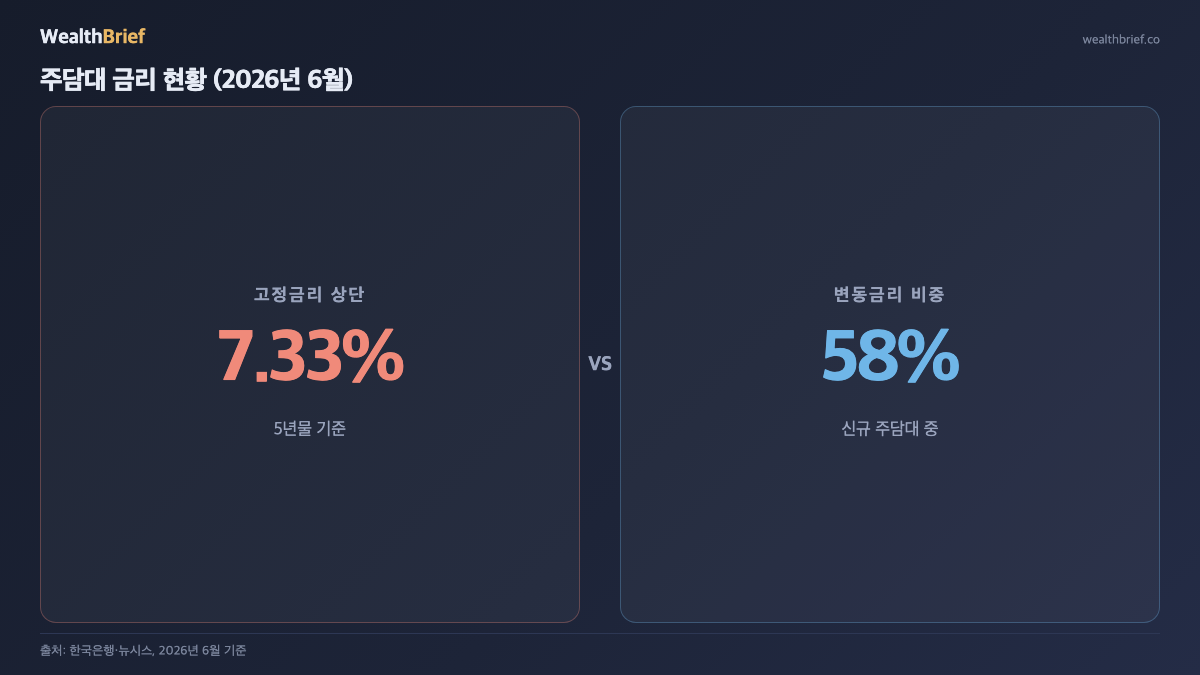
Here is the structural problem. With fixed-rate mortgages reaching 7.33% at the top end (Bank of Korea, June 2026), borrowers poured into variable-rate products: 58% of new mortgage originations are now on floating rates (Newsis, June 17, 2026).
Variable-rate mortgages in Korea are typically indexed to COFIX — the Cost of Funds Index published monthly by the Korea Federation of Banks. COFIX has risen for two consecutive months as of June 2026. When COFIX moves, variable-rate mortgage payments follow with a roughly three-month lag. If the BOK hikes in July, COFIX is likely to rise further.
The math is straightforward: borrowers who chose variable rates to escape today’s high fixed-rate environment may soon find the gap narrowing quickly — or disappearing.
| Metric | Current (June 2026) | Post-Hike Scenario |
|---|---|---|
| Fixed-rate mortgage ceiling | 7.33% | Further upside pressure |
| Variable-rate mortgages (COFIX-linked) | 5–6% range | Rise with ~3-month lag |
| COFIX trend | Two months rising | Likely to accelerate |
| Share of new mortgages on variable rate | 58% | Large exposed cohort |
Sources: Bank of Korea, Korea Federation of Banks, Newsis — June 2026
If Refinancing Is Blocked, What Options Remain?
The platform route is largely closed. That doesn’t mean borrowers have zero options — but the remaining paths require more legwork. The following is general information; individual circumstances vary, and consulting a financial advisor or your bank directly is advisable.
- Rate-capped variable products: Some banks offer hybrid structures with a ceiling on how high the variable rate can go. These exist, though they typically carry a premium spread at origination. Worth asking your bank about explicitly.
- Negotiating directly with your existing lender: Platform-based switching may be blocked, but going into the branch and requesting a rate review is still possible. Banks have some discretion in adjusting spreads for customers with strong credit profiles, salary transfers, or long-standing relationships. There is no legal right to a lower rate, but there is a negotiating opening.
- Policy mortgage programs: The Korea Housing Finance Corporation (HF) offers fixed-rate policy loans (e.g., Bogeumjari, Special Bogeumjari) with income and home-price caps. Eligibility requirements tightened in 2025–2026, so check current criteria at hf.go.kr before assuming you qualify.
- Partial prepayment to reduce exposure: If you have liquid savings and LTV headroom, paying down principal before the next rate reset reduces the variable-rate balance that gets repriced. Calculate the early-repayment fee first — it may offset the interest savings over short horizons.
Three Things to Check Before the July Decision
The BOK’s July Monetary Policy Committee meeting date should be confirmed via the Bank of Korea’s official website. Before the decision, consider:
- Your next rate reset date: Variable-rate mortgages typically reprice every three or six months using the most recent COFIX figure. Find this in your loan agreement or mobile banking app. Knowing when you’ll be repriced is the baseline.
- The cost of switching between fixed and variable: Some products impose fees or strip preferential rates when you convert. Ask your bank for the exact figure before deciding.
- Stress DSR Phase 3 implications: New rules that took effect July 2026 reduced the maximum loan amount for new mortgages in the Seoul metro area. If you’re considering any new borrowing or restructuring, this ceiling may be lower than you expect.
A rate hike doesn’t hit all borrowers the same way. Fixed-rate holders are insulated for now but face refinancing risk at maturity. Variable-rate holders — more than half of new mortgage borrowers — will feel it most directly. With the refinancing exit largely shut, the minimum useful step is knowing exactly how and when your own mortgage rate moves. That’s not complex analysis. It’s just your contract.
This article is for informational purposes only, based on publicly available news reports and financial institution data. It does not constitute investment or financial advice. For decisions specific to your situation, consult a qualified financial professional or your lender.
Leave a Reply