

Before You Switch: The Question That Matters Most
With South Korean mortgage rates hovering between 7% and 8%, the idea of refinancing to a lower-rate bank is hard to ignore. Since May 2023, the Financial Services Commission’s online one-stop loan transfer platform has made it easier than ever to compare rates across banks and move your mortgage without multiple branch visits. Yet plenty of borrowers who switch end up saving less than they expected — sometimes nothing at all.
The culprit is almost always the prepayment penalty (중도상환수수료, jungdo sangwhan susuryo). This guide walks through how to calculate it, what other costs add up, and how to decide whether switching actually makes sense for your situation.
How the Prepayment Penalty Works
Korean banks charge a prepayment penalty when a mortgage is paid off — in full or in part — within 36 months of origination. The standard formula is:
Penalty = Outstanding Balance × Fee Rate × (Remaining Months ÷ 36)
As of July 2026, typical prepayment penalty rates at major banks are as follows:
| Bank | Fixed Rate Loans | Variable Rate Loans | Fee Waiver |
|---|---|---|---|
| Kookmin (KB) | 1.2% | 0.7% | Zero after 36 months |
| Shinhan | 1.2% | 0.8% | Zero after 36 months |
| Hana | 1.2% | 0.7% | Zero after 36 months |
| Woori | 1.2% | 0.8% | Zero after 36 months |
| NH Nonghyup | 1.2% | 0.6% | Temporary waiver event (H1 2026) |
| KakaoBank | 1.2% | 0.6% | Extended waiver announced (H1 2026) |
Sources: Individual bank loan agreements and public disclosures, July 2026. Rates vary by product and are subject to change — verify with your bank before proceeding.
A Real-Numbers Example
Let’s make this concrete. Suppose you have:
- Remaining balance: KRW 290 million (original KRW 300M, 30-year term, 18 months in)
- Current rate: 7.5% variable (COFIX-linked)
- Target rate at new bank: 6.8% fixed (5-year)
- Prepayment penalty rate: 0.7% (variable loan)
- Months elapsed: 18 of 36
Step 1 — Penalty cost:
KRW 290M × 0.7% × (18 ÷ 36) = approx. KRW 1.015 million
Step 2 — Monthly interest saved:
Rate difference = 0.7 percentage points
KRW 290M × 0.007 ÷ 12 = approx. KRW 169,000/month
Step 3 — Break-even point:
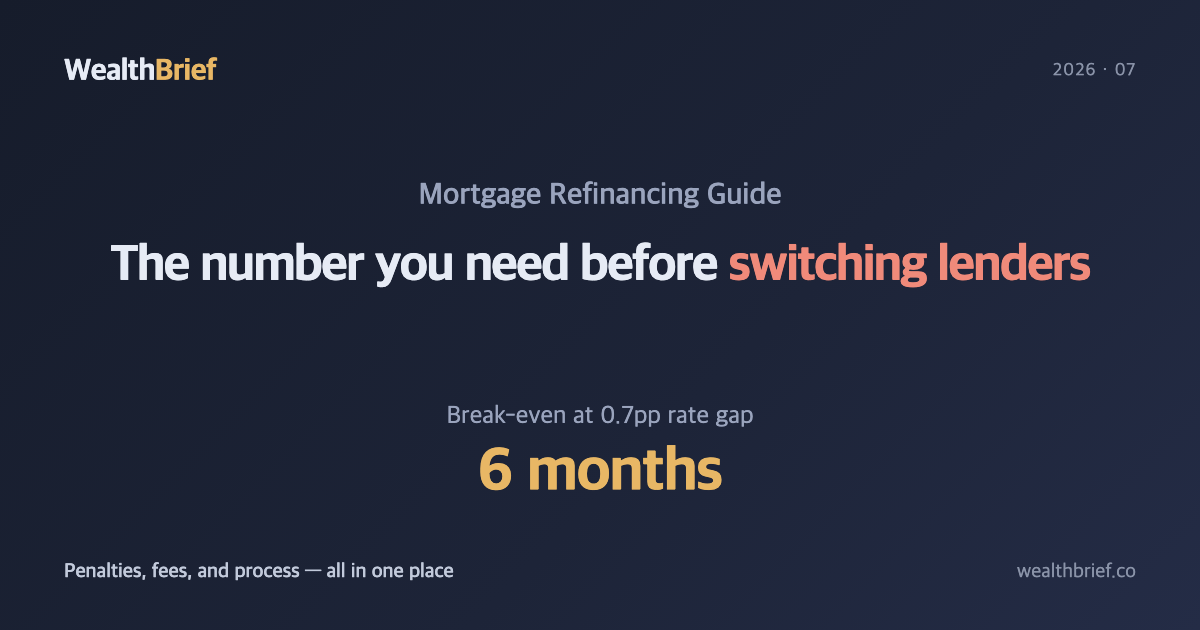
KRW 1,015,000 ÷ KRW 169,000 ≈ ~6 months
After six months, every month of the new loan puts KRW 169,000 back in your pocket. Over a full 5-year fixed term (60 months), that’s roughly KRW 10.1 million in gross savings — minus the penalty and transfer costs, a net gain of around KRW 8–9 million.
Flip the scenario to a 0.3 percentage-point gap and the break-even stretches to roughly 14 months. If you plan to sell or relocate within a year or two, the math rarely works in your favor.
The Online Transfer Platform: How It Works
The FSC’s one-stop service lets you compare offers from multiple banks in a single app session. As of July 2026, participating platforms include KakaoPay, Naver Financial, Toss, BankSalad, and Finda, covering most major commercial banks and the internet-only banks.
One important caveat for mid-2026: several major banks, including KB Kookmin and Woori, have temporarily suspended or capped new mortgage refinancing applications amid government household debt curbs (Korea Economic Daily, Newsis — July 2026). Always check whether your target bank is currently accepting applications before submitting a formal request.
General process (online platform route):
- Open the platform app — KakaoPay, Toss, BankSalad, etc.
- Authorize data pull — Consent to financial data sharing; current balance and rate are retrieved automatically.
- Compare offers — Banks display indicative rates side by side. Note: these are pre-screening estimates, not final approvals.
- Apply to a new bank — A formal credit inquiry is made at this point.
- Approval and fund transfer — The new bank pays off the old lender directly; you submit additional documents (e.g., property ownership certificate).
- Re-register mortgage lien — The collateral property’s registered mortgage holder changes, triggering legal registration costs.
Hidden Costs That Can Eat Your Savings
Beyond the prepayment penalty, three more costs deserve a line in your spreadsheet:
- Mortgage lien transfer fees: Canceling the old bank’s lien and registering the new one requires a court registration procedure, typically handled by a judicial scrivener (법무사). Total cost including government fees: roughly KRW 300,000–700,000, scaling with loan size.
- Documentary stamp tax (인지세): KRW 70,000 for loans between KRW 50M and KRW 100M; KRW 150,000 for KRW 100M–1 billion. Normally split 50/50 between borrower and bank.
- Fire insurance: Some banks require a new policy through their designated insurer. Check for overlap with an existing policy.
Who Should Switch — and Who Should Wait
| Factor | Favorable for Switching | Reason to Wait |
|---|---|---|
| Time since origination | 36+ months → no penalty | Under 12 months → maximum penalty |
| Rate gap | 0.5 percentage points or more | 0.2–0.3 pp → side costs eat the gain |
| Residency horizon | Plan to stay 5+ years | Likely to sell within 1–2 years |
| Loan type | Variable → fixed shift reduces rate risk | Already on a low locked-in fixed rate |
One more thing to check: if your current loan is a government-backed mortgage — Bogeumjari, Dirim, or a similar policy product — switching to a commercial bank loan permanently forfeits those preferential terms. Even if the commercial bank’s rate looks cheaper today, the long-term benefit of a subsidized policy loan can outweigh a short-term rate advantage.
Five-Minute Pre-Application Checklist
- When was your loan originated? (Has the 36-month clock expired?)
- What is your current outstanding balance?
- What is the indicative rate at the new bank? (Check platforms — this is an estimate until formal approval.)
- What are total side costs: lien transfer fee + stamp tax + any insurance?
- What is your break-even point in months?
If the break-even is under 12 months and you plan to stay in the property, refinancing is almost certainly worth it. If it stretches past 24 months, recalculate after your prepayment penalty period expires — at that point, the decision becomes much cleaner.
This article is for informational purposes only and does not constitute financial advice or a recommendation to any specific product. Rates, fees, and regulations are subject to change. Always verify current terms with your bank and consult the Financial Supervisory Service consumer portal at fine.fss.or.kr for the latest guidance.
Leave a Reply