

Your credit score is about to be judged by new rules. In 2025 and 2026, the US mortgage and lending industry is going through its biggest credit-scoring shake-up in decades — VantageScore 5.0 launched in July 2026, and the Federal Housing Finance Agency (FHFA) has mandated that Fannie Mae and Freddie Mac accept two competing score models simultaneously. If you’re planning to buy a home, refinance, or simply want to get the best rate on a credit card, here’s what the changes actually mean for you.
What’s Changing: Two Models, One Mortgage Application
For nearly 30 years, the FICO Classic score dominated mortgage lending. That’s now ending.
The FHFA has directed Fannie Mae and Freddie Mac — which together back roughly half of all new US mortgages — to accept both FICO 10T and VantageScore 4.0 on loans they purchase. This “bi-merge” requirement means lenders now pull scores from all three bureaus under both models and submit them alongside each loan application.
Then, in July 2026, VantageScore went further and launched VantageScore 5.0 — a next-generation model trained on post-pandemic data that aims to score more Americans, including those with thin credit files (per VantageScore, July 2026).
| Score Model | Score Range | Used For | Key Difference |
|---|---|---|---|
| FICO Classic (8 / 9) | 300–850 | Most credit cards, auto loans, legacy mortgages | Ignores medical debt; does not score thin-file consumers |
| FICO 10T | 300–850 | New Fannie/Freddie mortgage submissions (2025–26) | Uses “trended data” — tracks whether balances are rising or falling over 24 months |
| VantageScore 4.0 | 300–850 | New Fannie/Freddie mortgage submissions (2025–26) | Scores thin-file and credit-invisible consumers; weighs medical debt less heavily |
| VantageScore 5.0 | 300–850 | Consumer products, some lenders (launched July 2026) | Trained on post-pandemic data; cross-bureau consistency improved; product-specific inputs |
Why This Matters for Real Borrowers
The score shift isn’t just a technicality. It has direct cash consequences.
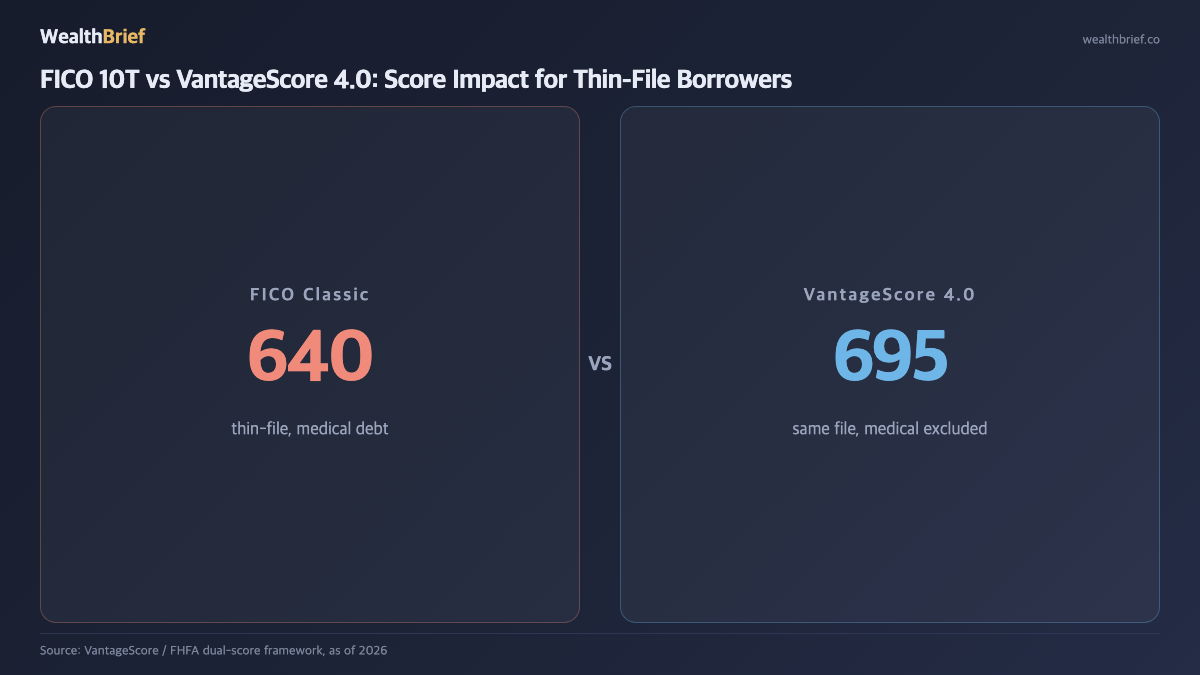
Scenario: You’re applying for a $400,000 mortgage. Under Classic FICO, your score is 680 (fair). Under VantageScore 4.0, the same credit file scores 695 because VS 4.0 ignores certain medical collections and credits your on-time rent payments (if your landlord reports). That 15-point gap can mean the difference between a 7.0% and a 6.6% rate — roughly $96 per month, or $34,560 over 30 years on a standard amortization.
FICO 10T’s “trended data” feature works the other way. If your balances are creeping up month after month, FICO 10T sees that trend and may score you lower than Classic FICO would — even if your current utilization looks fine. Borrowers who carry revolving balances need to be especially aware of this.
How FICO and VantageScore Calculate Your Score
Both models sit on the same foundation — your credit report data from Equifax, Experian, and TransUnion. The weights differ, but the core factors overlap significantly.
| Factor | FICO Weight (approx.) | VantageScore Weight | What to Do |
|---|---|---|---|
| Payment history | 35% | “Extremely influential” | Never miss a due date — even one 30-day late can drop your score 50–100 points |
| Credit utilization (amounts owed) | 30% | “Highly influential” | Keep reported utilization under 30%; under 10% to maximise points |
| Length of credit history | 15% | “Less influential” | Avoid closing old accounts — they anchor your average account age |
| New credit / hard inquiries | 10% | “Less influential” | Rate-shop mortgages/auto loans within a 45-day window (counts as one inquiry) |
| Credit mix | 10% | “Less influential” | Having both revolving (card) and installment (loan) accounts helps slightly |
Source: myfico.com; CFPB; VantageScore model disclosures, as of 2026.
Six Practical Steps to Improve Your Score in 2026
The model change doesn’t replace the fundamentals — it adds nuance on top of them. These six steps work regardless of which score your lender pulls.
- Pull your free reports first. Visit AnnualCreditReport.com (the only federally authorized source) to get free weekly reports from all three bureaus. Errors are more common than people think — a 2021 FTC study found 1 in 5 Americans had a material error. Dispute anything inaccurate directly with the bureau; they must investigate within 30 days under the FCRA.
- Pay before your statement closes, not just by the due date. Credit cards report your balance to the bureaus on the statement close date, not the payment due date. Pay down balances before the statement closes and your reported utilization drops immediately — typically reflected in your score within 30–45 days.
- Target under 10% utilization on each card. The 30% “rule” is a floor, not a target. Scoring models reward lower utilization, and per-card utilization matters as much as total utilization. If you have a $5,000 limit card, keeping the reported balance under $500 is the goal.
- Watch your balance trend, not just your balance. FICO 10T looks back 24 months. If you’re carrying $3,000 one month, $3,800 the next, and $4,500 the next, that upward trend gets flagged — even if your utilization ratio is still under 30%. Flatten or reduce balances in the 12–24 months before a major loan application.
- Add yourself as an authorized user on a long-standing account. A family member’s old, well-managed credit card can be added to your file as an authorized user. The entire history — length, limit, payment record — shows up on your report. Under both FICO and VantageScore this can meaningfully raise a thin-file score.
- Don’t close cards you’re not using. Closing a card cuts your available credit limit, which instantly raises your utilization ratio — a double hit. It also shortens your average account age over time. Unless there’s an annual fee you can’t justify, keep old cards open and use them occasionally.
Worked Example: From 640 to 720 in 12 Months
Let’s say your starting position in January 2026 is a 640 FICO score:
- Two credit cards with a combined limit of $6,000; balances of $4,200 (70% utilization)
- One 30-day late payment from 2024
- No instalment loan (thin credit mix)
- Three years of credit history
Month 1–3: Pay down balances to $1,500 total (25% utilization). Pull free reports, dispute one inaccurate collection that turns out to belong to someone else. Score jumps ~40 points from utilization reduction alone; another ~15 from the removal.
Month 4–6: Set up autopay on all cards to catch every due date. Add yourself as an authorised user on your partner’s seven-year-old card with a $10,000 limit and clean history. Combined credit limit on your file is now $16,000; $1,500 balance = 9.4% utilization. Another ~25-point improvement likely.
Month 7–12: Take out a small credit-builder loan ($500–$1,000) through a credit union. This adds an installment account to your mix with no hard pull at some institutions. The 30-day late from 2024 continues to age and carry less weight with each passing month.
Estimated result: 720–730 range after 12 months — moving from “Fair” to “Good” on the FICO scale, which is roughly the threshold where most prime mortgage and card rates kick in.
What the New Dual-Score System Means If You’re Buying a Home Soon
Under the new FHFA framework, your lender will report both your FICO 10T and VantageScore 4.0 scores from each of the three bureaus — six scores in total. The middle score from each model, from the middle bureau, is then used in the underwriting decision.
What this means practically:
- If VantageScore 4.0 is higher than your Classic FICO, ask your lender whether they’re already using the new system. Some lenders adopted it in mid-2025; others are still transitioning.
- Your score gap between models tells you where to focus. A big difference usually means medical debt or thin-file factors — areas where VantageScore 4.0 is more lenient.
- FICO 10T’s trended data penalises rising balances. If you’re 12–18 months out from a home purchase, get your revolving balances on a clear downward trajectory now.
- Don’t rate-shop across dozens of lenders: under both models, multiple hard inquiries for the same loan type within 45 days count as one inquiry.
In 3 Lines
- The US mortgage market now uses two competing score models (FICO 10T and VantageScore 4.0) simultaneously — the biggest change to credit scoring in a generation, per FHFA’s 2025 directive to Fannie Mae and Freddie Mac.
- FICO 10T penalises rising balance trends over 24 months; VantageScore 4.0 scores thin-file consumers more generously and weighs medical debt less — knowing which favours you can save thousands on a mortgage rate.
- The fundamentals haven’t changed: pay on time, keep utilisation under 10% per card, watch your balance trend, and start with a free report from AnnualCreditReport.com.
Related guides: Capital Gains Tax 2026: Brackets, Rates, and How to Cut Your Bill · 401(k) Contribution Limits 2026: Max Out Your $24,500
For information only, not financial advice. Credit scoring models, weightings, and lender requirements change — confirm current rules at myfico.com, vantagescore.com, CFPB (consumerfinance.gov), and your specific lender before making any borrowing decision. FHFA guidance as of 2025–2026; VantageScore 5.0 details per VantageScore, July 2026.
Leave a Reply