
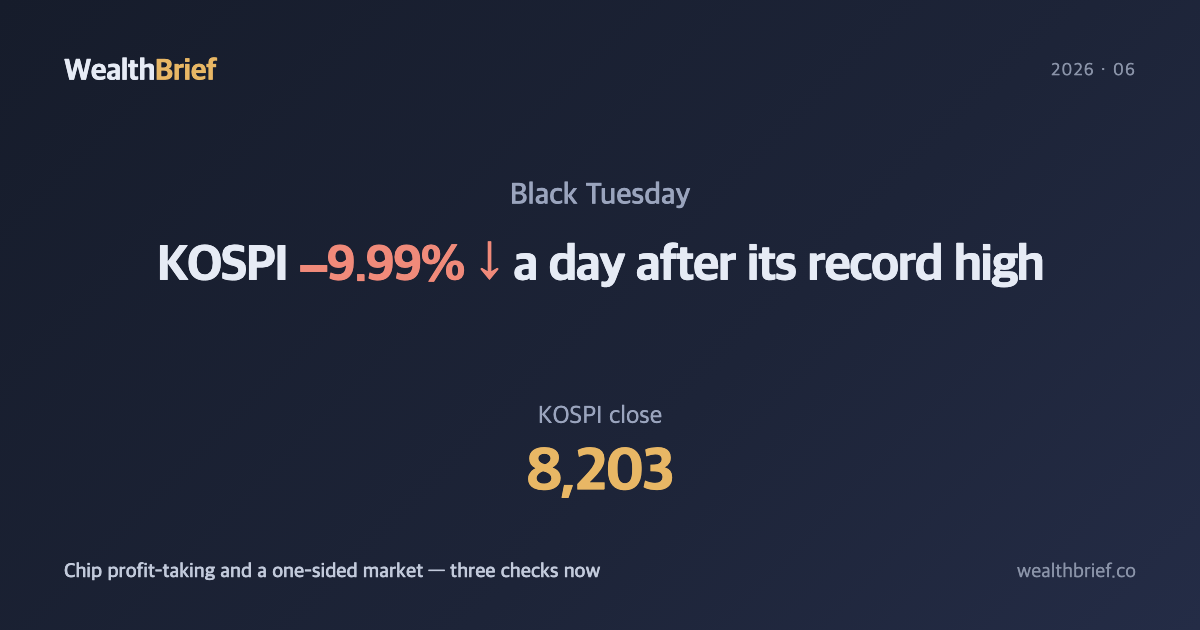
On June 23, 2026, the KOSPI fell 9.99% in a single session. Roughly 910 points vanished, leaving the index at 8,203 (Yonhap/SBS, June 23 close). The collapse came one day after the index set an all-time high of 9,114.55 on June 22 (Infostock Daily, June 22). Record high one day, “Black Tuesday” the next.
The KOSDAQ dropped 7.94% (Yonhap, June 23). Intraday, a sell-side sidecar gave way to a full circuit breaker—the fourth halt of the year (Yonhap Infomax, June 23). Yet the cause, stripped to one line, is surprisingly plain. This was not a macro shock. It was the day the very names that had carried the rally turned around.
What Happened — The Day in Numbers
A circuit breaker halts all trading when the index drops past a set threshold; a sidecar freezes program-trading orders for five minutes when futures swing sharply. Both are brakes. On this day, the brakes engaged and the car kept sliding.
- KOSPI close: 8,203, down 9.99% (about 910 points)—among the five worst single-day drops on record (KBS, June 23)
- KOSDAQ: −7.94% (Yonhap, June 23)
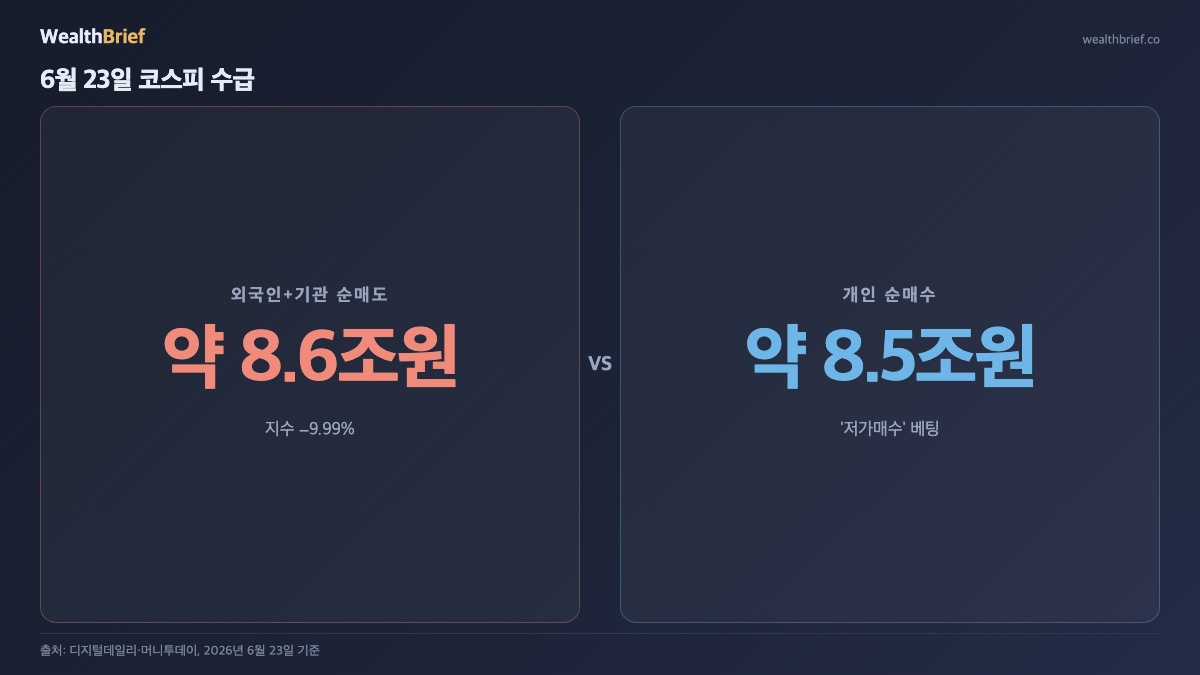
- Combined net selling by foreigners and institutions: roughly 8.6 trillion won (Digital Daily, June 23)
- Net buying by retail investors: around 8.5 trillion won—estimates ranged from 8 to 11 trillion depending on the source (Money Today/Herald, June 23)
- Samsung Electronics and SK hynix: down roughly 12% intraday (Seoul Finance, June 23)
Why It Fell — The Paradox of a Chip-Led Market
The engine that had pushed the KOSPI above 9,000 was, in practice, two stocks: Samsung Electronics and SK hynix. On June 22, SK hynix hit a record and was reported to have briefly passed Samsung in market value (The Report, June 22). While the index printed all-time highs, strip out those two chipmakers and the rally felt far thinner than the headline suggested.
The trouble is that the same arithmetic runs in reverse. When the lift comes from one corner, the index sinks the moment that corner cools. On June 23, Micron—reporting earnings the next day—fell nearly 13% in U.S. trading, and the Philadelphia Semiconductor Index dropped 7.87% (News1/Daum, June 23). With expectations for the AI memory boom running hot, traders rushed to bank profits before the numbers arrived. Many local analysts read the day not as a macro blow but as an unwinding of short-term froth and chip profit-taking (Yonhap Infomax/Nate, June 23).
Foreigners Sold, Retail Bought — One Market, Two Bets
The most striking feature of the session was the flow. As foreign and institutional investors dumped more than 8 trillion won, retail investors absorbed a comparable amount, treating the drop as a buying opportunity. There is a caveat. If this proves a brief correction, the retail bet pays off; if the trend has actually broken, those buyers have merely lowered their average price while the loss deepens. One analysis warned that aggressive dip-buying could turn painful in a prolonged decline (NewDaily, June 23).
There is one statistic worth noting. In 8 of the 10 most severe single-day KOSPI drops on record, the index rose the following day (News1, June 23). But that describes a next-day technical bounce, not a recovery of the trend. A rebound and a turn are not the same thing.
What to Check Now — Neither Panic Nor Euphoria
On days like this, retail investors tend to err at the extremes: dumping at the bottom in fear, or borrowing to buy more in excitement. Both are decisions hostage to a single day’s volatility. Three calm checks cut the impulse down.
- Is your book overweight chips? The drop was, at its core, the unwinding of a sector concentration. If Samsung, SK hynix, and semiconductor ETFs dominate your holdings, your account can swing harder than the index.
- Are you using leverage or margin? Positions bought on borrowed money face forced liquidation in a sharp selloff. The more volatile the tape, the more urgent it is to check margin first.
- Mind the Micron variable. Micron’s June 24 earnings are widely cited as a directional cue for sentiment around Samsung and SK hynix (Business Post, June 23). Until the result is in, betting heavily one way is the riskier path.
For context, the won traded in the 1,540-per-dollar range on June 23. A weak won and foreign selling tend to feed on each other, which makes it hard to read the equity market in isolation.
A 10% drop in a day is a genuinely jarring number. But the size of the shock and the right response are not proportional. The fact that the crash arrived the day after a record high is itself the lesson: it shows how much this market had climbed on a single, concentrated bet. Rather than rushing to an answer, start by asking which side of that concentration your portfolio sits on.
Related
- Korea’s Dual Market Sidecar — What Triggered It
- KOSPI at 9,000 but Your Account Is Flat? The ‘Half Rally’
This article is for informational purposes only and is not investment advice. Figures cited reflect the time and source of reporting and may vary by data provider and date. Investment decisions and their outcomes are the responsibility of the individual investor.
Leave a Reply