
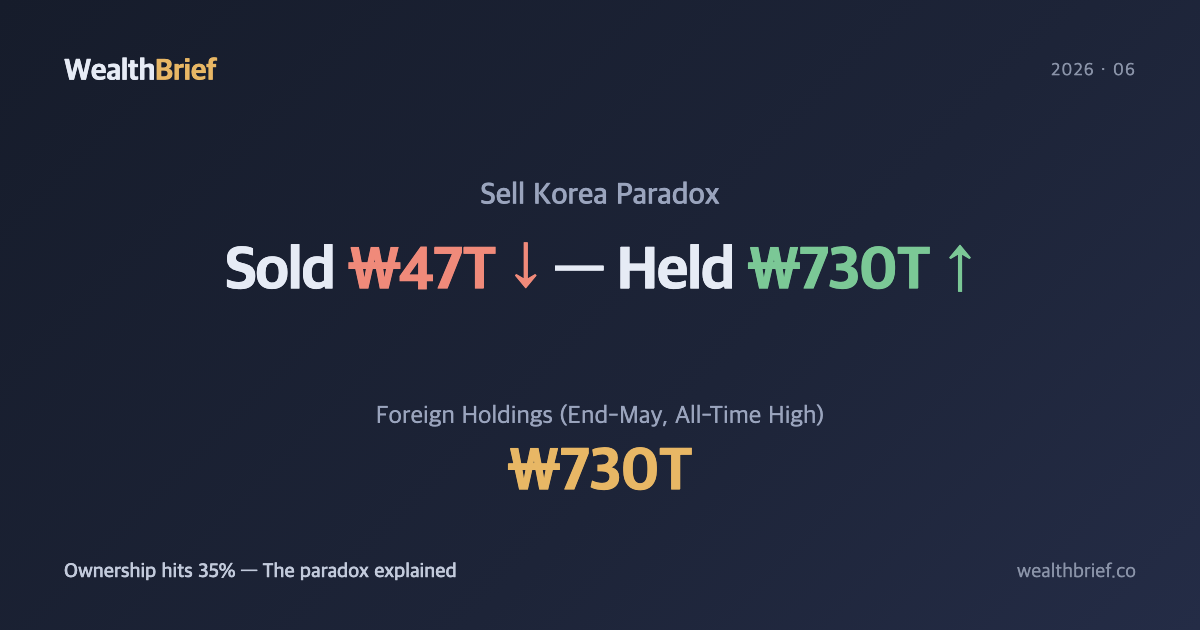
Sold ₩47 Trillion, Gained ₩730 Trillion
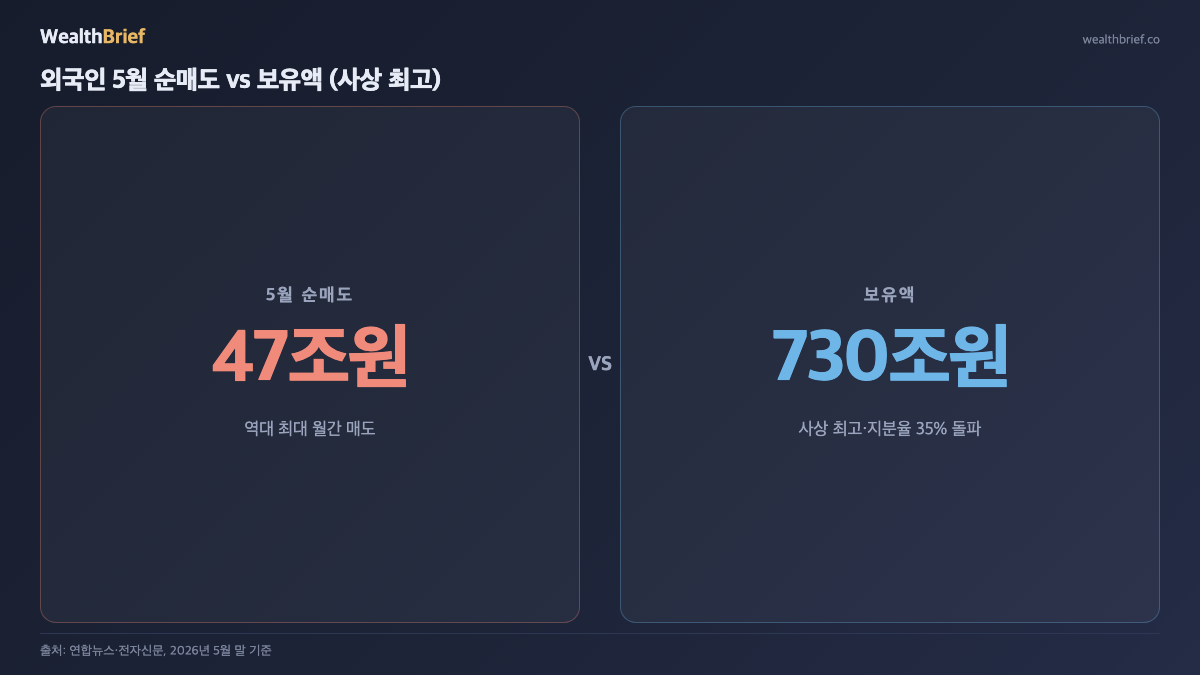
The numbers defy instinct. In May alone, foreign investors net sold ₩47 trillion worth of Korean equities — the largest monthly net sale on record. Running the clock back to January, five consecutive months of selling add up to more than ₩100 trillion in net outflows (Digital Today, June 26, 2026). Yet as of end-May, foreign holdings of Korean stocks stood at approximately ₩730 trillion — an all-time high. Their ownership share crossed 35% for the first time ever (Yonhap, June 25, 2026).
They sold. They ended up with more. So what is going on?
The Arithmetic Behind the Paradox
There is a straightforward explanation: the stocks foreigners kept rose faster than the cash they took out. KOSPI climbed from the 6,000s at the start of the year to near 9,000 by late June — a gain of well over 40%. Even if you sell ₩47 trillion in May, the remaining positions can appreciate by a far larger amount. The value of what you hold, not what you sell, drives the total.
This is sometimes called the price effect: a portfolio can shrink in share count yet grow in total value when unit prices rise. That is precisely what happened here. Foreign aggregate holdings hit a record high while the transaction tally said “seller.”
What “Sell Korea” Often Gets Wrong
When headlines declare foreigners are dumping Korean shares, most readers picture three things simultaneously: loss of confidence in Korea, capital flight, and falling prices. That template does not always hold.
At least three other explanations fit this episode better. First, profit-taking. After a 40%-plus rally, locking in gains is rational portfolio management, not a vote against the market. Second, global rebalancing. If Korean equities appreciate sharply, they grow beyond their target weight in a global portfolio; a disciplined institutional investor has to trim — not because Korea looks bad, but because Korea grew too large. Third, currency hedging. With the won sitting in the ₩1,530–1,550 per dollar range (Yonhap TV, late June 2026), some foreign funds may reduce won-denominated exposure to protect dollar-denominated returns.
None of this means every selling order was benign. Some portion almost certainly reflects genuine skepticism about Korea. The point is that the single-variable reading — “foreign selling = bearish signal” — was demonstrably wrong in outcome over the past five months.
Three Things to Watch as a Korean Investor
- What a 35% ownership share actually implies: Foreigners now own more than a third of the Korean equity market by value. That concentration cuts both ways. A coordinated exit would be destabilizing; but the fact that they hold this much while still selling suggests they have not written off the market.
- Managing equities alongside currency: The won’s weakness — hovering at levels last seen during the 1997–98 currency crisis — is a meaningful drag on dollar-equivalent returns. If your portfolio is purely domestic Korean equities, the exchange rate deserves a separate line in your risk assessment.
- Who is absorbing the foreign supply: Foreign selling has been more than offset by domestic demand — retail and institutional. The sustainability of that domestic bid depends on whether earnings growth and policy support hold up. The Bank of Korea has recently signaled a possible rate hike (Newspim, June 25, 2026), and rising rates typically compress equity valuations.
Key Numbers at a Glance
| Item | Figure | Source / Date |
|---|---|---|
| May foreign net sales | ₩47 trillion (record monthly high) | Yonhap, June 25, 2026 |
| Jan–May cumulative net sales | Over ₩100 trillion | Digital Today, June 26, 2026 |
| Foreign equity holdings (end-May) | ~₩730 trillion (all-time high) | Electronic Times, June 25, 2026 |
| Foreign ownership share | Above 35% (all-time high) | Daily Good News, June 26, 2026 |
| KRW/USD rate (late June) | ₩1,530–1,550 | Yonhap TV, June 27, 2026 |
The Question That Remains
Foreigners ended May with more Korean equity wealth than they had in January — despite selling throughout — because the market outran their outflows. Whether that continues depends on two things arriving together: earnings season in July, and the Bank of Korea’s next policy move. Rate hikes, now openly discussed, put downward pressure on valuations. If the market has priced in too much optimism and earnings disappoint, the price effect that saved foreign balance sheets this spring could quickly reverse.
Headline-level foreign selling data tells you what happened, not why, and not what comes next. Pair it with the price trend, the ownership share, and who is buying what foreigners sell — that is where the signal sits.
This article is for informational purposes only and does not constitute investment advice. All investment decisions should be made at your own discretion and risk.
Leave a Reply