

The Short Version: What’s Actually Changing
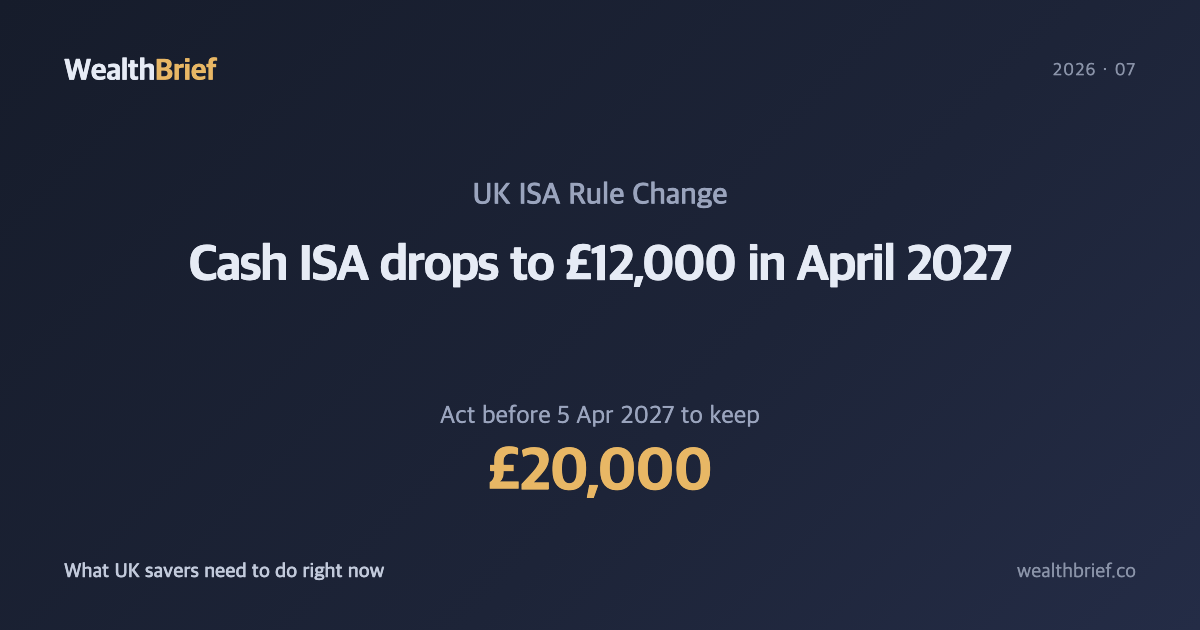
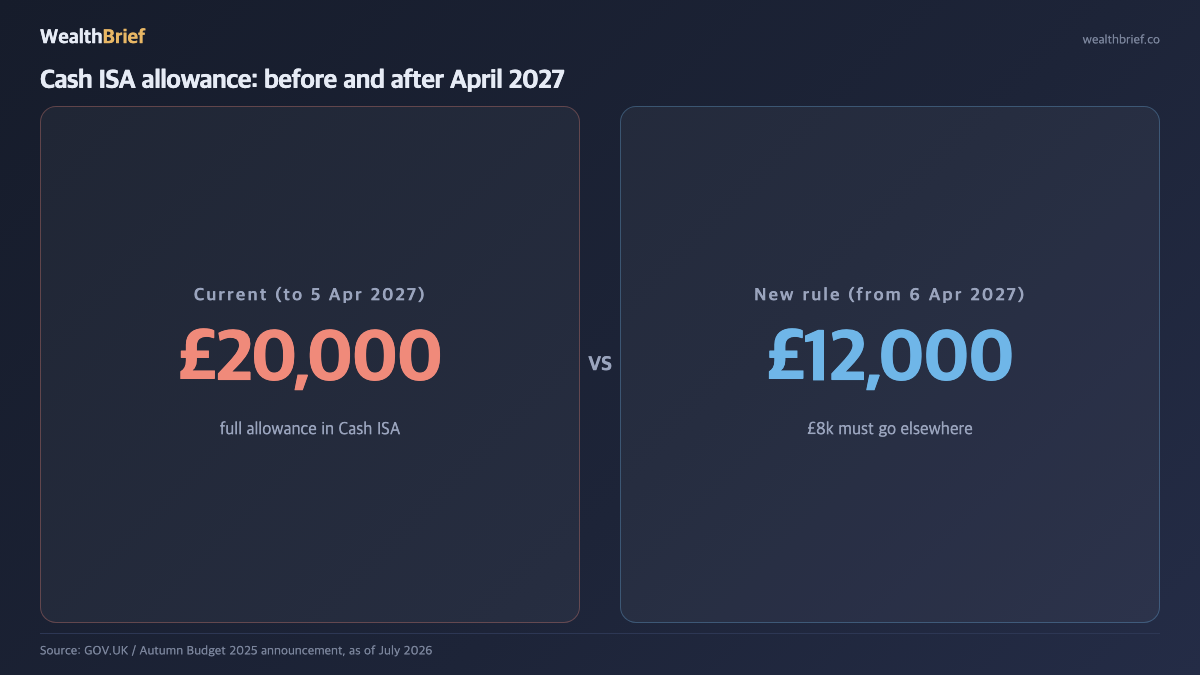
From 6 April 2027, the UK government is cutting the Cash ISA annual allowance from £20,000 to £12,000. The overall ISA allowance stays at £20,000 — but from that date, at least £8,000 of whatever you save will need to go into a non-cash wrapper (a Stocks and Shares ISA or an Innovative Finance ISA) if you want to use your full tax-free entitlement.
This was announced at the Autumn Budget 2025 by the Chancellor and confirmed by HMRC in their ISA Reform 2027: anti-circumvention rules factsheet, published on GOV.UK. The rules for the 2026/27 tax year (which runs until 5 April 2027) are unchanged: you can still put up to £20,000 into a Cash ISA right now. That window closes on 5 April 2027.
Alongside the allowance cut, HMRC is also introducing a 22% withholding charge on interest earned on cash held inside Stocks and Shares ISAs from April 2027. That second rule is designed to stop savers from simply “parking” cash inside investment accounts to get around the new Cash ISA limit. Money market funds held within S&S ISAs are reportedly spared from the charge — but straightforward cash deposits or cash deposits earning interest will not be.
Why the Government Is Doing This
The stated rationale is to nudge British savers toward investing in stocks and shares — particularly UK-listed equities — rather than leaving money in low-risk cash savings accounts. The Treasury’s argument is that too much of the country’s household savings is sitting in cash, doing little for long-term wealth building or the UK economy.
Whether you agree with that logic or not, the practical effect for anyone who currently maximises their Cash ISA is significant. Under the new rules, a saver putting £20,000 into a Cash ISA every April will only be allowed to put £12,000 there. The remaining £8,000 will have to go somewhere else — either a Stocks and Shares ISA (which carries investment risk), an Innovative Finance ISA (which lends to businesses), or be left outside a tax-free wrapper entirely.
Critics, including some MPs and consumer groups, have argued the change punishes cautious savers and lower-income households who rely on guaranteed, accessible cash savings. The political debate was still live as of July 2026.
Who Is Affected — and Who Might Be Exempt
The £12,000 Cash ISA cap applies to most savers under 65. However, news reports in June and July 2026 (including coverage by Birmingham Live and MSN) suggest that state pensioners born before 1962 may face different or exempted rules, as the government has signalled that older savers — who are more likely to depend on accessible, low-risk savings — will have some form of protection. HMRC has not yet published full implementation guidance on this age-based exemption as of July 2026. If you are over 65 or close to state pension age, check GOV.UK or speak to a financial adviser before assuming the limit applies to you.
Accounts unaffected by the Cash ISA cap change:
- Stocks and Shares ISA — allowance stays at £20,000 (subject to the 22% cash-interest charge if you park cash inside one)
- Lifetime ISA (LISA) — contribution limit stays at £4,000 per year for eligible savers (ages 18–39 to open; up to age 50 to contribute), and counts towards the overall £20,000 ISA allowance
- Junior ISA — separate allowance, currently £9,000 per year (2026/27 tax year, per HMRC); not affected by the adult ISA changes
- Innovative Finance ISA — unchanged limit of £20,000 (shared with the overall allowance)
What the Numbers Look Like: A Worked Example
Say you’re 40, employed, and you’ve been saving £1,500 a month — roughly the amount needed to max out your ISA — into a Cash ISA every year. Here’s how the change plays out:
| Tax year | Max Cash ISA contribution | Overall ISA allowance | What changes |
|---|---|---|---|
| 2026/27 (now → 5 Apr 2027) | £20,000 | £20,000 | Nothing yet — use this window |
| 2027/28 (from 6 Apr 2027) | £12,000 | £20,000 | £8,000 must go elsewhere |
If you want to use your full £20,000 allowance in 2027/28, you would put £12,000 into a Cash ISA and £8,000 into a Stocks and Shares ISA. You’d still shelter the full £20,000 from income tax and capital gains tax — but £8,000 of it would be exposed to stock market risk, rather than sitting in a guaranteed-rate cash account.
Interest rates as context: Cash ISA rates reached as high as 4.70% APY in July 2026, per Moneyfacts data published ahead of the 2027 allowance cut. The best easy-access Cash ISA rates as of July 2026 were around 4.25%–4.70% (sources: Moneyfacts, Moneysavingexpert; rates change daily, so check current comparators before choosing an account).
The 22% Cash-in-Investment-ISA Charge: What It Means Practically
This is the less-discussed but important second rule. From April 2027, if you hold cash deposits earning interest inside a Stocks and Shares ISA, HMRC will apply a 22% withholding charge on that interest. The charge is designed to make it unattractive to simply shift your cash savings into an S&S ISA wrapper to avoid the £12,000 cap.
The nuance: money market funds — which pool short-term lending to governments and large corporations — are not subject to the charge, per reporting by Interactive Investor in June 2026. So savers who want a low-risk, cash-like option inside an S&S ISA can still use money market funds without penalty. This is a meaningful distinction for cautious investors who don’t want full stock-market exposure but need somewhere to put that forced £8,000.
As a rough illustration: if you earned £400 in interest on £10,000 of cash sitting in an S&S ISA, the 22% charge would take £88 of that. That’s not trivial — and it would effectively reduce your net return on that cash. Switching to a money market fund with similar characteristics would avoid the charge entirely (confirm tax treatment at the time of investing; rules could change).
Five Things to Do Before 5 April 2027
- Top up your Cash ISA now if you have remaining 2026/27 allowance. The £20,000 Cash ISA limit for the current tax year runs until 5 April 2027. Money you put in before that date is locked in at the old, more generous limit — existing balances are not affected by the cap change.
- Open a Cash ISA if you haven’t got one. There is a surge in account openings reported ahead of April 2027 (multiple UK banks confirmed this in June–July 2026 press coverage). Don’t wait — providers can close accounts to new applicants when oversubscribed, and there may be rate changes as we approach the new tax year.
- Compare Cash ISA rates now. With the allowance cut confirmed, providers may adjust rates. Use FCA-regulated comparison sites (MoneySavingExpert, Moneyfacts, Which?) to find the best current rate. Fix for 1–2 years only if you might need access — fixed-rate ISAs lock your money in.
- Think about where your £8,000 “overflow” will go from April 2027. Your options are: a Stocks and Shares ISA (investment risk, but tax-free growth), an Innovative Finance ISA (loans to businesses — not FSCS-protected), or simply a regular savings account (interest taxable above your Personal Savings Allowance). Money market funds inside an S&S ISA are a middle-ground option if you want low volatility.
- If you’re over 65 or approaching retirement, hold fire until HMRC publishes full guidance. The age exemption has been trailed in government briefings but was not fully legislated as of July 2026. GOV.UK (gov.uk/individual-savings-accounts) is the authoritative source. Do not rely on press summaries for final decisions — check the legislation or speak to a regulated financial adviser.
For information only; this is not financial advice. ISA rules, allowances, and tax treatments can change — always confirm the current position at GOV.UK/individual-savings-accounts or with a financial adviser regulated by the FCA (fca.org.uk). The information above reflects publicly available government and press sources as of July 2026 and may not reflect subsequent legislative changes.
Leave a Reply