
What happened
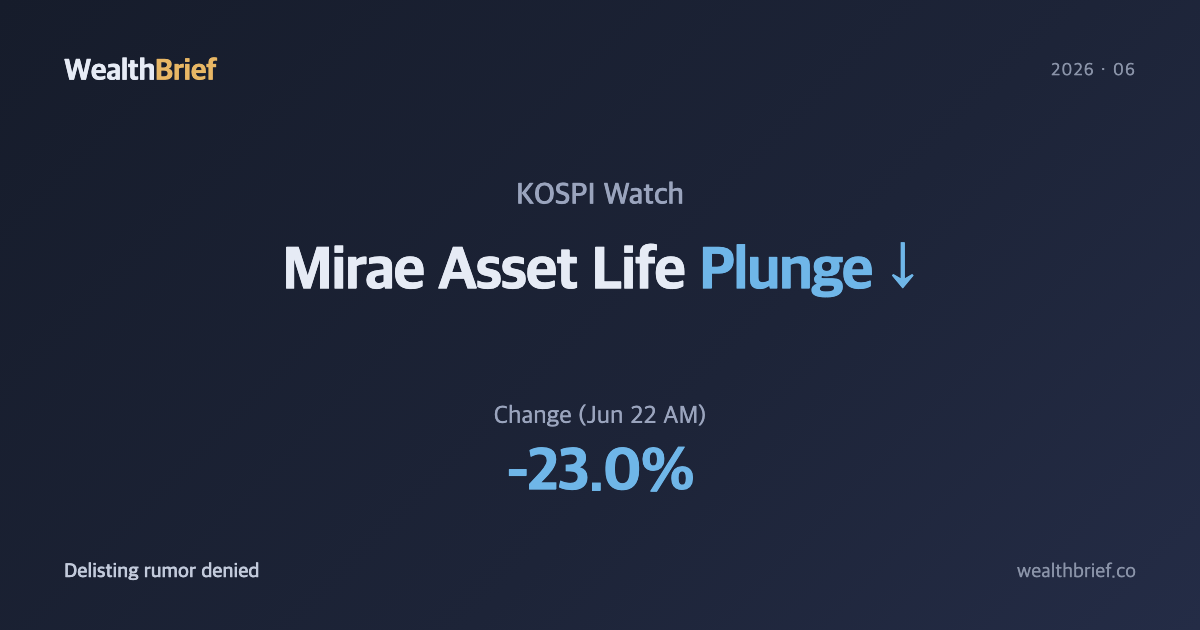
As of the morning of June 22, 2026, KOSPI-listed insurer Mirae Asset Life Insurance (085620) tumbled roughly -23% from the prior session, ranking among the KOSPI’s biggest decliners. Trading volume reached about 400,000 shares — a heavy turnover for an insurance stock that is not usually actively traded. Because the stock had surged sharply over the previous month, the day’s plunge looks largely like a pullback that unwound part of that rally.
Why it moved — a delisting rumor and the company’s denial
The central theme around Mirae Asset Life recently has been a so-called “voluntary delisting” rumor. Speculation circulated that the group might absorb Mirae Asset Life as a wholly owned subsidiary and voluntarily delist it from the exchange. Anticipating a take-private, buyers piled in over a short window, and the share price climbed sharply in June.
The company, however, repeatedly denied this. According to reports from Maeil Business Newspaper, Asia Economy and InTheNews (June 19–20, 2026), Mirae Asset Life stated that it “has not reviewed a voluntary delisting” and urged investors “to be cautious about unverified information.” As the price — lifted by delisting hopes — cooled quickly following the denial, the stock slid into the sharp drop seen on this day.
Background and context
Another point worth noting is the “investment warning” designation. Outlets including Topstarnews reported that, after the short-term surge, the Korea Exchange designated Mirae Asset Life as an investment-warning stock, with a warning that further gains could trigger a trading halt. Such a designation is a market-alert measure aimed at cooling short-term overheating, and the designation itself tends to dampen buying sentiment.
On fundamentals, there were reports (Electronic Times) that the company’s solvency indicator (K-ICS ratio) was stable as of the end of the first quarter. Even so, this price action was driven less by earnings than by the interplay of a “catalyst” — the delisting rumor — its denial, and the market alert: in short, a supply-and-demand event.
Points to keep in mind
This case illustrates how quickly a stock that surged on unverified expectations (a theme or catalyst) can reverse once that catalyst is denied. Having risen sharply within a month, the shares carry very high volatility, and swings can widen further while a market alert such as an investment-warning designation is in place. It is also worth remembering that “rumor”-stage information beyond the company’s official statements and exchange disclosures cannot be treated as established fact.
Disclaimer
This article is market commentary for informational purposes only and is not a buy or sell recommendation or investment advice for any specific security. All investment decisions and their consequences are solely your own responsibility. Figures are as of the time of writing (morning of June 22, 2026) and are subject to change with market conditions.
Leave a Reply