

Seoul’s Rising Apartment Prices Are No Longer a Gangnam Story
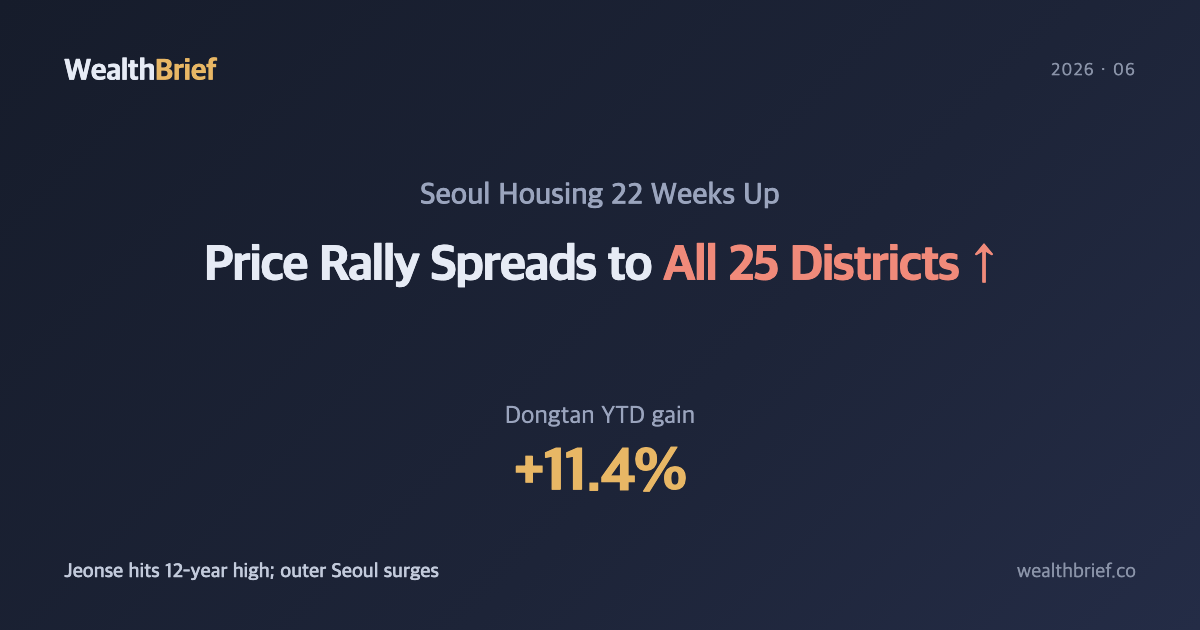
For most of the past year, the narrative about Seoul’s housing market centered on Gangnam, Seocho, and the so-called “Ma-Yong-Seong” corridor — Mapo, Yongsan, and Seongdong districts. Then came the week of June 22–28, 2026: all 25 of Seoul’s autonomous districts posted apartment price increases simultaneously for the first time. Dobong district climbed 0.46% in a single week; Guro was close behind at 0.4%. Gangnam, the perennial leader, posted 0.35% — and trailed them both. (Source: KB Housing Market Report and Korea Real Estate Board weekly data, week of June 22, 2026)
Seoul apartments have now risen for 22 consecutive weeks. What began as a high-end phenomenon — luxury units in Gangnam, premium new-builds in Yongsan — has spread steadily outward. Industry observers call it the “price catch-up,” a pattern where buyers priced out of core districts look for relative value in the periphery. Whether that logic holds long-term is a separate question; right now, the data simply shows money flowing outward.
Dongtan Outpaced Seoul — +11% in Five Months
Even more striking is what happened in Hwaseong’s Dongtan, a new-town district about 50 kilometers south of Seoul. From January through June 2026, Dongtan apartment prices rose a cumulative 11.4% — the highest of any district in the country. (Source: KB Housing Market Monthly Report, June 2026) In one week alone, Dongtan prices reportedly jumped 4.16%.
- Likely driver: Strong earnings and bonuses at Samsung Electronics and SK Hynix, both of which have major campuses in the Hwaseong-Giheung semiconductor belt. This is an industry-level inference; no official breakdown of bonus inflows into real estate has been published.
- Spillover effect: Adjacent cities — Gwangmyeong, Seongnam, Bundang, Suwon — have seen comparable acceleration, described in media coverage as a “semiconductor belt price alignment.”
- Recent signal: Local brokers in Dongtan reported a slowdown in inquiries toward late June. Post-surge plateaus are common; whether this is a short pause or a genuine peak is not yet clear.
Seoul’s Jeonse Market: Biggest Jump in 12 Years
Jeonse (전세) is South Korea’s lump-sum lease system, where a tenant deposits a large sum — typically 50–80% of the property’s value — with the landlord in lieu of monthly rent. The landlord uses the deposit as operating capital; the tenant gets it back at the end of the lease term.
In the week ending June 28, 2026, Seoul’s jeonse prices posted their largest single-week increase in 12 years and 8 months, according to Korea Real Estate Board data. The causes are structural: fewer apartments coming to market, a rising share of landlords preferring monthly-rent leases over jeonse arrangements (given higher interest rates on deposits), and displaced Seoul renters pushing demand into the Gyeonggi suburbs.
For anyone currently in the jeonse market, the speed of price increases makes deposit safety worth re-examining:
| Checklist Item | How to Verify |
|---|---|
| Jeonse-to-sale price ratio | Above 70% indicates elevated risk. Check via MOLIT’s real transaction database (rt.molit.go.kr) |
| Landlord’s senior liens (근저당) | Pull the property’s certified registry (등기부등본). If deposit + existing liens exceed market value, exposure is real. |
| Jeonse deposit insurance eligibility | Check HUG (주택도시보증공사) or SGI Seoul Guarantee criteria before signing — not all properties qualify. |
The 1.5-Billion-Won Mortgage Threshold Is Getting Crowded
As outer Seoul districts approach price levels previously associated only with Gangnam, a regulatory boundary is coming into focus. Under Korea’s housing finance rules, apartments priced above ₩1.5 billion (approximately $1.1 million at current rates) are ineligible for standard bank mortgage loans (주택담보대출, or judam dae). Mapo, Yangcheon, and Gwangjin are now reportedly approaching that mark, according to News1 coverage from late June 2026.
Two key regulatory concepts:
- LTV (Loan-to-Value ratio / 담보인정비율): The maximum loan amount as a percentage of the property’s assessed value. In Seoul’s regulated zones, the cap is 50% for most buyers.
- DSR (Debt Service Ratio / 총부채원리금상환비율): Annual principal and interest repayments across all debts cannot exceed 40% of gross annual income. A Stress DSR framework (스트레스 DSR, implemented in September 2024) applies a higher notional interest rate when calculating the cap, further shrinking effective borrowing capacity.
The practical consequence: as prices in outer districts rise, buyers who relied on outer-district affordability as an alternative to Gangnam are finding their loan limits contracting at the same time as asking prices are expanding.
A Country of Two Markets: Seoul vs. the Provinces
While the Seoul metropolitan area surges, provincial Korea tells a different story. According to Dailyan coverage from late June 2026, unsold new apartment inventory in non-metropolitan regions has exceeded 40,000 units. Government support programs are in place, but their impact on actual sales has been limited.
The divergence between Seoul and the provinces is not new, but the gap appears to be widening. The underlying causes — population migration, employment concentration, infrastructure investment — are slow-moving and structural. Buyers considering provincial properties should weigh regional oversupply and population outflow trends alongside headline price data.
What to Watch in the Second Half of 2026
The bullish data points are real. Twenty-two weeks of consecutive gains, citywide breadth, a 12-year record in jeonse prices — these are not noise. But several countervailing factors are worth tracking:
- Supply pipeline: Project approvals slowed significantly in 2023–2024. That typically translates into reduced completions in 2026–2027, which would limit supply-side relief on prices.
- Interest rates: The Bank of Korea’s next moves are not settled. A rate increase would raise monthly loan burdens and could dampen demand more quickly than prices tend to suggest.
- Regulatory response: Prolonged price surges have historically prompted tighter lending restrictions from Korean financial authorities. The 2021–2022 cycle saw multiple rounds of such measures. A similar policy response is possible if current trends continue.
The question of whether to buy now or wait is not one this article can answer — it depends entirely on your income, loan capacity, time horizon, and which market you are actually participating in. A Seoul apartment for primary residence and a Dongtan unit bought on momentum are not the same decision, even if they appear in the same headlines.
This article is for informational purposes only, based on publicly reported data and news coverage. It does not constitute investment advice or a recommendation to buy or sell any property. Real estate decisions should be made in consultation with qualified financial and legal professionals, based on your individual circumstances.
Leave a Reply