
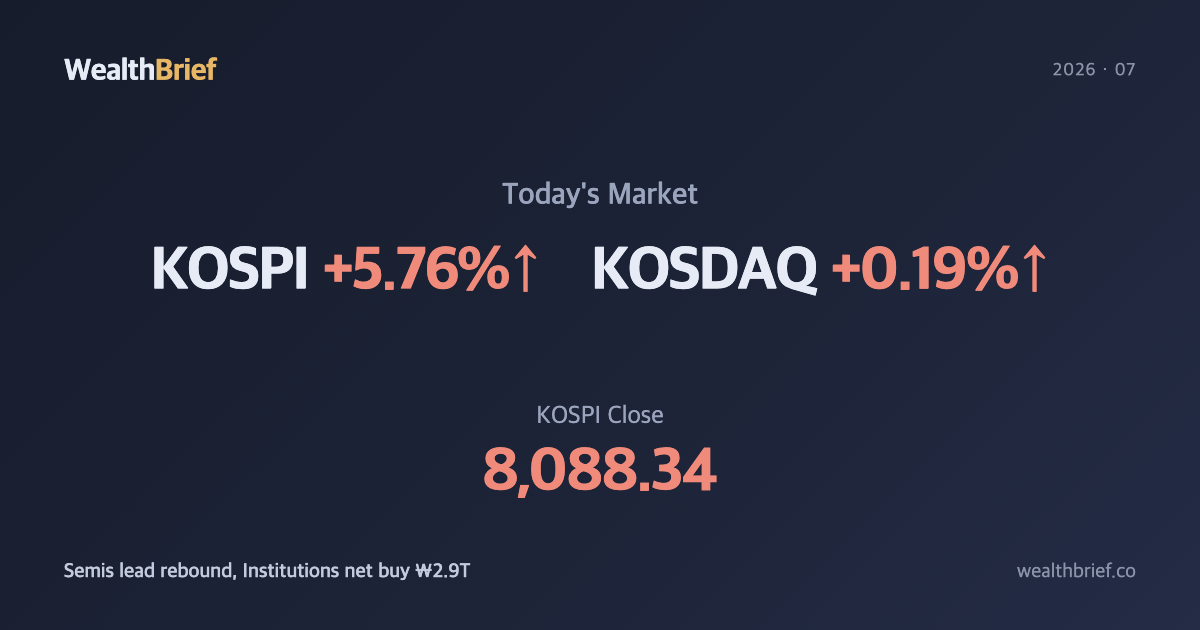
Rollercoaster Day — KOSPI Surges 5.76% to 8,088 as Chips Stage a Comeback
South Korea’s benchmark KOSPI closed at 8,088.34 on July 3, 2026, gaining 440.25 points (5.76%) — erasing more than half of the previous session’s brutal 7.89% sell-off in a single day. The KOSDAQ eked out a marginal 0.19% gain to 868.41, underscoring that this recovery was almost entirely driven by heavyweight semiconductor names. A circuit-breaker-style “buy sidecar” was triggered intraday as the surge in buy orders momentarily overwhelmed market capacity.
Market Overview — Institutions Step In with ₩2.9 Trillion
Institutional investors were the day’s primary catalyst, pouring roughly ₩2.9 trillion (approximately $1.9 billion) into the market in net purchases. Foreigners, who offloaded a net ₩148 trillion from Korean equities in the first half of the year, continued selling but at a noticeably slower pace than the day before. Retail investors were largely active on the buy side through leveraged ETFs and direct chip-stock purchases.
The won strengthened, with the USD/KRW rate settling at 1,531.60 — down from recent highs. A softer-than-expected U.S. jobs report (June non-farm payrolls came in at 57,000 vs. a consensus of roughly 110,000) pushed the dollar 0.52% lower globally, which helped reduce currency-related headwinds for Korean assets.
Sector Breakdown — Semiconductors Carry the Day
Semiconductors (Samsung Electronics / SK Hynix): The stocks that led Wednesday’s crash led Thursday’s recovery. Samsung Electronics climbed roughly 8% and SK Hynix surged approximately 11%, reclaiming the ₩2.4 million level. The day before, the two companies had shed a combined ₩400 trillion in market capitalisation. KB Securities raised its target price on SK Hynix to ₩4.2 million, citing what it called a “structural demand story” that matters more than near-term noise around AI capex commentary from U.S. mega-caps.
Batteries / EV supply chain: Secondary battery stocks — LG Energy Solution, Samsung SDI and peers — had a far quieter session. Recovery was modest at best, with lingering concerns about EV demand growth and raw material costs keeping buyers cautious. The sector’s tepid day highlights how narrowly focused Thursday’s rebound was.
Biotech / Pharmaceuticals: The KOSDAQ’s near-flat close tells most of the story here. Select clinical-stage names saw buying interest, but the broader biotech segment lacked a clear catalyst to keep pace with the semiconductor rebound. The sector is watching the domestic drug approval pipeline and global licensing deal flow for fresh direction.
Financials / Banks: Easing rate-hike expectations in the U.S. theoretically creates a mixed backdrop for Korean banks — lower rates can compress net interest margins, but they also reduce credit stress. On balance, financials moved modestly, constrained by continued foreign selling pressure that has not fully abated.
Autos: Hyundai Motor, Kia and related parts suppliers logged a largely uneventful session. Won appreciation (if sustained) acts as a structural drag on export earnings, while tariff uncertainty persists as a medium-term variable. No major catalysts pushed the sector strongly in either direction.
Global Context — Dow at Record Highs, Nasdaq Dragged by Chips
In New York trading that concluded in the early hours of July 3 (Korean time), markets split: the Dow Jones Industrial Average rose 1.1% to a new all-time high, while the Nasdaq Composite fell 0.8% as chip stocks came under renewed selling. The Philadelphia Semiconductor Index dropped roughly 5% at its lows, and Micron Technology skidded more than 10%, falling back below the $1,000 level.
The weak U.S. payroll print shifted the macro narrative somewhat: ING Research was quoted as saying the report “applied partial brakes” to Fed rate-hike expectations, which helped gold and interest-rate-sensitive assets. For Korean equities, the combination of a weaker dollar and reduced odds of further tightening proved supportive.
Japanese equities tracked a softer path, with SoftBank down 5% and memory chipmaker Kioxia tumbling nearly 9% — a stark contrast to the resilience displayed by Samsung and SK Hynix.
What to Watch Next
- Samsung Electronics Q2 earnings: Preliminary results are expected imminently. Some forecasts put operating profit in the region of ₩80 trillion for the quarter, driven by memory price recovery. The actual print — and the guidance tone — will be a key inflection point for the entire chip sector.
- Foreign flows: With ₩148 trillion in net selling accumulated over six months, the question of whether foreigners begin to reverse course is pivotal. A sustained won recovery and an end to U.S. rate-hike speculation would lower the bar for re-entry.
- U.S. big-tech AI capex commentary: The Meta-triggered sell-off this week centred on fears that AI infrastructure investment is running ahead of monetisable demand. When major U.S. platforms report Q2 results (late July through August), the AI capital expenditure guidance they provide will either validate or challenge that thesis — with direct consequences for Korean memory and chip suppliers.
- USD/KRW rate: At ₩1,531.60, the won remains near historically elevated levels versus the dollar. Currency direction will continue to influence both foreign investor behaviour and the earnings outlook for export-heavy sectors.
Disclaimer
This article is a market commentary based on publicly available news sources and market data as of the close on July 3, 2026 (KST). It does not constitute investment advice or a recommendation to buy or sell any security. All investment decisions and their outcomes are the sole responsibility of the individual investor. Please conduct your own due diligence and consult a qualified financial professional before making any investment.
Leave a Reply