

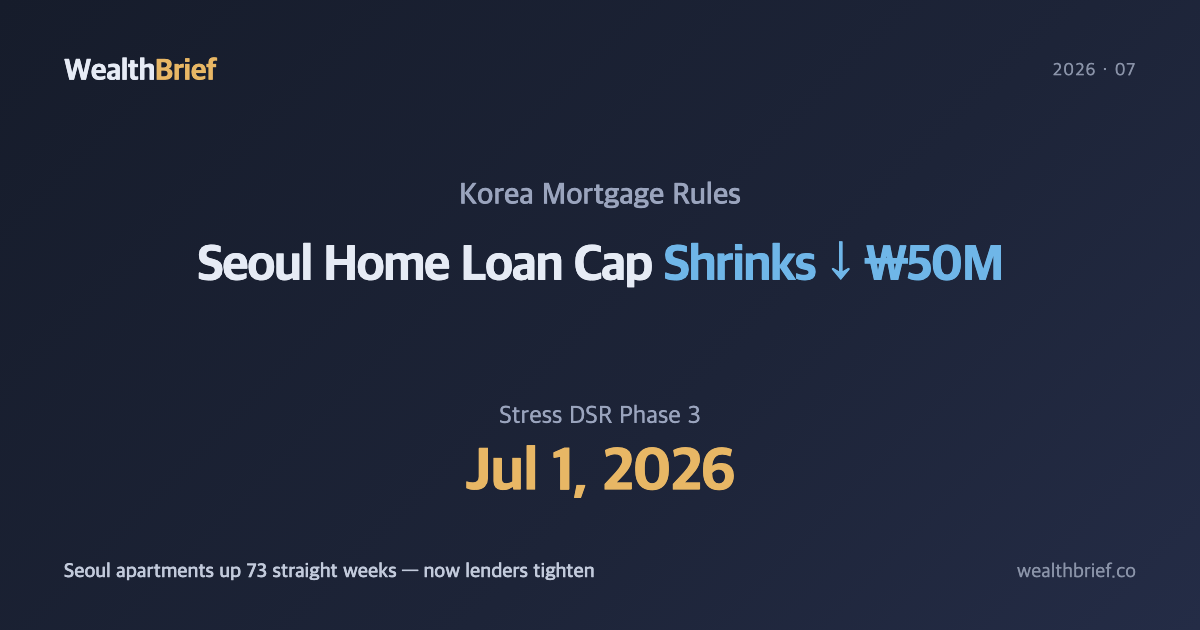
A Change That Hits Your Mortgage — Starting July 2026
Home prices keep climbing. Rents are rising faster. And from July 1, 2026, borrowing just got harder if you’re buying in Seoul or the greater Seoul metropolitan area. Korea’s financial regulator stepped up its Stress DSR framework to Phase 3 — and if you’re shopping for a home loan in the capital region, your maximum loan amount just shrank.
What Is Stress DSR?
DSR (Debt Service Ratio) caps total annual loan repayments — across all your debts — at 40% of gross income. That’s the baseline rule. For someone earning KRW 70 million a year, total annual debt payments can’t exceed KRW 28 million (roughly KRW 2.33 million per month).
Stress DSR takes that a step further. Instead of using today’s actual interest rate to calculate repayments, it adds a hypothetical “stress rate” on top — modeling what happens if rates rise. The loan size that passes the DSR test is calculated at this artificially higher rate. Smaller loan ceiling, more conservative debt exposure.
- Phase 1 (Feb 2024–): +0.38%p stress premium added to actual rate
- Phase 2 (Sep 2024–): +0.75%p stress premium
- Phase 3 (Jul 1, 2026–, Seoul metro & regulated zones): +1.50%p stress premium
Outside the metropolitan area, Phase 2 (+0.75%p) stays in place through end of 2026. The Financial Services Commission granted a six-month reprieve to protect regional first-time buyers from an abrupt tightening.
How Much Does This Actually Cut?
Let’s ground this in rough numbers. Assume a variable-rate mortgage at 4.0% annual interest, 30-year term, principal-and-interest repayment.
| Factor | Phase 2 | Phase 3 |
|---|---|---|
| Stress rate add-on | +0.75%p | +1.50%p |
| DSR calculation rate | 4.75% p.a. | 5.50% p.a. |
| Max loan (KRW 70M annual income, approx.) | ~KRW 540M | ~KRW 490M |
※ These figures are illustrative estimates based on a simplified principal-and-interest calculation. Actual limits vary by bank, debt composition, and income verification method. Always check directly with your lender.
That’s roughly a KRW 50 million gap from the same income — just from moving between phases. For households that budgeted tightly for a specific apartment, this can be the difference between getting the loan or not.
One detail worth knowing: fixed-rate and mixed-rate mortgages get a partial discount — only half the stress premium applies (+0.75%p in Phase 3 instead of +1.50%p). That makes fixed/mixed-rate products look better on paper for borrowing capacity. Whether the higher upfront rate actually saves money depends on where rates go — which nobody reliably predicts.
The Market Context: Seoul Up 73 Straight Weeks
This tightening didn’t come out of nowhere. As of July 2, 2026, Seoul apartment prices rose 0.27% in a single week, according to the Korea Real Estate Board (한국부동산원). That extends an unbroken 73-week run of gains.
The rental side is actually moving faster. Seoul apartment jeonse (long-term deposit rents) rose 0.30% week-on-week over the same period — slightly outpacing sales prices. Year-to-date, Seoul jeonse prices are up 5.10% through early July 2026 (Korea Real Estate Board), with roughly 7,000 listings disappearing from the market compared to the start of the year, per press reports.
In Dongtan, a satellite city in Gyeonggi Province, prices jumped 1.46% in a single week — driven partly by anticipation around the GTX express rail extension. That kind of weekly number grabs headlines, but it’s worth remembering that rapid single-week gains in specific submarkets have historically been followed by corrections. No guarantee the momentum holds.
Why the Seoul–Regional Split?
The two-speed approach reflects the divergence in Korea’s housing market. Seoul and surrounding areas are hot. Much of the rest of the country is not. Regions like Daegu, parts of Gyeongnam, and rural areas still carry elevated unsold inventory (미분양). Applying Phase 3 uniformly would disproportionately hurt buyers in markets that don’t have a speculation problem.
The reprieve runs through year-end 2026, but the FSC has signaled it will reassess based on market conditions. If regional markets show unexpected heat, Phase 3 could arrive early. If you’re buying outside the capital and working with a tight debt-to-income ratio, staying aware of this calendar matters.
What Buyers Should Check Now
- Variable vs. fixed rate: Under Phase 3, fixed and hybrid rate products carry half the stress premium. If your income is borderline, a fixed-rate structure may unlock a higher limit — but compare the actual starting rates carefully.
- Clear other debts first: Credit card loans, car financing, student debt — all of these count toward your DSR. Paying these down before applying for a mortgage directly increases your borrowable amount.
- Self-employed income verification: Banks apply different recognized income formulas for freelancers and business owners. Limits can come out noticeably lower than for salaried employees at the same gross income. Shopping across multiple banks is worth the effort.
- LTV on top of DSR: The loan-to-value cap (LTV) runs alongside DSR and can be the binding constraint in regulated zones. Check both, not just one.
A smaller maximum loan doesn’t automatically mean you shouldn’t buy. It does mean any plan built on pre-July 2026 assumptions needs to be recalculated with current numbers before you sign anything.
This article is for informational purposes only, based on publicly available policy data and press coverage. It does not constitute financial, investment, or lending advice. Consult a qualified financial professional before making any borrowing or investment decisions.
Leave a Reply