

Open Enrollment for Health Insurance 2026: Key Dates
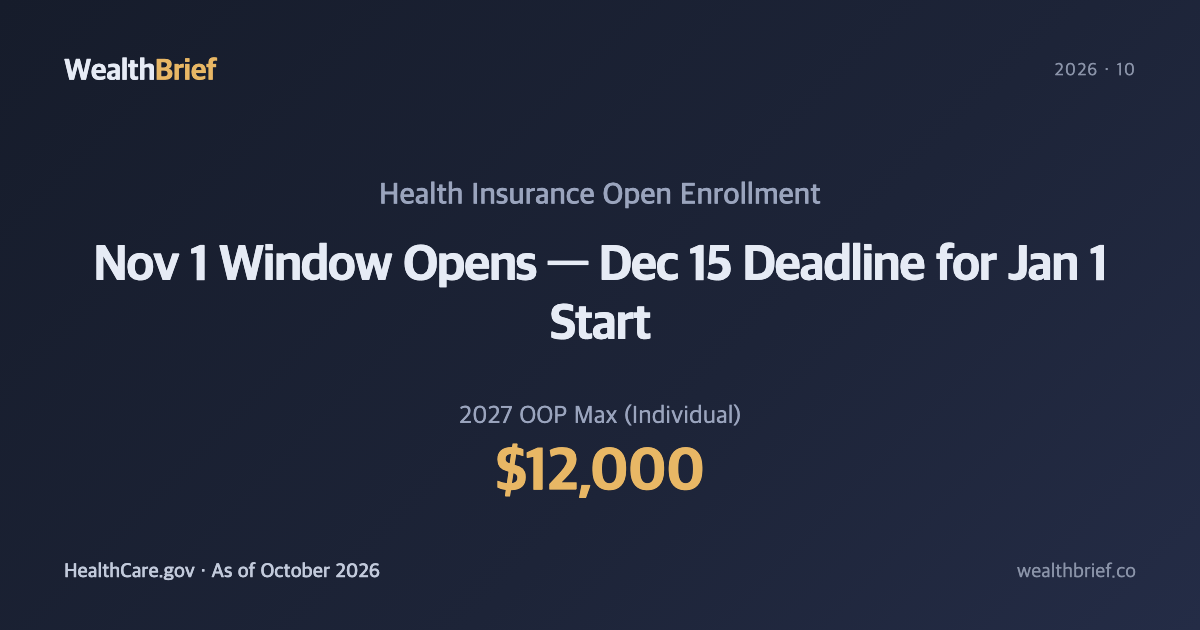
Open enrollment for 2027 Marketplace coverage runs November 1 through January 15, 2027 in most states, per HealthCare.gov. Two dates inside that window actually drive your coverage start:
- December 15, 2026 — enroll by this date and your plan starts January 1, 2027.
- January 15, 2027 — enroll after Dec 15 but by this date and coverage begins February 1, 2027.
If you’re on an employer plan, open enrollment typically runs in October or November — check your HR portal. The Marketplace window above applies to individual and family ACA plans on HealthCare.gov (or your state’s exchange).
State-run exchanges often set their own, later deadlines. California’s Covered CA, for example, extends to January 31, 2027, per the CA Health and Safety Code §1399.848. New York State of Health, Massachusetts, and several other state exchanges also run past January 15 — confirm at your state exchange’s website.
| State / Exchange | Window Opens | Window Closes | Jan 1 start deadline |
|---|---|---|---|
| Federal (HealthCare.gov — most states) | Nov 1, 2026 | Jan 15, 2027 | Dec 15, 2026 |
| California (Covered CA) | Nov 1, 2026 | Jan 31, 2027 | Dec 15, 2026 |
| New York (NY State of Health) | Nov 1, 2026 | Jan 31, 2027 | Dec 15, 2026 |
| Employer plans (typical) | Oct–Nov (varies) | Set by employer | Jan 1, 2027 |
Sources: HealthCare.gov, CoveredCA.com, NY State of Health — as of October 2026. Always confirm at your exchange or HR.
Open Enrollment for Health Insurance 2026: What Actually Changes Year to Year
Most people auto-renew without reviewing their plan — and that’s often a mistake. Premiums, deductibles, provider networks, and formularies (drug lists) can all shift from one plan year to the next. A plan you liked in 2026 may no longer include your doctor or cover your prescriptions at the same tier.
The biggest change heading into 2027: the ACA out-of-pocket maximum rises to $12,000 for individuals and $24,000 for families, up roughly 13% from 2026 ($10,600 / $21,200), per HHS (February 2026). That’s the most you can be required to pay in-network in a single plan year — after hitting this cap, your insurer covers 100%.
Also worth knowing: the enhanced premium subsidies that ran from 2021 through 2025 expired on January 1, 2026. The 400% federal poverty level (FPL) income cliff is back. For 2027 coverage, households earning above roughly $63,840 (single) or ~$130,000 (family of four) are no longer eligible for a premium tax credit on HealthCare.gov, per 2026 FPL guidelines reported by CNBC (January 2026). If you were receiving subsidies before, double-check your eligibility.
How to Choose a Health Insurance Plan: Metal Tiers Explained
ACA Marketplace plans are sorted into four metal tiers, each representing a different split of costs between you and the insurer. The tier you pick is the single biggest driver of your out-of-pocket costs — more important than the plan brand.
| Tier | Insurer pays (actuarial value) | Typical deductible | Monthly premium | Best for |
|---|---|---|---|---|
| Bronze | ~60% | $6,000–$8,000+ | Lowest | Healthy, rarely use care; can fund an HSA with HDHP Bronze |
| Silver | ~70% | $2,500–$4,500 | Mid | Most people; only tier eligible for cost-sharing reductions (CSR) |
| Gold | ~80% | $500–$2,000 | Higher | Regular prescriptions, specialist visits, managing a condition |
| Platinum | ~90% | $0–$500 | Highest | Frequent, predictable high medical use |
Source: HealthCare.gov plan types overview; as of 2026. Exact figures vary by insurer and region.
A common mistake: picking the cheapest Bronze plan without doing the math. If you end up needing surgery or a hospital stay, your deductible and coinsurance costs can dwarf the premium savings. Run the numbers for a worst-case scenario, not just the monthly premium.
One more thing: if your income qualifies for cost-sharing reductions (CSR), you must enroll in a Silver plan to get them. CSR lowers your deductible and out-of-pocket maximum significantly — a Silver plan with CSR can behave like a Gold or Platinum plan at a Silver price. Only available through the Marketplace, never off-exchange. (Per HealthCare.gov.)
Worked Example: Choosing Between Silver and Gold
Here’s how to think through the choice. Suppose you’re 35, living in Illinois, earning $55,000 a year (single). Two plans are available:
- Silver plan: $340/month premium after tax credit, $3,500 deductible, 20% coinsurance, $7,000 out-of-pocket max
- Gold plan: $470/month premium after tax credit, $1,000 deductible, 20% coinsurance, $5,000 out-of-pocket max
Premium difference: Gold costs $130/month more → $1,560/year extra.
Scenario A — low-use year (annual check-up only, $200 in claims):
- Silver: $340 × 12 + $200 = $4,280
- Gold: $470 × 12 + $200 = $5,840
- Silver wins by $1,560.
Scenario B — moderate-use year (one ER visit, some imaging: $8,000 billed, all in-network):
- Silver: $4,080 premiums + $3,500 (hit deductible) + 20% of remaining $4,500 = $3,500 + $900 = $4,400 out-of-pocket → total $8,480
- Gold: $5,640 premiums + $1,000 (deductible) + 20% of $7,000 = $1,000 + $1,400 = $2,400 out-of-pocket → total $8,040
- Gold slightly cheaper once you need care above the deductible threshold.
The break-even point is roughly $1,560 in extra out-of-pocket costs on Silver — if you expect more than that in annual claims beyond premiums, Gold starts to pay. Run this same calculation with your actual plan options on HealthCare.gov’s comparison tool. (Note: figures above are illustrative; your plan’s exact numbers will differ by region and insurer.)
What Happens If You Miss Open Enrollment?
Missing the deadline locks you out of Marketplace coverage until the next open enrollment — unless you qualify for a Special Enrollment Period (SEP). An SEP opens a 60-day window after certain qualifying life events, per HealthCare.gov:
- Losing job-based coverage (layoff, reduced hours below benefits threshold)
- Getting married or divorced
- Having or adopting a child
- Moving to a new coverage area
- Turning 26 and losing a parent’s plan
- A change in household income that affects your subsidy eligibility
If you miss open enrollment and don’t have an SEP event, your options narrow: Medicaid (year-round, income-based, no deadline), CHIP for children, a short-term health plan (not ACA-compliant, no guaranteed coverage for pre-existing conditions), or going uninsured. None of these are ideal — which is why treating the enrollment window as a hard deadline is worth the effort.
Open Enrollment for Health Insurance 2026 Texas & Georgia: Key Points
Texas and Georgia are among the largest states that use the federal HealthCare.gov platform rather than a state-run exchange. That means the standard November 1 – January 15, 2027 window applies, with December 15 as the deadline for a January 1 start date. There are no state-specific extensions — Texas does not run its own exchange, so Jan 15 is a hard cutoff.
If you live in Texas or Georgia, watch for one extra wrinkle: some counties in these states have limited insurer participation, meaning fewer plan options. Check HealthCare.gov early to see what’s available in your ZIP code before the window opens November 1.
Medicare Open Enrollment 2026: Separate Window, Same Season
Medicare open enrollment is a different program — it runs October 15 through December 7, 2026 (for 2027 coverage), per Medicare.gov. During this window, people already on Medicare can switch between Original Medicare and Medicare Advantage, or change Part D drug plans.
This is separate from the ACA Marketplace window above. If you’re 65 or older (or under 65 with certain disabilities) and already on Medicare, the ACA Marketplace does not apply to you. If you’re approaching 65, keep in mind: you have a 7-month Initial Enrollment Period around your 65th birthday to sign up for Medicare Parts A and B.
5-Step Open Enrollment Checklist
- Check your current plan’s renewal notice. Insurers mail or email changes to premiums, deductibles, and networks by early October. Read it before assuming you’ll auto-renew.
- Update your income estimate on HealthCare.gov. Your premium tax credit is based on your projected 2027 income — report any changes (job switch, raise, freelance income) accurately to avoid repaying excess credits at tax time.
- Verify your doctors and prescriptions are in-network. Networks narrow and formularies change. Call your doctors’ offices or use the plan comparison tool on HealthCare.gov.
- Run the annual vs. worst-case cost math. Use the worked example framework above. HealthCare.gov’s “Estimate Total Yearly Costs” tool does much of this for you.
- Enroll by December 15 if you want January 1 coverage. Don’t leave it to the final week — site traffic spikes and technical glitches happen at deadline time every year.
Open enrollment is also a good moment to review your broader year-end financial checklist. If you have a 401(k) at work, the contribution deadline is December 31 — see our guide on 401(k) year-end moves for 2026. And if you have taxable investments, the tax-loss harvesting window closes December 31 too — here’s how tax-loss harvesting works.
In 3 Lines
- Open enrollment for 2027 Marketplace health insurance runs November 1 – January 15, 2027 on HealthCare.gov; enroll by December 15 for January 1 coverage.
- The 400% FPL income cap on premium subsidies returned in 2026 — single earners above ~$63,840 no longer qualify for Marketplace tax credits.
- If you miss the deadline without a qualifying life event, you must wait until next year’s window; Medicaid remains open year-round for those who qualify.
For information only — not financial or insurance advice. Rules, income limits, and deadlines change annually. Always confirm your exact dates, plan details, and subsidy eligibility at HealthCare.gov, your state exchange, or a licensed insurance navigator. As of October 2026.
Leave a Reply