

You’ve Got 81 Days — Here’s How to Use Them
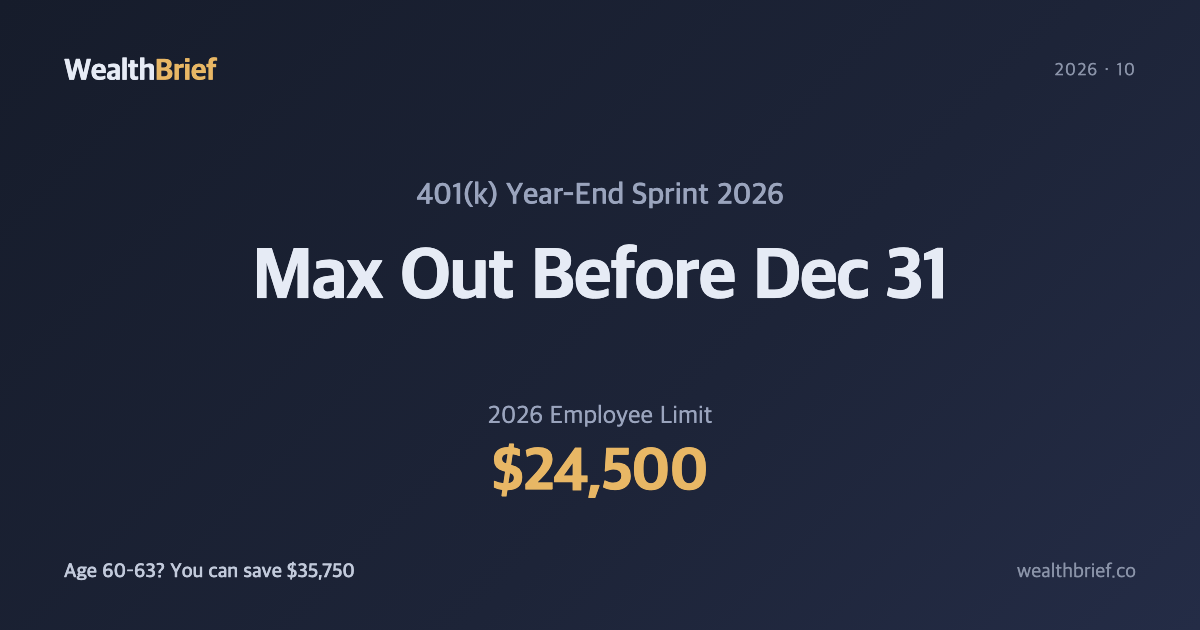
The 401(k) deadline is December 31, 2026 — not April 15. Whatever you don’t put in by New Year’s Eve is gone forever as 2026 tax-sheltered savings.
As of mid-October, most workers have roughly 5 to 6 paychecks left in the year. That’s not much runway, but it’s enough to close a meaningful gap — if you know the numbers and act now.
This guide lays out every 2026 limit, shows you the paycheck math to hit the cap, and flags the new SECURE 2.0 rule that’s already tripping up high earners.
The 2026 401(k) Limits at a Glance
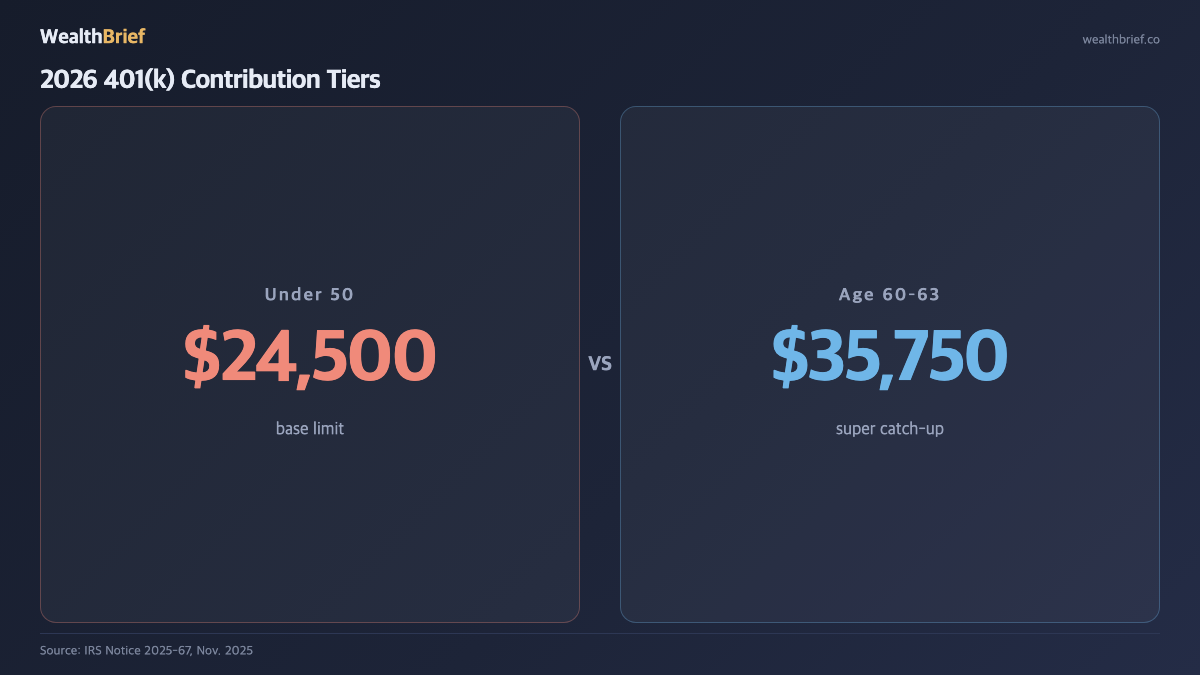
The IRS raised the 2026 limits via IRS Notice 2025-67 (released November 13, 2025). Three tiers now apply:
| Age group | Employee deferral cap | Add catch-up | Total you can put in |
|---|---|---|---|
| Under 50 | $24,500 | — | $24,500 |
| 50–59 & 64+ | $24,500 | +$8,000 | $32,500 |
| 60, 61, 62, or 63 | $24,500 | +$11,250 (super catch-up) | $35,750 |
Source: IRS.gov, IR-2025-111 (Nov. 13, 2025) and IRS Retirement Topics – Catch-Up Contributions (updated May 2026). Figures apply to traditional and Roth 401(k) plans combined.
The age 60–63 “super catch-up” is new under SECURE 2.0. It permanently raises the catch-up ceiling for anyone who turns 60, 61, 62, or 63 during the tax year — not just for the year they hit 60.
Employer matching contributions don’t count toward these employee-deferral caps. They sit on top, up to the IRS’s overall annual additions limit.
The Big New Rule in 2026: Roth-Only Catch-Up for High Earners
If you’re over 50 and your 2025 FICA wages from a single employer exceeded $145,000, the IRS now requires your catch-up contributions to go into a Roth 401(k) — not a traditional pre-tax account. This mandate took effect January 1, 2026, under SECURE 2.0.
Why does it matter? Roth contributions are made with after-tax dollars. You pay the income tax now instead of at retirement. For someone in a high bracket today who expects to be in a lower bracket later, that’s potentially the wrong move — but it’s no longer optional.
Three things to check:
- Does your plan offer a Roth 401(k)? If not, your employer’s HR team has to set one up — and the IRS gave plans until January 1, 2026 to comply. If your plan still doesn’t offer Roth, your plan administrator should be handling your catch-up separately; confirm with HR.
- What were your 2025 FICA wages from this employer? This is Box 4 of last year’s W-2 divided by 6.2% — or simply look at your prior W-2’s Box 3 (Social Security wages). The $145,000 threshold applies to each employer separately.
- Is your payroll system updated? Some plans auto-routed catch-up contributions to traditional accounts well into 2026. If yours did, talk to your plan administrator — you may be able to recharacterize.
Source: IRS Final Regulations on SECURE 2.0 Catch-Up Provisions (effective Jan. 1, 2026); ADP Spark, July 2026; Fidelity Learning Center, January 2026.
The Paycheck Sprint: Real Numbers for the Last 6 Pay Periods
With roughly 6 biweekly paychecks left between now and December 31, here’s how two realistic workers close the gap.
Example 1 — Sarah, 36, earns $95,000/year
Sarah gets paid biweekly (26 pay periods/year). She’s contributed $18,000 through her first 20 paychecks. She needs $24,500 − $18,000 = $6,500 more.
| Numbers | |
|---|---|
| Gross pay per paycheck | $3,654 ($95,000 ÷ 26) |
| Remaining to contribute | $6,500 |
| Paychecks left | 6 |
| Required per paycheck | $1,083 |
| Required contribution rate | ≈ 30% |
Sarah logs into her plan portal today, raises her contribution rate to 30%, and leaves it. The plan withholds $1,083 from each remaining paycheck — her take-home drops by roughly $730 after-tax (assuming a 22% federal bracket plus state), and she hits the cap exactly.
Example 2 — James, 62, earns $130,000/year
James qualifies for the age 60–63 super catch-up, so his ceiling is $35,750. He’s put in $28,000 so far. He needs $35,750 − $28,000 = $7,750 more over 6 paychecks.
| Numbers | |
|---|---|
| Gross pay per paycheck | $5,000 ($130,000 ÷ 26) |
| Remaining to contribute | $7,750 |
| Paychecks left | 6 |
| Required per paycheck | $1,292 |
| Required contribution rate | ≈ 26% |
Because James earned over $145,000 in 2025 FICA wages, his $11,250 catch-up portion must go to a Roth account. His plan automatically routes the base $24,500 to traditional (pre-tax) and the $11,250 catch-up to Roth. He gets the full shelter either way — the tax treatment just differs.
Both examples use 2026 IRS limits per IRS Notice 2025-67. Arithmetic verified: $6,500 ÷ 6 = $1,083.33; $1,083 ÷ $3,654 = 29.6% ≈ 30%. $7,750 ÷ 6 = $1,291.67; $1,292 ÷ $5,000 = 25.8% ≈ 26%.
Don’t Leave the Employer Match on the Table
One underappreciated Q4 trap: if you cram all your remaining contributions into the last few paychecks, you might hit the $24,500 cap early — before your employer’s match cycle finishes.
Many employers match dollar-for-dollar or 50-cents-on-the-dollar only on pay periods when you contribute. If you max out by paycheck 24 of 26, you forfeit two paychecks of matching — potentially $500–$1,500 in free money.
The fix: Spread contributions evenly across remaining pay periods (as Sarah does above), rather than front-loading the final stretch. Some plans offer a “true-up” provision that pays the missed match at year-end — but many don’t. Check your Summary Plan Description (SPD) or ask HR.
Three Moves Worth Making This Week
- Log into your plan portal and check your year-to-date contribution. Most plans (Fidelity, Vanguard, Empower, etc.) show this on the dashboard. Subtract from $24,500 (or $32,500 / $35,750 if you qualify for catch-up).
- Calculate the contribution rate you need for the remaining paychecks using the examples above, then update your deferral rate today — not after the next paycheck.
- If you earn over $145,000 in FICA wages and are over 50, confirm your catch-up is routing to a Roth account. This is now legally required. If your plan hasn’t updated payroll, ask HR in writing so there’s a record.
Planning your full retirement picture? Our Roth IRA 2026 contribution guide walks through income phase-out ranges and the backdoor strategy for high earners. If you want the full IRS limit table across all account types, see our 401(k) contribution limits 2026 overview.
One more thing worth knowing: you can change your contribution rate at any time during the year — most plans process changes within one to two pay periods. If life gets expensive in November, you can dial back slightly. The point is to start the sprint now, not to find the perfect number.
In 3 Lines
- The 2026 401(k) employee limit is $24,500 — or up to $35,750 if you turn 60–63 this year — and the December 31 deadline leaves only 5–6 paychecks to close any gap.
- If you earned over $145,000 in 2025 FICA wages and are 50+, SECURE 2.0 now legally requires your catch-up contributions to go into a Roth 401(k), not a traditional account.
- Watch the employer match trap: maxing out too early can cost you matching contributions on your final paychecks if your plan doesn’t offer a year-end true-up.
For information only — not financial or tax advice. Contribution limits and tax rules change annually. Confirm all figures at IRS.gov and review your plan’s Summary Plan Description before making changes. Consult a qualified financial advisor or tax professional for guidance specific to your situation.
Leave a Reply