

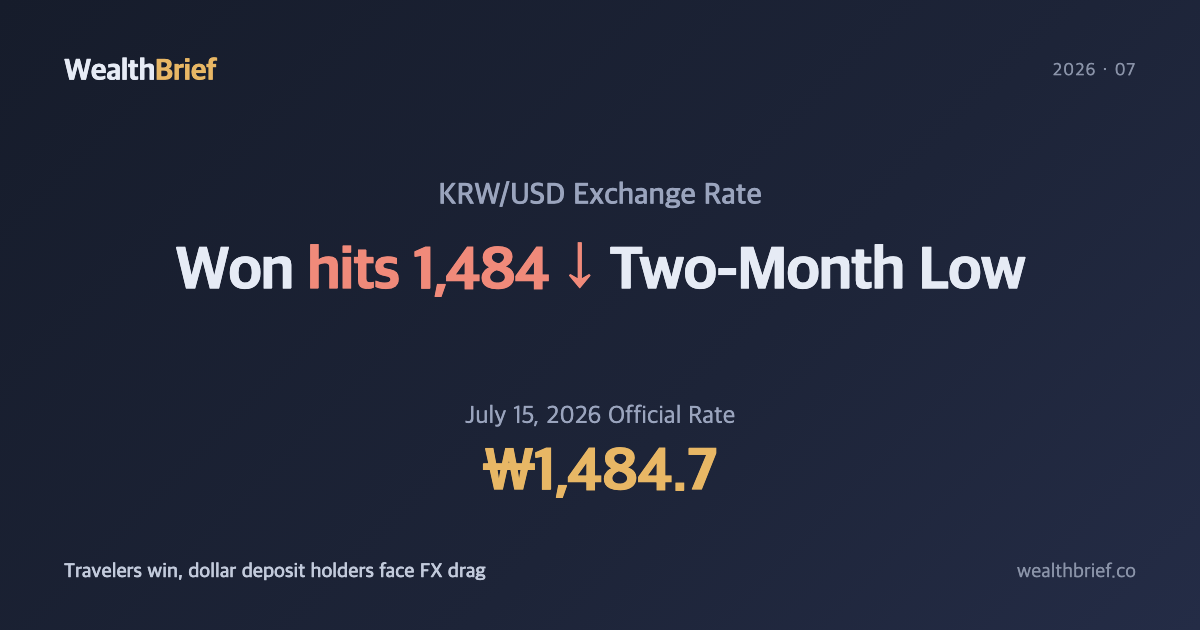
The Won Just Hit a Two-Month Low at 1,484 — Here’s What It Means for Your Money
On July 15, 2026, the Korean won closed at 1,484.7 per U.S. dollar, shedding 8.3 won in a single session — the weakest closing rate in two months (Yonhap, Chosunbiz, July 15, 2026 official rate).
An 8-won drop sounds trivial. But convert $10,000 and that’s ₩80,000 in difference. Exchange-rate shifts are quiet; their impact on your wallet is not.
What Drove the Drop: A Three-Way Dollar Squeeze
The trigger was U.S. June CPI data. Headline inflation fell back into the 3% range, signaling a meaningful deceleration in U.S. price pressures and sharply reducing expectations for additional Fed rate hikes (Chosun Ilbo, July 14, 2026).
A day later, U.S. June PPI came in with a surprise decline as well, prompting markets to start pricing in rate cuts (Dailian, July 15, 2026). When the dollar weakens, the won strengthens — and the exchange rate falls.
On the Korean side, speculation that the Bank of Korea may shelve further rate hikes helped narrow the Korea-U.S. long-term yield spread to near its lowest level in roughly three years. A shrinking rate differential reduces demand for dollar-denominated assets.
The immediate supply catalyst: heavy corporate dollar selling by major exporters, including SK Hynix, which repatriated large export receipts into won, accelerating the move lower (Seoul Finance, July 15, 2026).
What It Means for You — by Type
A falling won-to-dollar rate is not uniformly good or bad. It depends entirely on which side of the dollar you sit.
| Profile | Impact | Practical Effect |
|---|---|---|
| ✈️ Traveler (buying USD) | ✅ Positive | Converting $1,000 costs ~₩60,000–70,000 less vs. levels two months ago. Exchange now vs. waiting. |
| 🛒 Overseas Shopper | ✅ Positive | A $200 purchase costs roughly ₩13,000 less in won terms at current rates. |
| 💵 Dollar Deposit Holder | ⚠️ Paper Loss | Won-denominated value of existing USD deposits declines. Weigh your current USD deposit interest rate (check your bank’s published rate as of July 2026) against the currency drag before cashing out. |
| 📈 Overseas Stock (USD) Investor | ⚠️ FX Drag | Even flat U.S. equities now return less in won. May be offset if U.S. stocks rally on rate-cut expectations. |
| 🏠 Importer / Domestic Business | ✅ Positive | Lower import costs for raw materials and components. |
| 🏭 Export-Oriented Stock Investor | ❌ Negative | Revenue repatriated to won shrinks. Headwind for Samsung Electronics, Hyundai Motor, etc. |
The simple rule: if you need to buy dollars in the future, lower rates favor you; if you already hold dollars, you’re sitting on unrealized losses.
Further Drop vs. Snap-Back Risk
Making an exchange-rate call is notoriously difficult. Here is what both camps look like right now.
Case for further won strength (rate drifts toward 1,460–1,470):
- If July CPI also prints soft, Fed rate-cut pricing deepens and the dollar slides further.
- KB Securities has cited a near-term technical floor around 1,460–1,470 as a reasonable base case (KB Think, July 14, 2026).
- Continued large-cap exporter dollar selling keeps supply-side pressure on USD/KRW.
Case for a rebound (rate bounces back above 1,500):
- Stronger-than-expected U.S. jobs or retail sales data could revive Fed hike expectations fast.
- Any escalation in geopolitical risk on the Korean Peninsula typically triggers a safe-haven dollar rally.
- A Chinese yuan depreciation — driven by slowing Chinese growth — tends to drag the won lower alongside it.
- Below 1,450, Korean exporters become aggressive dollar buyers for hedging, creating a natural floor and rebound mechanism.
Market consensus leans toward “more downside room” (KB Think, July 14, 2026), but the FX market can reverse on a single data print. Directional bets are a high-stakes game; staged, averaged exchanges are the more practical response.
Action Checklist — What to Do Right Now
Adjust based on your own tax situation, fees, and time horizon. This is for informational guidance only.
- ✈️ Travelers (within 3 months): Convert 50% now, and split the rest into 2–3 tranches closer to departure. If rates dip to 1,450, convert more aggressively.
- 🛒 Online shoppers / direct buyers: This is a favorable window. If you’ve been waiting to place orders, current rates reduce your won outlay meaningfully.
- 💵 Dollar deposit holders: Don’t rush to liquidate. Compare your bank’s current published USD deposit rate against the projected currency drag before cashing out (check your bank’s posted rate as of July 2026). Set a target exit rate (e.g., 1,500 or above) and partially convert if the rate rebounds there.
- 📈 Overseas equity investors: FX losses may be partially offset by equity gains if U.S. stocks rally on rate-cut hopes. Long-term holders should not let short-term FX noise drive exit decisions.
- 🔄 Split your conversion: For amounts over ₩5 million, break exchanges into at least 3 tranches at different rate levels (e.g., 1,480 / 1,470 / 1,460). This averages your cost and reduces regret.
- 📱 Set rate alerts: Use apps like Wise, TravelWallet, Toss, or KakaoPay to set notifications at your target rate — you won’t have to watch the screen all day.
3-Line Summary
- The Korean won closed at 1,484.7 per dollar on July 15, 2026 — a two-month low driven by softer U.S. CPI/PPI data and heavy exporter dollar selling.
- Travelers and overseas shoppers benefit now; dollar deposit and overseas stock holders face unrealized FX losses but shouldn’t panic-sell.
- Further downside toward 1,460–1,470 is possible, but rebound risks (U.S. data, geopolitics) are real — split your exchange into tranches and set rate alerts instead of making a single all-in call.
This article is for informational purposes only and does not constitute investment or financial advice. Exchange rates are inherently unpredictable; consult a qualified financial professional before making currency or investment decisions based on this content.
Leave a Reply