

The Confusion That Costs Investors Thousands
“Index fund” and “ETF” get used interchangeably on Reddit, YouTube, and even in mainstream financial coverage. They’re not the same thing.
Index fund is a strategy — it means the fund tracks a market index (like the S&P 500) instead of paying a manager to pick stocks. ETF is a structure — it means the fund trades on a stock exchange throughout the day like a share of Apple or Tesla.
Those two ideas overlap a lot — most ETFs are index funds, and most index funds are now incredibly cheap — but the differences between them matter when you’re deciding where to put your 401(k) dollars, what to hold in a taxable brokerage account, and how much you’ll actually keep after the IRS takes its cut.
Here’s what actually changes depending on which you choose, with numbers to back it up.
How an Index Fund (Mutual Fund Structure) Works
A traditional index fund is a mutual fund. You buy shares directly from the fund company — Vanguard, Fidelity, Schwab — not on an exchange. The price you get is the fund’s net asset value (NAV), calculated once per day after markets close at 4 p.m. ET.
You invest a dollar amount, not a share count. Want to put in exactly $500? Done — you get fractional shares automatically. There’s no bid-ask spread to pay, and no brokerage commission if you’re buying at the fund company’s own platform.
Many index mutual funds require a minimum initial investment. Vanguard’s Admiral Shares (e.g., VTSAX, the Total Stock Market Index Fund Admiral Shares) carry a $3,000 minimum. Fidelity’s index funds have no minimum at all — and their ZERO funds (FZROX, FNILX) charge literally 0.00% in annual fees, as of 2026, per Fidelity’s fund prospectuses.
One important catch with Fidelity ZERO funds: they use proprietary benchmarks rather than standard CRSP or MSCI indexes, so they’re not directly portable to another brokerage. If you ever move your account, you’d need to sell and rebuy — potentially triggering a taxable event.
How an ETF Works
An ETF — exchange-traded fund — holds a basket of stocks or bonds just like a mutual fund, but its shares trade on an exchange minute by minute. To buy, you place a trade just as you would for any stock: you specify a share count (or, at most brokerages, a dollar amount), and the market fills your order.
Most ETFs also track an index, so their underlying holdings are similar or identical to an index mutual fund at the same provider. Vanguard’s VTI (Total Stock Market ETF) and VTSAX (the mutual fund version) hold the same stocks. The structure is just different.
What the ETF structure changes:
- You can trade any time during market hours. For long-term investors this rarely matters, but it can be useful if you want to place a limit order or move quickly during a market event.
- You buy by share, not by dollar amount (unless your broker supports fractional ETF shares — most major ones now do).
- There’s a bid-ask spread. For large, liquid ETFs like VOO or VTI, this spread is typically a penny or two per share — trivial. For niche or thinly traded ETFs, it can be meaningful.
- ETFs can be more tax-efficient in a taxable account — this is the structural advantage that matters most, and it’s explained below.
Side-by-Side Comparison
| Feature | Index Mutual Fund | Index ETF |
|---|---|---|
| How you buy | From fund company; dollar amount | On exchange; share count (or $ with fractional) |
| Pricing | Once daily (end-of-day NAV) | Real-time throughout market hours |
| Typical expense ratio (index, 2026) | 0.00%–0.05% (Fidelity ZERO: 0.00%; FXAIX: 0.015%; VTSAX: 0.04%) | 0.03%–0.20% (VTI & VOO: 0.03%; SPY: 0.0945%) |
| Active fund average (for context) | 0.64%, per ICI March 2026 report on 2025 fund fees | |
| Minimum investment | $0 (Fidelity) to $3,000 (Vanguard Admiral) | Price of one share, or $1 with fractional trading |
| Capital gains distributions | Possible (depends on redemptions) | Rare for broad index ETFs (in-kind redemption) |
| Available in 401(k) | Yes — most 401(k)s only offer mutual funds | Typically no (401(k) platforms rarely support ETFs) |
| Available in IRA / taxable brokerage | Yes | Yes |
| Portable across brokerages | Generally yes (standard-benchmark funds) | Yes — ETFs are universal |
Sources: Vanguard fund profiles (2026); Fidelity prospectuses (2026); ICI “Trends in the Expenses and Fees of Funds,” March 2026 (covering 2025 data). Expense ratios are annual, applied to your account balance automatically.
The Tax Efficiency Edge — and When It Matters
Here’s the structural advantage ETFs have over mutual funds in a taxable brokerage account. When investors sell out of a mutual fund, the fund sometimes has to sell securities to meet those redemptions — which can generate capital gains that get distributed to all remaining shareholders, even if they didn’t sell anything.
This is called a “phantom gain” — you get a tax bill on a profit you didn’t choose to realize. In 2022, when markets dropped and many investors fled mutual funds, two-thirds of mutual funds still distributed capital gains, per analysis by Global Market Journal. ETF holders in similar funds largely avoided that hit.
ETFs sidestep this problem through a mechanism called in-kind redemption: large institutional investors (called authorized participants) exchange ETF shares for the actual underlying stocks, rather than cash, when they want to redeem. No cash changes hands inside the fund, so no taxable event.
The practical takeaway:
- In a taxable account: ETFs generally win on tax efficiency. Broad index ETFs like VTI or VOO have distributed zero capital gains for years. This is meaningful if you’re investing outside a retirement account.
- In a 401(k) or IRA: Tax efficiency doesn’t matter — everything grows tax-deferred (traditional) or tax-free (Roth) anyway. Use whichever your plan offers. Most 401(k) plans only offer mutual funds, so the choice is often made for you.
- Vanguard exception: Vanguard’s mutual funds share their ETF’s share class, giving them similar in-kind redemption tax efficiency. So VTSAX and VTI are roughly equivalent on taxes, per Vanguard’s structure. Most other fund companies don’t work this way.
Worked Example: What Fee Differences Actually Cost Over 30 Years
The real stakes here aren’t ETF vs. mutual fund — it’s low-cost index vs. high-cost active. These numbers show why.
Assume $50,000 invested, 8% gross annual return, held 30 years:
| Fund type | Annual fee | Net annual return | Ending balance |
|---|---|---|---|
| Actively managed equity mutual fund (avg) | 0.64% | 7.36% | ~$420,000 |
| Index ETF or mutual fund (e.g., VTI, FXAIX) | 0.03% | 7.97% | ~$498,000 |
| Fidelity ZERO fund (FZROX) | 0.00% | 8.00% | ~$503,000 |
Calculation: compound growth on $50,000 at the net return shown for 30 years. 0.64% fee figure from ICI March 2026 report (covering 2025 asset-weighted average for actively managed equity mutual funds). All figures rounded to nearest $1,000. This is a mathematical illustration; actual returns vary.
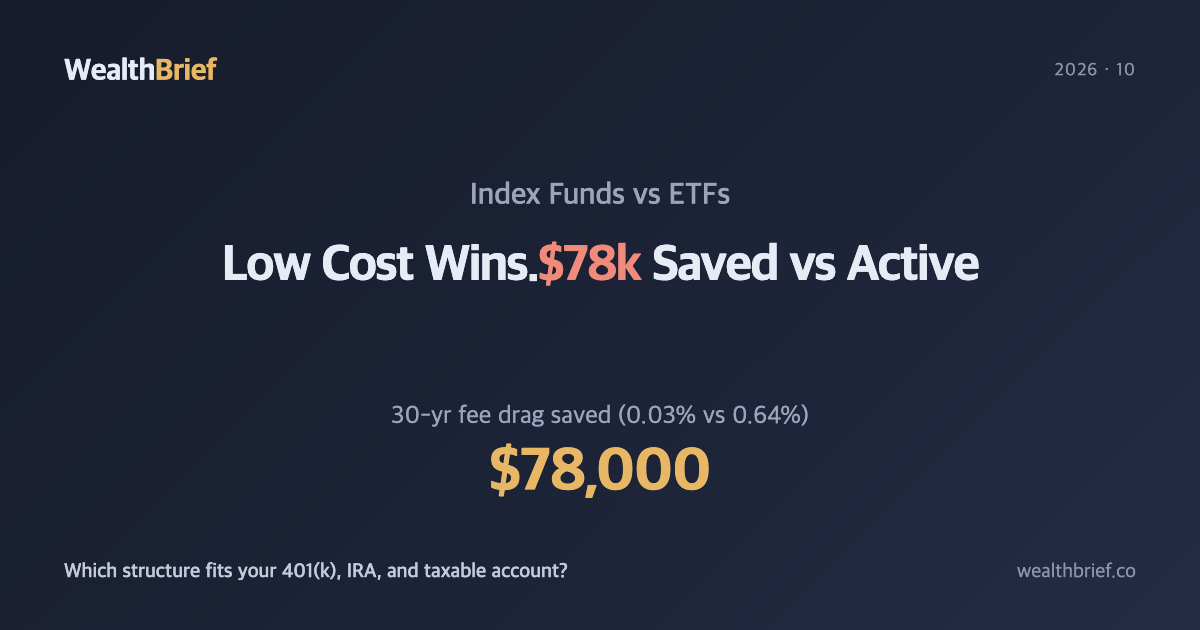
The difference between the active fund and a standard index ETF: roughly $78,000. That’s not a market-beating result — that’s just the math of not paying 0.61% more per year for 30 years.
The gap between VTI (0.03%) and FZROX (0.00%) over 30 years? About $5,000 on a $50,000 start. Real, but small compared to the active-vs-passive gap — which is why obsessing over 0.03% vs. 0.00% is mostly a rounding error for most investors.
Which Should You Use — and Where?
There’s no universally correct answer, but here’s a clean framework:
- In your 401(k): You almost certainly get mutual funds, not ETFs. Look for the lowest-cost index options — often S&P 500 or total market funds from Vanguard, Fidelity, or Schwab. Ignore expense ratios above 0.20%; those are likely active funds. If your plan’s cheapest option is above 0.50%, it’s worth raising this with your HR department.
- In an IRA (Roth or traditional): Either works. Many investors prefer ETFs for flexibility and the fact that you can hold the same ticker regardless of which brokerage you use. If you’re at Fidelity and cost is everything, FZROX at 0.00% is hard to argue with — just know it’s not portable.
- In a taxable brokerage account: ETFs have a meaningful tax edge over non-Vanguard mutual funds. Stick with broad-market ETFs (VTI, VOO, SCHB) and hold long-term. If you’re at Vanguard, VTSAX is roughly equivalent to VTI after accounting for Vanguard’s shared share-class structure.
- If you automate contributions: Mutual funds are slightly easier — you can set up automatic investments of exact dollar amounts. With ETFs, fractional shares are now available at most major brokers, so this advantage has shrunk considerably.
The single most important decision isn’t ETF vs. mutual fund — it’s keeping costs below 0.10% and staying in the market long enough for compounding to work. Everything else is fine-tuning.
In 3 Lines
- “Index fund” means the strategy (tracking a market index); “ETF” means the structure (trades on an exchange) — most index ETFs and index mutual funds are nearly identical in what they hold and cost.
- ETFs have a tax efficiency advantage in taxable accounts due to in-kind redemptions, but this difference largely disappears inside a 401(k) or IRA where gains are sheltered anyway. (See also: 401(k) Year-End Sprint 2026 for contribution deadlines.)
- The biggest lever is the active-vs-index cost gap: at the 2025 average active fund fee of 0.64% versus 0.03% for an index ETF, a $50,000 portfolio over 30 years loses roughly $78,000 in fee drag (ICI 2026; own calculation).
For informational purposes only — not investment, tax, or legal advice. Fund expense ratios, tax rules, and contribution limits change; verify current figures at IRS.gov, Vanguard.com, Fidelity.com, Schwab.com, and the SEC’s EDGAR database before making decisions. Past performance of any fund does not guarantee future results.
Leave a Reply