
Semiconductors Carry KOSPI to End a Turbulent First Half
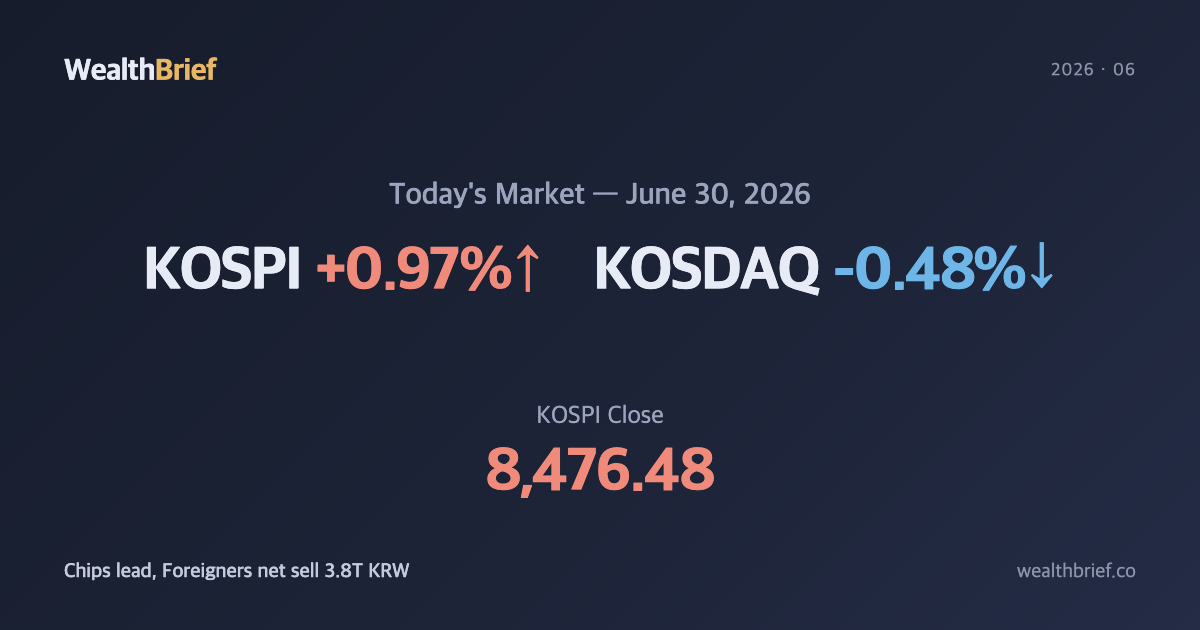
South Korea’s benchmark KOSPI closed the final trading session of the first half on a strong note. On June 30, 2026, the index gained 81.83 points, or 0.97%, to settle at 8,476.48 — snapping a three-session losing streak (Korea Exchange, close of June 30, 2026). The tech-heavy KOSDAQ slipped 0.48%, pulling back after surging more than 8% the previous session.
Market Overview
The rebound came despite relentless foreign selling. Overseas investors offloaded roughly 3.8 trillion won on the main board — part of a sustained wave of net selling that has run into the tens of trillions of won over the first half. Domestic institutions absorbed much of the pressure, keeping the index afloat. The won traded around 1,548–1,549 per dollar (Seoul foreign exchange market, June 30, 2026), with the weak currency providing a tailwind for export-oriented names.
Sector Breakdown
- Semiconductors: Samsung Electronics and SK Hynix — collectively called “Samjeon-Nix” in local market parlance — staged sharp recoveries, leading the index higher. The catalyst was a 2%-plus rally in the Nasdaq the prior session, driven by AI chip names. South Korea’s government added to the mood by unveiling the “3 Mega Projects” blueprint: an 800 trillion won semiconductor fab cluster in Gwangju and a 1,000 trillion won AI data-center build-out (Maeil Business Newspaper, June 30, 2026).
- Biopharma: After the previous day’s dramatic surge on KOSDAQ, biotech and pharma stocks saw profit-taking. The broader expectation of roughly 11 trillion won in institutional inflows into the sector in the second half is keeping sentiment from souring.
- EV Batteries: Secondary-battery stocks moved sideways in a holding pattern, with demand-outlook uncertainty limiting directional conviction.
- Financials: Banks and insurers edged higher, benefiting from a high-rate, high-exchange-rate environment that tends to widen net interest margins.
- Construction / Infrastructure: Shares tied to government infrastructure spending attracted buyers on the back of the mega-project announcements, though reports that the Yongin national semiconductor industrial complex land-development tender has stalled for six months (Chosunbiz, June 30, 2026) tempered enthusiasm.
Global Context
The mood on Wall Street set a constructive tone. The Nasdaq rose more than 2% on June 29 as AI infrastructure demand stayed in focus (News2day, morning briefing June 30, 2026). That performance flowed through to Korean chip names at the open. U.S. Treasury yields showed modest stability, though the broader dollar-strength trend has been a persistent headwind for foreign investor flows into Korean equities — even as a weaker won boosts the earnings outlook for exporters. A rate-cut pivot by the Federal Reserve, if it materialises later this year, could narrow that tension.
Looking at the first half as a whole, KOSPI tracked global AI-and-chips optimism upward from early in the year, punctuated by sharp swings around geopolitical and macro events. Foreign investors were net sellers throughout, yet domestic retail participation surged: transaction-tax receipts through May were up roughly 400% year-on-year (Yonhap News Agency, June 30, 2026), underscoring how deeply ordinary Koreans have engaged with this rally.
What to Watch in Early July
The U.S. non-farm payrolls report and any Federal Reserve commentary in the first week of July will set the early tone for risk appetite. A cooler labour market reading could reinforce rate-cut expectations and ease the dollar; a surprise on the upside would do the opposite. Domestically, the government’s mega-project timeline deserves close scrutiny — actual ground-breaking schedules and budget authorisations matter far more than headline figures. KOSDAQ may need a few more sessions to digest its prior-day surge before finding a new direction, while biotech catalysts — clinical-trial readouts scheduled for the second half — remain a wildcard.
Disclaimer: This article is a market commentary based on publicly available news and data as of June 30, 2026. It does not constitute investment advice or a recommendation to buy or sell any securities. All investment decisions should be made at the reader’s own discretion and risk.
Leave a Reply