

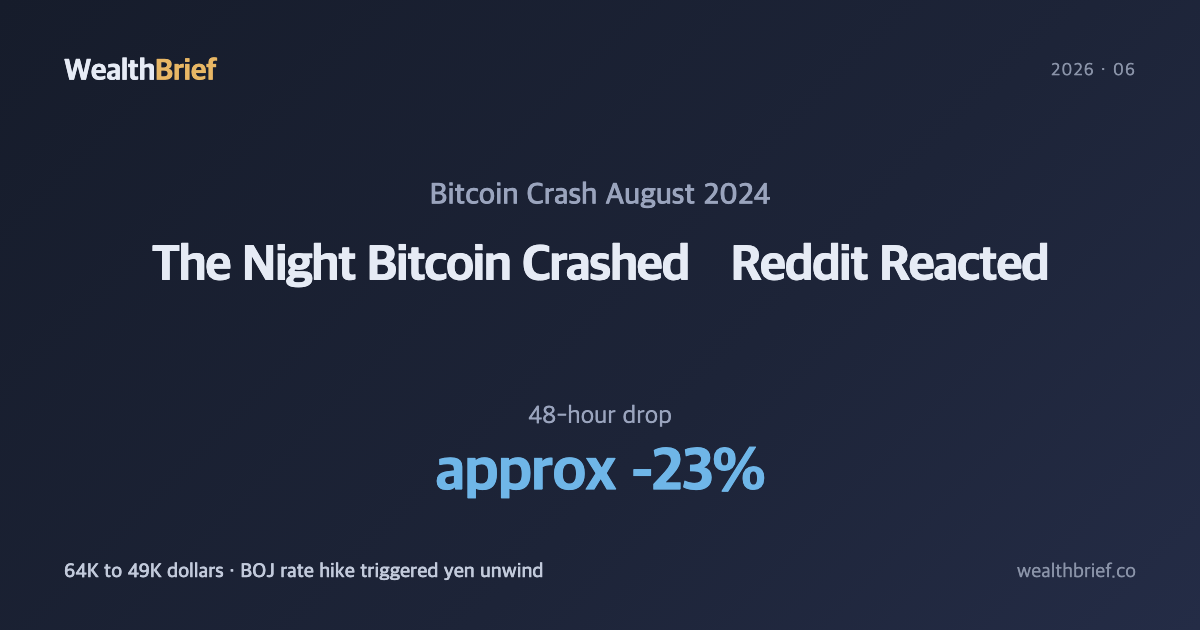
It was early August 5, 2024. On Reddit’s Bitcoin and CryptoCurrency threads, something unusual was happening — but it wasn’t panic. Or at least, not only panic. While Bitcoin shed roughly 23% in under 48 hours, plummeting from $64,000 to $49,000,[1] the comment sections lit up with a strange mix of gallows humor, cold-eyed opportunity-spotting, and surprisingly sharp investing commentary. Most headlines that week focused on the macro shock. The real texture of the moment, though, was playing out one comment at a time.
What Actually Happened in 48 Hours
The trigger was Japan. The Bank of Japan (BOJ) raised its benchmark interest rate in late July 2024 — an unexpected move that set off a massive unwinding of yen carry trades.[1] For years, investors had borrowed cheaply in yen and deployed that capital into higher-yielding assets worldwide. When Japanese borrowing costs rose, those positions had to be closed: assets sold, yen repurchased. The yen surged as much as 3.3% against the dollar in a single session.[4]
The ripple effects were swift and broad. On August 5 alone, Japan’s Nikkei 225 fell 12%.[2] The S&P 500 dropped 3%, the Nasdaq 3.4%, and Ethereum lost 10.1% on the day.[2] Bitcoin fell 7.2% that Monday, but the full 48-hour tally reached approximately 23%.[1] An estimated 1.6 million leveraged trading positions were forcibly liquidated across crypto markets during the episode.[3] Margin calls cascaded. Forced selling begat more forced selling. It was the kind of event that gets written up in BIS bulletins after the dust settles.
And on Reddit, people were watching it happen in real time.
What Was Happening on Reddit
One of the more memorable posts came from someone who had apparently sold at a loss — a significant one. The community’s response was blunt, but in a way that only the internet can deliver.
“Good grief my guy! You did it backwards, you supposed to buy low and sell high. You are what’s called ‘weak hands’. The fear got to you and you lost 31k.”
Source: Reddit community post (anonymized; original text used as-is, URL: https://reddit.com/r/CryptoCurrency/comments/1ekvk2z/22m_im_embarrassed_and_scared_31500_in_losses_how/lgznldz/), 2024-08-07
“Weak hands” is a well-worn crypto term for investors who fold under pressure — who sell when fear peaks rather than when their analysis calls for it. The comment reads almost like a roast. What gives it weight, though, is that it’s not wrong. This particular poster had sold in the middle of a crash and locked in a six-figure loss. The community, in its fashion, named exactly what had happened.
Not everyone was spiraling, though. In the same r/Bitcoin daily thread, another voice struck a notably different tone.
“I’d be thrilled if we even hold this level for a few weeks so I can buy more when I get paid again, this is a great buying opportunity for people with steady income”
Source: Reddit community post (anonymized; original text used as-is, URL: https://reddit.com/r/Bitcoin/comments/1ekgmwm/daily_discussion_august_05_2024/), 2024-08-04
No drama. No doomscrolling. Just: when does my paycheck land? Whether this perspective turned out to be well-timed is a separate question — past instances of “buying the dip” have sometimes worked out, and sometimes haven’t. What’s striking is the cognitive distance between this comment and the previous one, given they were both looking at the same chart.
Then there was this observation, which gained traction in the following day’s thread.
“The new ETF Boomers seem to be acting more like BTC OG HODLers rather than emotional, panicking, Crypto Bros trying to flip their rent money on short term gains.”
Source: Reddit community post (anonymized; original text used as-is, URL: https://reddit.com/r/Bitcoin/comments/1ela9hs/daily_discussion_august_06_2024/lgrcybp/), 2024-08-06
After U.S. spot Bitcoin ETFs launched in January 2024, a new wave of traditional investors entered the market — people whose primary relationship with investing had been through retirement accounts and index funds. The irony here is thick: the crypto-native crowd, supposedly hardened by years of volatility, was reportedly rattled. Meanwhile, the “boomers” who came in through an ETF wrapper were sitting tight. It’s an observation that doesn’t prove much on its own, but it’s hard to read without smiling.
The Line That Actually Made Me Stop
Among hundreds of comments, one stood out for the clarity of its framing.
“Fiat thinking: Bitcoin is crashing it’s only 55k. Bitcoin thinking: Bitcoin is undervalued and I should buy more.”
Source: Reddit community post (anonymized; original text used as-is, URL: https://reddit.com/r/Bitcoin/comments/1elwhil/daily_discussion_august_07_2024/lgz00p1/), 2024-08-07
The number is the same — $55,000 — but the frame around it is completely different. “Fiat thinking” anchors to recent price history: it was $64,000 last week, so $55,000 is a loss, a crash, a signal to get out. “Bitcoin thinking” anchors to something else entirely — a longer-term thesis about value and supply, where the current price is measured against a different baseline.
This isn’t an argument for either interpretation. Bitcoin could stay undervalued for a long time, or it could continue falling — there’s no formula that resolves that. What the comment captures, with unusual economy, is that two people looking at identical data can construct completely opposite narratives — and those narratives determine whether they click “sell” or “buy.” That’s not a trivial point. Understanding which frame you’re actually operating from might be more useful than debating whether $55,000 is high or low.
How Rushed Decisions Leave You Worse Off
For the person who had already sold and was wondering what to do next, the most substantive reply in the thread spelled out the psychological trap in clinical detail.
“When you bought at presumably a higher price, it was because you believed it would rise further. So what has changed? Things never move in a straight line. The risk now is you sold and it will rise. Even if briefly. That will make you panic buy because ‘oh no I made a mistake’. So you’ll buy back in at a higher price only for the brief rise to stop and fall again. This is where the ‘buy high, sell low’ meme comes from. You see how you’re trading with emotions? This is why DCA is a much better strategy.”
Source: Reddit community post (anonymized; original text used as-is, URL: https://reddit.com/r/Bitcoin/comments/1ekh839/how_funny_is_it_going_to_be_if_the_etfs_in_fact/lgkpdsz/), 2024-08-05
Map the loop: price falls → panic → sell. Then the price bounces, even briefly. Now the emotion shifts: “I was wrong to sell.” So you buy back — at a higher price than you sold. The bounce ends. Price falls again. You’ve now sold low and bought high. Twice. The “buy high, sell low” meme isn’t a joke about stupidity; it’s a description of what emotion-driven trading produces structurally.
The counter-argument exists: if you can accurately identify the bottom and re-enter at the right moment, active timing works. Some traders managed exactly that during the August 2024 episode. The difficulty is that no one can reliably identify the bottom in real time — that clarity only arrives in retrospect. DCA (Dollar-Cost Averaging — buying a fixed amount at regular intervals regardless of price) sidesteps the timing problem entirely. Whether it’s the right approach depends entirely on an individual’s circumstances, conviction, and risk tolerance. But as a description of why emotional trading tends to underperform, this Reddit comment is hard to argue with.
Questions Worth Asking Yourself
- Which frame were you actually using when you looked at the price? Your original investment thesis, or the number relative to last week’s high?
- If you sold during a previous crash, what happened to your emotions afterward — and did those emotions drive your next decision?
- Are you holding a position sized for the volatility you’re actually experiencing? Positions funded by rent money or short-term savings are harder to hold without emotion taking over.
- When you feel an urge to act quickly, is that coming from analysis — or from the feeling that doing something is better than doing nothing?
This article is for informational purposes only. It does not constitute a recommendation to buy or sell any financial instrument. All investment decisions and their outcomes are the sole responsibility of the individual investor.
Sources
- CoinDesk, “August 5, 2024 Bitcoin Crash Retrospective” (as of August 5, 2024): “a surprise BOJ rate hike triggered a yen carry trade unwind that crashed bitcoin from $64,000 to $49,000 in 48 hours.” — coindesk.com
- Volmex Research Series + CoinDesk, as of August 7, 2024: Nikkei 225 -12%, S&P 500 -3%, Nasdaq -3.4%, Bitcoin (intraday) -7.2%, Ethereum -10.1%.
- BIS Bulletin No.90 (Bank for International Settlements): “retail traders faced margin calls.” / 1.6 million trader positions liquidated — Decrypt, Kazmierczak reanalysis, October 2025.
- Yonhapnews (연합뉴스): yen surged up to 3.3% against the USD in early August 2024 amid BOJ rate hike and Fed rate-cut expectations; global equity markets including South Korea’s KOSPI fell in tandem. — yna.co.kr
Leave a Reply