

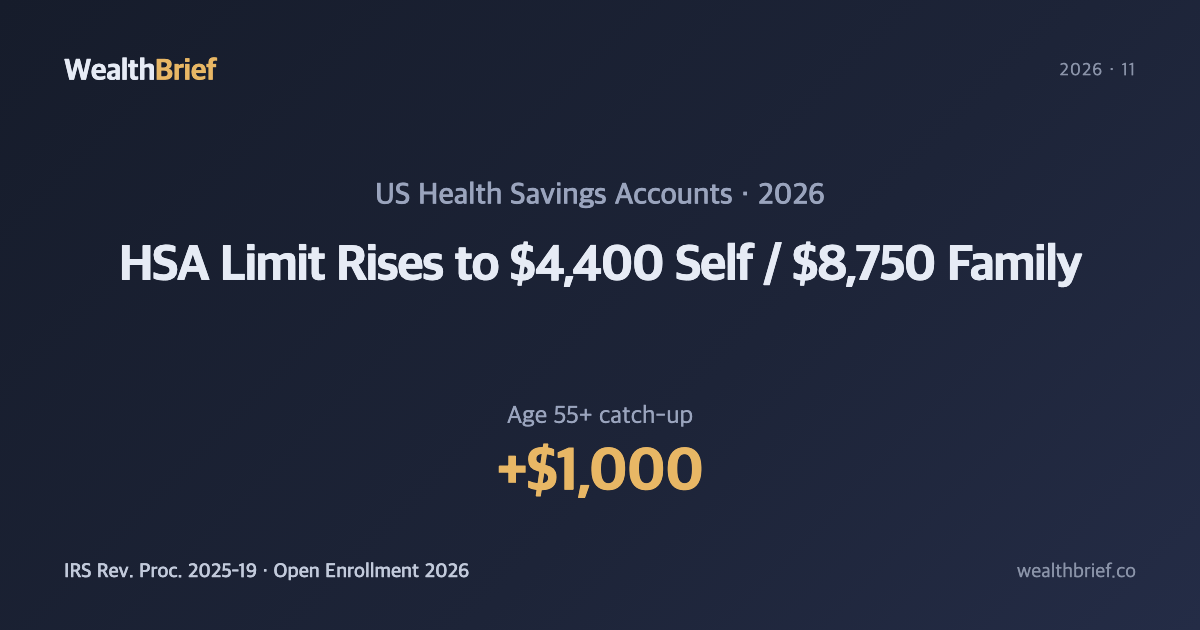
Open enrollment season means one thing for millions of American workers: the annual scramble to pick a health plan. If an HSA-eligible high-deductible health plan (HDHP) is on the table, the HSA contribution limits are the first number you need. For 2026, the IRS set the ceiling at $4,400 for self-only coverage and $8,750 for family coverage — both up from 2025 — with an extra $1,000 catch-up for anyone who is 55 or older by December 31, 2026. These figures come from IRS Revenue Procedure 2025-19, published in May 2025.
Below you’ll find every number you need for open enrollment decisions: what you can put in, what your employer contributions do to that ceiling, and a plain-English worked example so you can run your own numbers.
HSA Contribution Limits 2026 at a Glance
The IRS adjusts HSA limits each year for inflation. Here is the full 2026 table alongside 2025 for comparison:
| Coverage type | 2025 limit | 2026 limit | Year-over-year change |
|---|---|---|---|
| Self-only (individual) | $4,300 | $4,400 | +$100 |
| Family coverage | $8,550 | $8,750 | +$200 |
| Age 55+ catch-up (added to above) | $1,000 | $1,000 | No change |
Source: IRS Revenue Procedure 2025-19 (May 2025). All limits effective January 1, 2026.
So a married couple where both spouses are 55 or older could each add the $1,000 catch-up — but only if each has a separate HSA. The family coverage limit of $8,750 covers contributions from all sources combined (you + your employer + anyone else), and then each eligible spouse can layer their own $1,000 on top.
HSA Contribution Limits 2026 — Does It Include Employer Match?
Yes — your employer’s contributions count toward your annual limit. This surprises a lot of people. The $4,400 / $8,750 ceiling is a combined limit, not a personal limit.
If your employer deposits $1,200 into your HSA for 2026, your personal contribution room shrinks accordingly:
- Self-only: $4,400 − $1,200 employer = $3,200 you can add
- Family: $8,750 − $1,200 employer = $7,550 you can add
Exceeding the combined limit triggers a 6% excise tax on the overage every year it sits in the account, so it pays to know what your employer is kicking in before you max out your payroll deductions.
Where to check: your benefits portal or the summary plan description your HR team provides during open enrollment. Many employers front-load the contribution in January, while others seed it month by month — both affect your available room differently throughout the year.
HSA Contribution Limits 2026 Over 55 — Catch-Up Rules in Full
The catch-up contribution of $1,000 is fixed by statute; it does not adjust for inflation. A few rules that trip people up:
- Age by year-end: You must turn 55 by December 31, 2026 to qualify for the full catch-up for 2026. There is no prorating if your birthday is in December.
- No joint HSA: An HSA is always an individual account. If you have family coverage and both you and your spouse are 55+, each of you needs a separate HSA to each contribute the additional $1,000. Only one of you can use the HSA linked to the HDHP — the other must open a standalone HSA.
- Must be HDHP-enrolled: The catch-up only applies while you’re actively enrolled in an HSA-qualifying HDHP. If you switch mid-year to a non-HDHP plan (say, Medicare at 65), your limit is prorated by the number of months you were enrolled.
What Counts as an HSA-Qualifying HDHP in 2026?
You can only contribute to an HSA if you’re enrolled in a qualifying HDHP — not every high-deductible plan makes the cut. The IRS sets minimum deductibles and maximum out-of-pocket limits separately from the contribution caps:
| HDHP requirement | Self-only (2026) | Family (2026) |
|---|---|---|
| Minimum annual deductible | $1,700 | $3,400 |
| Maximum out-of-pocket (in-network) | $8,500 | $17,000 |
Source: IRS Revenue Procedure 2025-19. “Out-of-pocket” includes deductibles, copays, and coinsurance — but not premiums.
During open enrollment, look for the phrase “HSA-eligible” or “HSA-compatible” next to the plan name. A plan with a $2,000 deductible is not automatically HSA-eligible — it also has to stay below the out-of-pocket maximum above.
Worked Example: HSA Contributions for a Married Couple in 2026
Let’s make this concrete. Sarah and Tom, both 58, have family HDHP coverage through Sarah’s employer. Tom does not have his own employer health plan.
- Sarah’s employer seeds $1,500 into an HSA in January 2026.
- Family limit: $8,750. Catch-up for Sarah (58): +$1,000. Total ceiling for Sarah’s HSA: $9,750.
- After employer’s $1,500: Sarah can add up to $8,250 personally to her HSA.
- Tom is also 58. He can open a standalone HSA and contribute his own $1,000 catch-up — but he cannot contribute the family base ($8,750) there; that limit is already being used by Sarah’s HSA. His personal limit is $1,000.
- Total HSA contributions for the household in 2026: $1,500 (employer) + $8,250 (Sarah) + $1,000 (Tom) = $10,750.
Let’s verify: $8,750 family base + $1,000 Sarah catch-up + $1,000 Tom catch-up = $10,750. Minus the $1,500 already in via employer = $9,250 the couple contribute personally. ✓
That’s a meaningful tax shelter. Every dollar goes in pre-tax, grows tax-free, and comes out tax-free for qualified medical expenses (IRS Publication 969). For a couple in the 22% federal bracket, maxing out saves roughly $2,035 in federal income tax alone — not counting state income tax savings where applicable.
Deadline: When Do You Have to Contribute by?
You have until April 15, 2027 to make HSA contributions that count for the 2026 tax year. This mirrors the IRA contribution deadline and gives you breathing room even after the calendar year closes.
Two things to note about timing:
- Payroll deductions go in pre-FICA (payroll taxes), which lump-sum post-tax contributions do not. If you contribute outside of payroll, you still get the income-tax deduction but miss the FICA savings — that’s roughly 7.65% on the first $176,100 of wages (2026 Social Security wage base, per the SSA).
- Contributions made between January 1, 2027 and April 15, 2027 must be designated “for tax year 2026” — tell your HSA custodian explicitly, or they’ll book it for 2027.
HSA vs. FSA: Quick Comparison for Open Enrollment
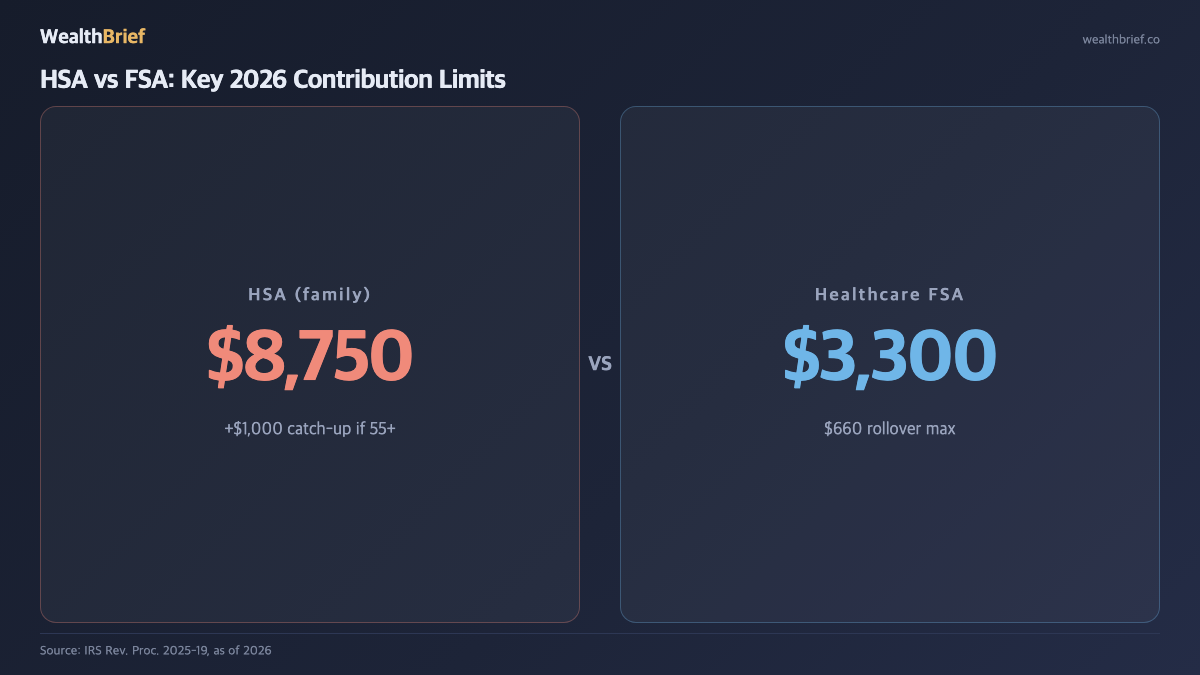
| Feature | HSA (2026) | Healthcare FSA (2026) |
|---|---|---|
| Requires HDHP? | Yes | No |
| Contribution limit (self-only) | $4,400 | $3,300* |
| Rolls over unused funds? | Yes, indefinitely | Limited — up to $660 in 2026 (if employer allows) |
| Invests and grows? | Yes | No (cash only) |
| Portable if you leave employer? | Yes | No |
| Triple tax advantage? | Yes | No (deductible only) |
*Healthcare FSA limit for 2026: confirm with your employer. FSA carryover limit $660 for 2026 per IRS Rev. Proc. 2025-19. HSA limits from same source.
The HSA’s killer feature is the rollover: money you don’t use in 2026 stays in the account and keeps growing. Over a 20-year career, an HSA funded consistently at the family limit can accumulate well into six figures — a dedicated pool for healthcare costs in retirement, when medical spending tends to spike.
In 3 Lines
- The 2026 HSA contribution limits are $4,400 (self-only) and $8,750 (family), per IRS Rev. Proc. 2025-19, with a $1,000 catch-up for anyone 55 or older.
- Your employer’s HSA contributions count toward the same annual ceiling — know what they deposit before setting your payroll deductions to avoid an over-contribution penalty.
- You have until April 15, 2027 to fund your 2026 HSA; payroll deductions also save FICA taxes, which post-tax lump-sum deposits do not.
For information only, not financial or tax advice. HSA rules and contribution limits change annually — confirm current figures at IRS Publication 969 and consult a qualified tax professional for your situation.
Try it with your own numbers
The calculator below uses the same rules explained in this article. Change the inputs to see your own result.
Leave a Reply