

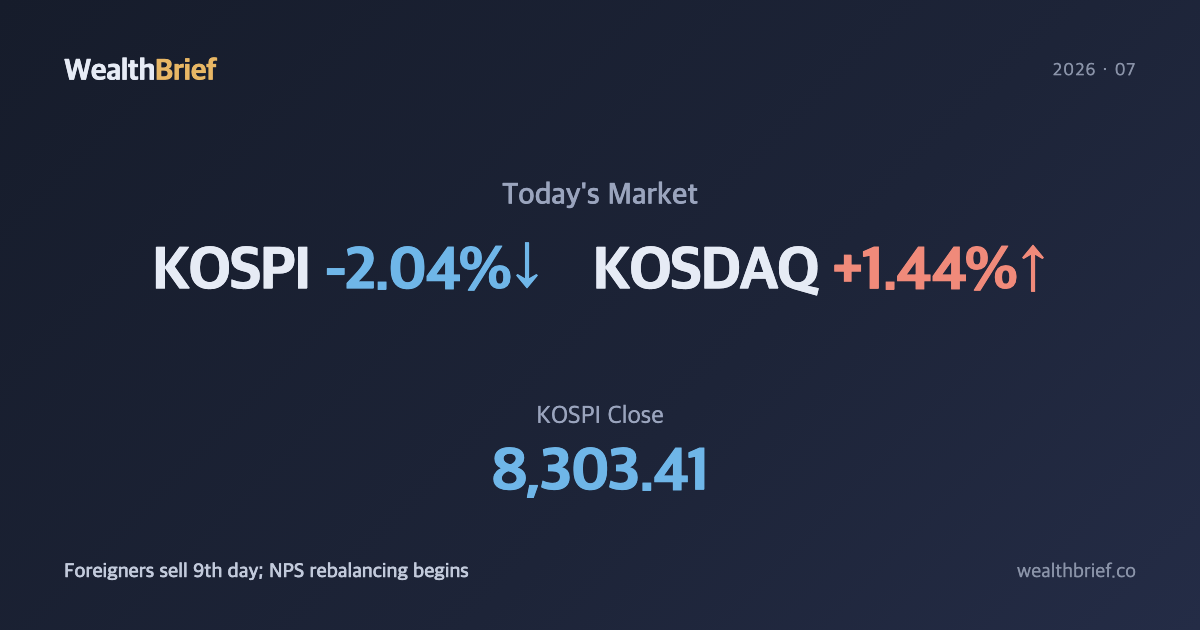
Today’s Snapshot — KOSPI Drops 2%, KOSDAQ Bucks the Trend
South Korean equities split sharply on Wednesday, July 1, 2026. The KOSPI closed at 8,303.41, shedding 173.07 points (2.04%) from the previous session. The index had opened in positive territory—briefly topping the 8,600 level on the back of strong overnight gains in U.S. tech stocks—before selling pressure from foreign investors and the National Pension Service (NPS) pushed it decisively lower. The KOSDAQ, by contrast, ended at 929.35, up 13.17 points (1.44%), marking a clear divergence from its large-cap peer.
Market Overview — NPS Rebalancing Begins, Foreigners Extend Selling Streak
The defining story of the day was the resumption of NPS portfolio rebalancing. With the KOSPI’s dramatic first-half surge pushing domestic equity allocations above permitted bands, the NPS officially began trimming its Korean stock holdings on July 1. Pre-market speculation had put the potential sell-off figure anywhere from 50 to 74 trillion won, rattling nerves. NPS chairman Kim Seong-ju moved to contain the anxiety, saying the process would be “gradual” and that a one-time “sell-off bomb” was “zero probability” (Newstoday, July 1, 2026). In practice, the first-day impact appeared contained.
Foreign investors extended their net-selling streak to nine consecutive sessions. Data compiled as of July 1 showed that foreigners sold a net 148 trillion won worth of KOSPI stocks in the first half of 2026 alone (Nate, July 1, 2026). The Korean won weakened to an intraday high of 1,559 against the dollar before settling at 1,556.50, keeping currency-related headwinds in place.
Sector Breakdown — Chips Drag, Biotech Lifts KOSDAQ
Semiconductors
Samsung Electronics and SK Hynix each fell more than 5% at their intraday lows, acting as the primary drag on the KOSPI. The irony was hard to miss: the prior session’s strength in U.S. chip names was unable to translate into Korean gains. The two names combined account for roughly 60% of total KOSPI market capitalization—a structural concentration that the Wall Street Journal flagged this week as a source of systemic fragility (Newsis, July 1, 2026). Samsung Electronics is scheduled to release its Q2 preliminary earnings on July 7, which will be a critical test of expectations.
Biotech / Pharmaceuticals — KOSDAQ’s Bright Spot
The KOSDAQ’s outperformance was driven largely by bio-pharma names. Alteogen held the 360,000-won line with a slight gain, and ABL Bio advanced more than 2% intraday, consolidating above the 100,000-won mark (CBC News, July 1, 2026). The KOSDAQ’s 30th anniversary fell on this date, and Korea Exchange pledged to pursue “quality restructuring and new market segments” as part of a revitalization agenda (Yonhap, July 1, 2026). Newly listed Maddup surged 26% on its trading debut, a reminder that selective risk appetite remains very much alive.
New Listing Rules Take Effect
New delisting criteria targeting penny stocks and companies falling below minimum market-cap thresholds took effect as of today (Yonhap, July 1, 2026). The change is expected to accelerate quality differentiation within the small-cap universe.
Flows
While foreigners and the NPS sold, retail investors and certain institutional players provided partial offset, particularly in the KOSDAQ. The pattern—institutions defending the secondary market while stepping back from blue chips—has become a recurring feature of recent sessions.
Global Context — Wall Street’s Best Quarter in Years
U.S. markets finished their second quarter with a flourish on June 30. The Nasdaq rose 1.52%, the Dow hit a fresh all-time high, and the S&P 500 logged its strongest quarter in six years. The Nasdaq’s Q2 gain came in at 21%—the best quarterly performance since 2020—with AI-related stocks leading the charge (Aju Economics, June 30, 2026). The gap between a buoyant Wall Street and a faltering Seoul stands out: Korea’s heavy concentration in a handful of semi-conductor names, combined with the NPS overhang, appears to be capping the transmission of positive global signals.
Things to Watch
- Samsung Electronics Q2 Preliminary Results (July 7): The single most important near-term catalyst for the KOSPI. Analyst expectations are high after Q1 strength; a miss—or even a soft beat—could amplify semiconductor selling.
- NPS Rebalancing Pace: Day one looked benign, but the pace matters. The NPS has guided for roughly 1–2 trillion won per month (Yonhap Infomax, June 30, 2026). Markets will be watching for any acceleration.
- Foreign Investor Turn: Nine straight days of net selling. The won/dollar rate crossing 1,560 would be a psychological trigger to monitor.
- U.S. Macro Data: U.S. jobs and ISM manufacturing readings due this week could shift global rate expectations, with downstream effects on Korean asset prices.
Disclaimer: This article is an informational commentary based on publicly available news reports and market data. It does not constitute a recommendation to buy or sell any security. All investment decisions carry risk and are the sole responsibility of the investor. Figures cited are based on media reports and may differ from final official data.
Leave a Reply