

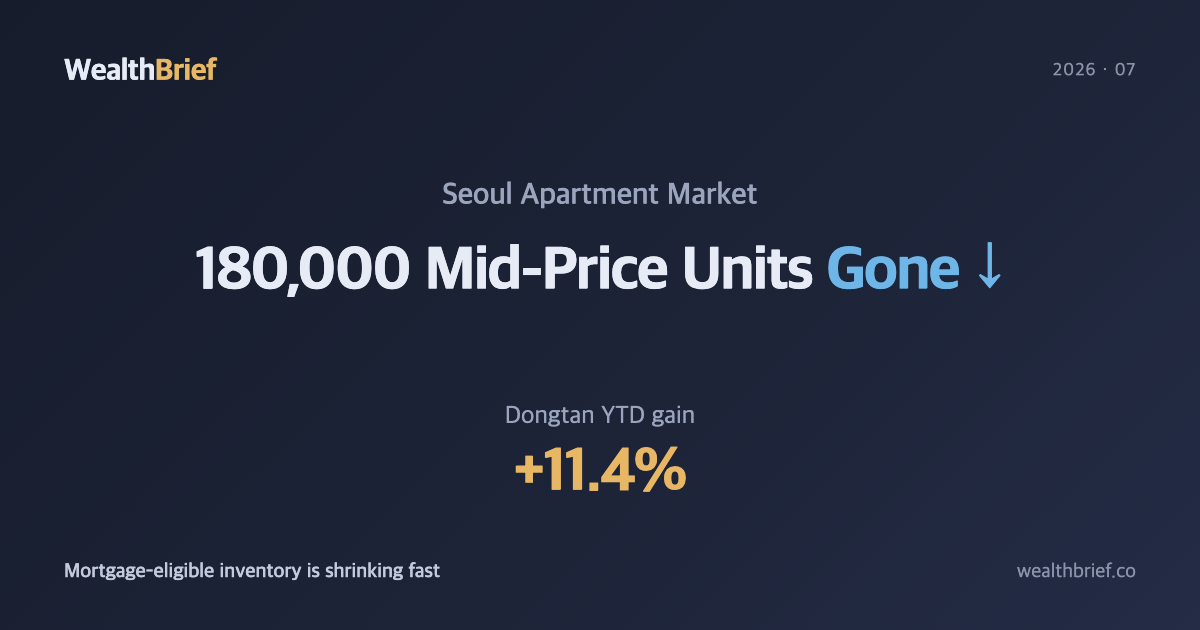
180,000 Apartments Have Disappeared
A figure reported exclusively by Financial News on June 30, 2026, deserves a close look: the number of Seoul apartments priced at 150 million won (KRW) or below dropped by approximately 180,000 units over a single year, with this price tier’s share of all Seoul apartments shrinking by 9 percentage points. As of late June 2026, Dobong-gu is the only district in Seoul where apartments priced at or below 60 million won still exist in meaningful numbers (Financial News, June 22, 2026).
This is not simply a story about rising prices. It reflects the narrowing of the entire price range where a buyer taking out a conventional mortgage can realistically enter the market. The 1.5-billion-won threshold matters because of how Korea’s mortgage rules work: apartments priced above that level in designated high-regulation zones are effectively ineligible for standard jeonse loan financing and face additional purchase mortgage restrictions. In practice, “the disappearance of sub-1.5-billion apartments” is close to saying “loan-eligible inventory is shrinking.”
Jeonse Prices Are Surging Simultaneously
It isn’t only purchase prices moving. According to KB Kookmin Bank’s June 2026 data — corroborated by reporting from Yonhap News, JoongAng Ilbo, and YTN — the monthly rate of increase in Seoul apartment jeonse (전세, Korea’s lump-sum deposit rental system) prices reached the highest point of 2026, with the absolute rise hitting a 12–13-year peak.
The mechanism is familiar: a shortage of jeonse supply pushes some tenants toward buying, which lifts purchase prices, which in turn tightens jeonse availability further. For households who had planned to rent on jeonse while saving toward a purchase, both sides of that equation have become more expensive at the same time.
The Wave Is Spreading: Dongtan, Giheung, and Guri
The pressure is not contained within Seoul. Korea Real Estate Board weekly data shows that apartments in Hwaseong’s Dongtan district gained 11.4% in value over the first five months of 2026, the highest cumulative gain of any city, county, or district in the country (Yonhap News, MBC News, June 2026). In a single week, Dongtan prices rose more than 2%.
The government responded on June 30, 2026, by placing Hwaseong Dongtan, Yongin Giheung, and Guri under a simultaneous “triple designation”: adjustment target zone, speculative overheating district, and Land Transaction Permit Zone (토지거래허가구역, toheoje). The practical effects stack on top of each other:
- Adjustment target zone: Loan-to-value (LTV) cap drops from 70% to 50%; tighter occupancy requirements for single-home owners.
- Speculative overheating district: LTV further reduced to 40% (with limited exceptions for first-time buyers meeting income criteria); housing subscription scoring shifted more toward subscription points.
- Land Transaction Permit Zone: Buyers must obtain district-office approval before purchasing, effectively blocking gap investing (갭투자), the practice of acquiring a property using a tenant’s jeonse deposit to cover most of the purchase price.
To make this concrete: on a 1-billion-won apartment in Dongtan, an LTV cap of 40% means a maximum mortgage of 400 million won. Under the previous 70% cap, the same buyer could have borrowed 700 million won. The gap — 300 million won — has to come from the buyer’s own pocket. For a 1.5-billion-won property, the ceiling is now 600 million won (Money Today, June 30, 2026).
All 25 Seoul Districts Rising — Led by Non-Gangnam Areas
For the first time in this cycle, Korea Real Estate Board weekly data for June 2026 showed positive price movement across all 25 of Seoul’s autonomous districts simultaneously. The top-performing district was Dongdaemun-gu (Alpha Economy, June 2026). While the Gangnam belt has been moderating somewhat, areas like Nowon, Dobong, Dongdaemun, and Seongbuk — traditionally the more affordable northern and eastern fringe — have become the new focal points of upward momentum.
| Area | Price Trend | Source / Date |
|---|---|---|
| Seoul (all) | 16 consecutive weeks of gains as of June 2026 | Korea Real Estate Board, Jun 2026 |
| Dongdaemun-gu | Top-ranked district in weekly gain rate | Korea Real Estate Board, Jun 2026 |
| Hwaseong Dongtan | +11.4% cumulative YTD through May–June 2026 | Korea Real Estate Board, Jun 2026 |
| Seoul jeonse | Largest monthly rise in 12–13 years | KB / Korea Real Estate Board, Jun 2026 |
| Seoul officetel | Average sale price crossed 300M won for the first time | Naewoe News, Jun 2026 |
There are competing interpretations of the non-Gangnam rally. One is that it signals broad demand: prospective buyers priced out of Gangnam are moving to the next available tier. The other is a cautionary reading: areas with weaker fundamentals — older building stock, less liquidity, smaller tenant demand base — tend to give back gains faster in a correction. Both dynamics have historically proven true in Seoul’s market, sometimes in quick succession.
What This Means for People Actually Looking
If you are a mortgage-backed buyer in Dongtan, Giheung, or Guri, contracts signed after July 1, 2026, are subject to the new LTV caps. Deals you penciled out with a 70% loan assumption need to be recalculated. The toheoje layer also adds a procedural step: an application to the district office that requires demonstrating a genuine intent to occupy. Plans to buy and immediately rent out are much harder to execute.
If you are looking in Seoul’s mid-price range, the shrinkage of the sub-1.5-billion inventory means fewer options in a tier that is still mortgage-eligible. Because loans above 1.5 billion won are blocked in high-regulation zones, every apartment that crosses that threshold effectively exits the pool of loan-accessible properties. That pool is getting smaller.
For jeonse renters facing contract renewal, the current rate of increase — a 12-year high — suggests that deposit top-up demands at renewal will be significant. The relevant numbers to check: your own DSR (총부채원리금상환비율, Debt Service Ratio: total annual principal and interest payments relative to annual income, capped at 40% for most borrowers under current rules) and the LTV applicable to the specific property and district you are targeting.
Will This Keep Going?
Regulation alone has not reliably cooled Seoul real estate in the past. The 2017–2021 period saw dozens of tightening measures alongside prices that roughly doubled. That cycle was powered by exceptionally cheap credit and ample liquidity. The interest rate environment is different today, and economic headwinds have not disappeared. On the other hand, Seoul’s structural supply shortfall — compounded by a jeonse-driven demand push into the purchase market — has historically provided a resilient floor.
What can be said with reasonable confidence: the mortgage-accessible price range in Seoul continues to narrow at a pace that matters for decision-making, and the spread of price momentum beyond the Gangnam core to the wider metropolitan area is now visible in official weekly data.
This article is provided for informational purposes only, based on publicly available news reports and data from Korea Real Estate Board and KB Kookmin Bank as of June–July 2026. It does not constitute financial advice, an investment recommendation, or a solicitation to buy or sell any property. Please consult a licensed financial or real estate professional for decisions specific to your situation.
Leave a Reply