

Why Loan Rates Move Before the Central Bank Does
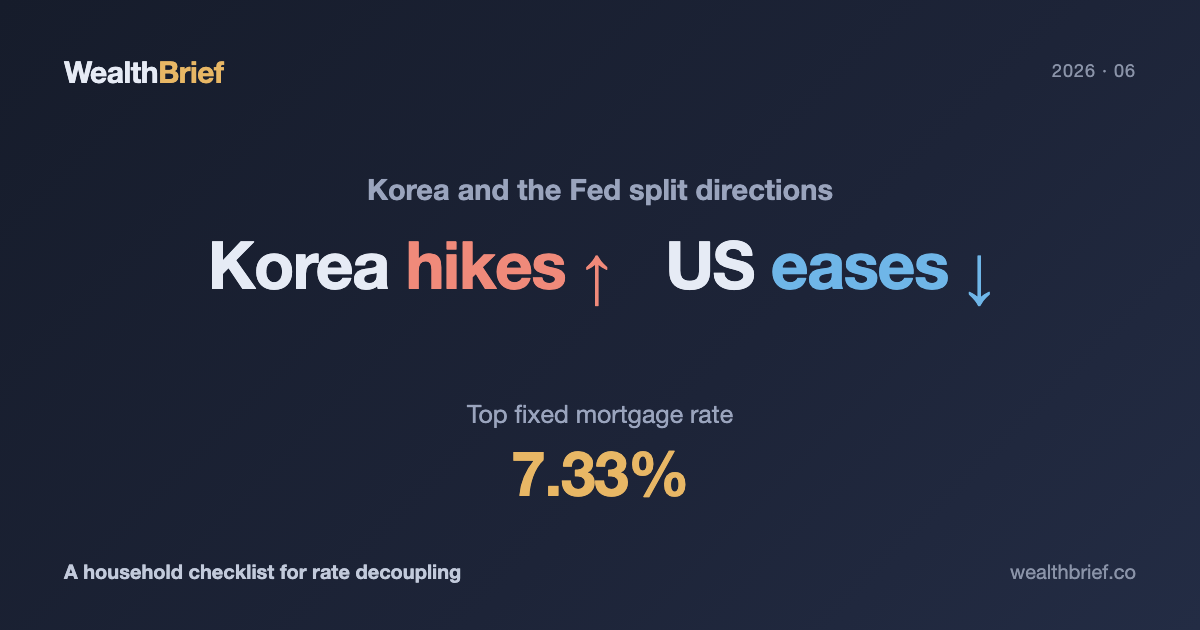
In June 2026, the policy paths of the United States and South Korea diverged. On June 17 the U.S. Federal Reserve held its benchmark rate at 3.5–3.75%[1], a hold that markets read as the pause before an easing cycle. The Bank of Korea (BOK) has kept its own policy rate at 2.50% — steady since early 2026[2] — yet market participants increasingly expect its next move to be a hike, not a cut. Two central banks, the same month, pointing in opposite directions: a rate decoupling.
The first thing worth clarifying is why Korean loan rates are already climbing even though the BOK hasn’t hiked. Retail loan rates are not pegged directly to the policy rate. They are set as a market funding cost plus a lender spread. The funding cost tracks bank bond yields and COFIX (the Cost of Funds Index), the benchmark behind most floating-rate mortgages in Korea — broadly the local counterpart to SOFR for retail credit. The lender spread reflects each bank’s operating costs, target margin, and risk pricing. When markets price in future hikes, funding costs rise before the central bank acts, and loan rates follow. Some Korean banks have also widened spreads under the label of “household debt management”[2].
The Numbers: Mortgage Rates Back Above 7%
The table below tracks rate changes at Korea’s five major banks — KB Kookmin, Shinhan, Hana, Woori, and NH NongHyup — between late December 2025 and early June 2026[3].
| Rate | End of Dec 2025 | June 5, 2026 |
|---|---|---|
| Fixed mortgage (5-yr bank bond basis), upper bound | 6.23% | 7.33% |
| Floating mortgage (new COFIX basis), upper bound | 5.87% | 6.23% |
| Unsecured personal loan (prime, 1-yr), upper bound | 5.36% | 5.93% |
| 5-yr AAA bank bond yield | 3.499% | 4.413% |
| COFIX (new originations) | 2.81% | 2.89% |
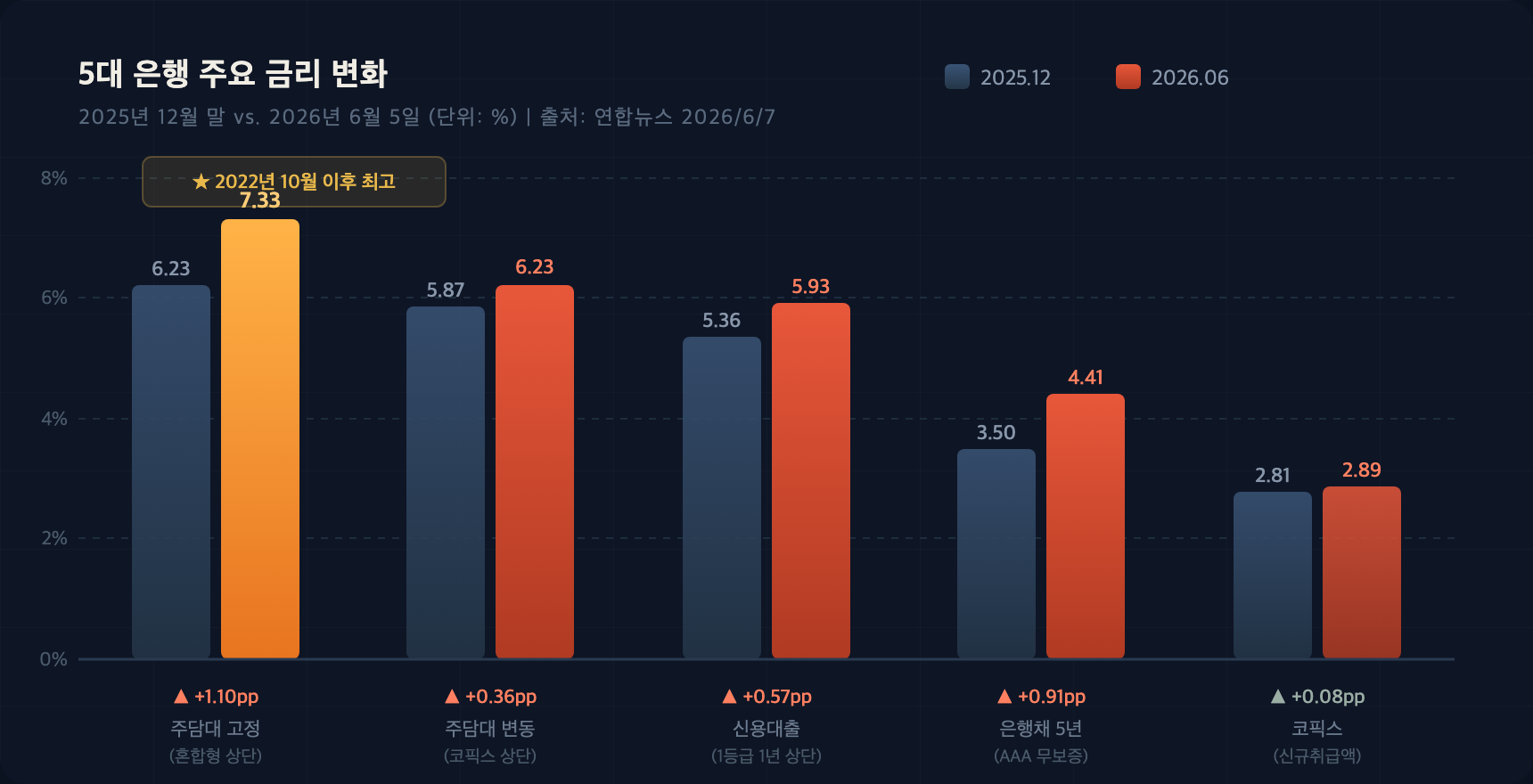
The 7.33% upper bound on fixed mortgages is up 0.33 points in a single month and 1.10 points since January. Per Yonhap, the last time the mortgage ceiling cleared 7.3% was October 2022 (7.33%) — three years and eight months earlier[3]. One distinction matters: back in 2022 the policy rate stood at 3.00%, versus 2.50% today, so a comparable loan rate now sits on a lower policy base. The immediate driver is the 5-year AAA bank bond yield, which rose roughly 0.9 points over the period to 4.413%.
The Case for Tightening: Inflation, the Won, Geopolitics
Three pressures explain why markets are pricing hikes in advance. Inflation came in at 3.1% year-on-year in May 2026, the highest since March 2024[3]. The currency weakened, with the dollar/won rate climbing into the 1,550 range and adding to imported-price pressure. And Middle East geopolitical risk continues to unsettle energy prices and inflation expectations.
Leadership signals point the same way. At his first rate-setting meeting on May 28, 2026, new BOK Governor Hyun Song Shin called the Korea–U.S. rate gap “a very important factor for the exchange rate,” and said narrowing it could ease downward pressure on the won[3]. Relative to his more cautious predecessor Rhee Chang-yong, that reads as a hawkish posture. Market forecasts align: Citi’s June 4 note projected quarter-point hikes in July and October 2026 and again in January and April 2027, and the BOK’s own six-month dot plot placed 19 of 21 dots above the current 2.50%[3].
None of this is a settled outcome. Citi itself flagged the risk that an easing turn could arrive sooner than expected. If inflation cools quickly or growth slows materially, the hiking path could be delayed. The consensus has tilted toward hikes, but the actual decision rests with the BOK’s Monetary Policy Board, not with the market.
For Borrowers: Floating-Rate and Leveraged Investors Are Most Exposed
How the decoupling lands on a household depends on its balance sheet. Borrowers — especially those on floating rates — are reasonably advised to prepare for heavier interest costs over the coming months. The most exposed group is investors who borrowed to buy equities. Per Yonhap, unsecured personal loan balances at the five major banks rose from roughly 106.5 trillion won at the end of May 2026 to about 107.5 trillion by June 4 — close to 1 trillion won, or around 330 billion a day, in just three business days[3].
The hazard here is that two losses can land together. If equities correct, a leveraged borrower faces both higher interest costs and mark-to-market losses at once. In past rising-rate episodes, leveraged positions have often unwound first — though that pattern is not guaranteed to repeat. What is clear is the starting point: confirm whether your loans are fixed or floating and whether they track COFIX or bank bonds, then model what another six months of hikes would do to your monthly payment. A worked number is more useful than a vague worry.
For Savers: The Same Conditions, a Different Effect
A rising-rate environment that burdens borrowers tends to benefit those holding cash. New deposit and bond yields generally rise alongside rates. A principle worth weighing in this phase is to avoid locking in for too long: keeping maturities short preserves the option to roll into higher-yielding instruments as rates climb[2]. Short-term deposits, certificates of deposit, and money market funds fit that approach. This is a general principle, not personalized advice — the right choice depends on an individual’s liquidity needs and goals.
So Where, and How, Do You Actually Invest?
This is the question that matters once the analysis is done: where should the money go? Frame it correctly first. The decoupling isn’t a “buy this” call; it’s a question of where you stand in the rate cycle. Change the phase and you change the answer. What follows is not a list of tickers but a map of how each asset class tends to behave in the current hike-leaning phase — and where the traps sit.
| Asset class | Tendency in this (hike-leaning) phase | Watch out for |
|---|---|---|
| Short-term deposits, CDs, MMFs | Favorable — risk-free yields at multi-year highs | Reinvestment yield falls again once rates peak |
| Long-duration bonds (government, corporate) | Unfavorable — prices fall as yields rise | When a rate peak comes into view, rotating into long duration to lock in high yields is the textbook move |
| Bank & insurance equities | Relatively favorable — rising rates tend to widen net interest margins | A tightening-driven slowdown can drag the whole market, financials included |
| High-debt growth, real estate, REITs | Unfavorable — higher funding costs bite earnings and valuations directly | Leveraged positions wobble first |
| USD assets (FX-exposed) | Two-sided — Fed easing pressures the dollar, but the won is the wild card | Buying USD unhedged near 1,550 carries FX-loss risk |
Two decisions do most of the work. The first is duration. While rates can still rise, the textbook sequence is to keep bond maturities short, then rotate into longer duration to lock in high yields once a peak comes into view — signaled by cooling inflation or a dovish turn at the BOK. Nobody times that peak precisely. The second is currency. With the won near 1,550 to the dollar[3], Governor Hyun is explicitly aiming to relieve won weakness by narrowing the Korea–U.S. rate gap. If Korea hikes while the Fed cuts, that gap closes and the won has room to firm — which makes adding unhedged dollar assets at today’s weak-won extreme a bet that can lose on both the asset and the currency.
So the center of gravity for a hike-leaning phase is reasonably clear: capture the higher short-term deposit yields, keep bonds short, approach the dollar with the hedge in mind, and cut positions built on borrowed money. These are general allocation principles, not individual product or security recommendations, and the right answer shifts with your time horizon and risk tolerance.
A Household Checklist for the Decoupling
For action items, a list is clearer than prose:
- Map your loan structure: identify fixed vs. floating and the benchmark (COFIX or bank bonds), then model six months of interest under a rising-rate scenario.
- Evaluate refinancing: Korean mortgages can typically be refinanced six months after origination[2], but only after confirming that interest saved exceeds total switching costs — prepayment penalties, stamp duty, and preferential-rate conditions included.
- Review leverage: compare borrowing cost against expected return; where interest threatens the expected upside, consider trimming leverage.
- Manage liquidity: hold spare cash in short-term instruments to preserve the option to move to higher rates if hikes continue.
The Korea–Fed decoupling is not a macro footnote; it is a variable that reaches directly into household borrowing, saving, and investing decisions. The consensus has tilted toward Korean hikes. But because that path is not fixed, the response that fits this phase is defensive rather than directional: check the debt, keep liquidity short, and let the math — not a single forecast — decide any refinancing move.
This article is editorial commentary for informational purposes only. It is not investment advice or a solicitation to borrow or to buy any financial product. Figures cited reflect the dates and sources noted and may change thereafter. All financial decisions remain your own responsibility.
Sources
- U.S. Fed holds rate at 3.5–3.75%, June 17, 2026 — CNBC, cnbc.com; NerdWallet, nerdwallet.com
- BOK hold stance, rising market rates, lender spreads, refinancing guidance, Feb 20, 2026 — Naver Pay Money Story (Byte Company), story.pay.naver.com
- Five-bank loan/market rates, personal loan balances, May CPI 3.1%, Governor Hyun’s remarks, Citi forecast & dot plot, June 7, 2026 — Yonhap News, yna.co.kr
Leave a Reply