
Who Actually Bought KOSPI to 9,000?
On June 18, 2026, South Korea’s benchmark KOSPI index crossed 9,000 for the first time in its history. The move came despite signals from U.S. Federal Reserve Governor Christopher Waller that rate cuts should slow — a detail that earned the headline “KOSPI ignores Waller” from Chosun Ilbo that same day.
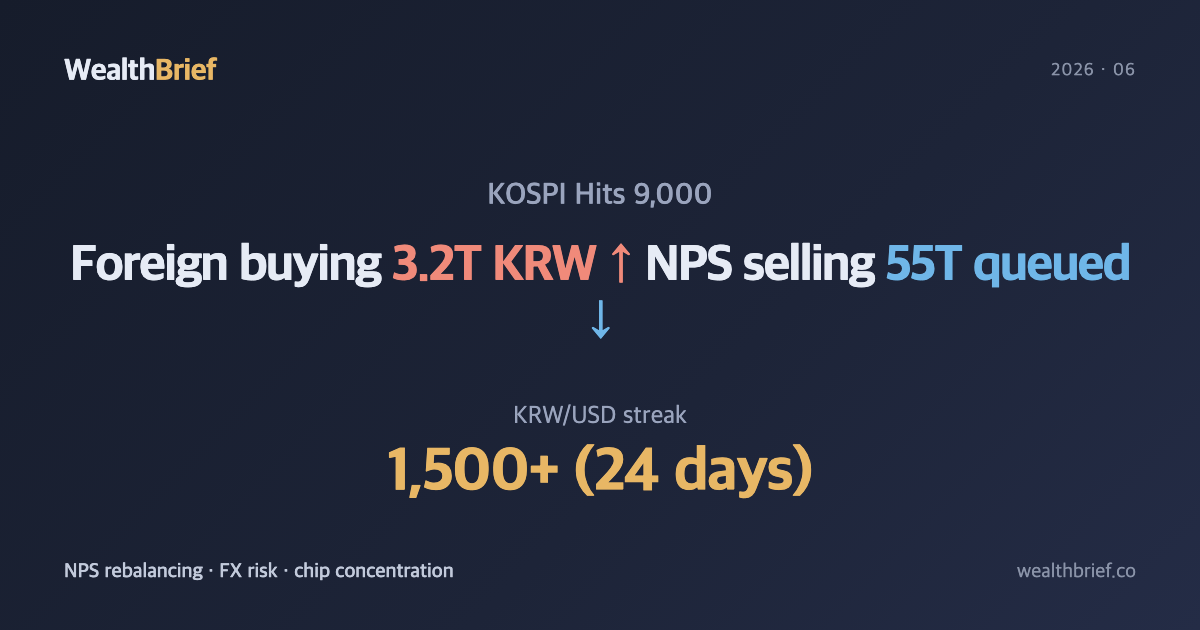
The buying was led by foreign investors. Between June 12 and June 20, offshore funds purchased a net 3.2 trillion won (roughly $2.1 billion at current rates) on the KOSPI, concentrated almost entirely in Samsung Electronics and SK Hynix (TopStarNews, June 20, 2026). For context: foreign investors had been significant net sellers earlier this year. The reversal reflects renewed confidence that South Korean chipmakers are positioned to capture a disproportionate share of AI-driven memory demand.
The question now is whether 9,000 is a launchpad toward 10,000 or a pause before the next challenge. Nobody can answer that with certainty. What investors can do is look squarely at three variables already in motion — and check how each one touches their own portfolio.
Variable 1 — The NPS Rebalancing Wall
The National Pension Service (NPS), South Korea’s ₩1,000-plus-trillion sovereign fund, began selling Korean equities within hours of the 9,000 crossing. According to Yonhap Infomax (June 18, 2026), the NPS offloaded approximately 400 billion won in a single session as an early rebalancing move. The larger number looming: up to 55 trillion won in domestic equity sales are queued for July once mandatory rebalancing formally resumes.
Why the selling? NPS’s strategic asset allocation sets a permitted range for domestic equities. With KOSPI surging, the domestic equity allocation had approached 30% of total assets — near the upper boundary of the permitted band (Yonhap Infomax, June 18, 2026). Once that ceiling is breached, selling is not discretionary; it is required under the fund’s own investment mandate.
The 55 trillion won will not hit the market in a single block. Sales are spread across quarters, and the NPS can coordinate the timing with foreign exchange needs to moderate the price impact. Still, July-to-September now carries a structural institutional selling overhang that would not exist in a lower-KOSPI environment. The pattern in past episodes — 2021 is the most recent comparable — is that large NPS rebalancing did cap index momentum for several weeks, though it did not reverse the broader trend on its own.
Variable 2 — A KRW/USD Rate Stuck at 1,500
The Korean won has traded above 1,500 per U.S. dollar for 24 consecutive trading days as of June 19, 2026 (Cheonji Ilbo; Hankyoreh, June 19, 2026). The persistence is unusual: ceasefire optimism and falling oil prices — factors that typically strengthen the won — have not been enough to push it through the 1,500 floor.
Barclays analysts pointed to NPS rebalancing itself as a structural culprit. When the NPS paused rebalancing, it also reduced the flow of foreign-asset proceeds being converted back into won — a natural source of won demand that temporarily went quiet (Investing.com Korea, June 15, 2026). Now that the rebalancing is restarting, some of that won demand should return, which could create modest downward pressure on the USD/KRW rate.
For investors, the exchange rate matters in two distinct ways. First, those holding overseas ETFs or dollar-denominated assets are sitting on inflated won-denominated valuations. A return to the 1,400s — which would require meaningful won appreciation — would trim those gains. Second, the rate affects foreign investors’ appetite for continued buying of Korean equities: at 1,500, the currency risk for an unhedged dollar-based investor is already elevated. If that discourages marginal foreign demand, the external buying support that lifted KOSPI to 9,000 could soften.
Variable 3 — The Semiconductor Concentration Risk
Korean financial daily Etoday put it plainly on June 21, 2026: “Semiconductors built KOSPI 9,000 — now they’ve become the concentration risk.” Semiconductors and electronics account for a disproportionately large share of KOSPI’s market cap, and foreign inflows are almost entirely concentrated in that single sector. The index and a handful of chip stocks have become nearly synonymous.
Concentration cuts both ways. If the AI memory cycle continues to accelerate, KOSPI can extend its rally with relatively narrow participation — that’s the bull case. The bear case is equally mechanical: any factor that pressures the semiconductor sector would hit the index harder than it would a more diversified market.
This week’s focal point is Micron Technology’s quarterly earnings release, expected around June 25. Micron is the closest publicly traded proxy for the health of the AI-driven DRAM and NAND market. A strong result would likely serve as a tailwind for Samsung Electronics and SK Hynix; a miss or cautious guidance could trigger a correction in chip stocks globally, including Seoul (Energy Economy News, June 21, 2026). Separately, the MSCI quarterly index review results take effect at the end of June, potentially reshuffling passive fund flows into or out of Korean equities.
What to Actually Check in Your Portfolio
A round number like 9,000 creates two almost simultaneous impulses: urgency (“I need to get in”) and doubt (“I’ve already missed it”). Neither impulse is particularly useful for making good decisions.
Three concrete checks are worth doing right now:
- Is your domestic equity weight above your target? If KOSPI’s surge has pushed your stock allocation above the range you set for yourself, the same logic that drives NPS rebalancing applies to you. Trimming to your target allocation is a rule-based response, not a market call. Factor in tax timing and transaction costs before acting.
- What’s your real KRW/USD exposure? If you hold foreign ETFs or dollar savings, their won-denominated values are inflated by the elevated exchange rate. A future won strengthening — whether from rebalancing flows, rate differentials, or macro shifts — would reduce that valuation. “More dollars” does not automatically mean “safer” at this point in the cycle.
- How much semiconductor risk do you actually hold? Many Korean equity funds and ETFs carry heavy semiconductor weightings by design. Being aware of that concentration — and how it would behave if Micron disappoints, or if NPS selling accelerates in July — lets you calibrate your expectations before the volatility arrives rather than after.
Whether KOSPI reaches 10,000 is a question the market will answer in its own time. What you can answer today is whether the risks already priced into your portfolio match the level you’re comfortable carrying.
Key Dates This Week
| Date | Event | Why It Matters |
|---|---|---|
| ~June 25 | Micron Q3 earnings release | AI memory demand signal → Samsung / SK Hynix read-through |
| Late June | MSCI quarterly review effective date | Passive fund rebalancing flows into/out of Korean equities |
| Early July | NPS mandatory rebalancing begins | Institutional selling pressure materializes |
This article is for informational purposes only and does not constitute investment advice, a solicitation to buy or sell any security, or a recommendation tailored to any individual’s financial situation. All figures cited are sourced as noted and reflect conditions as of their respective publication dates. Consult a licensed financial professional before making investment decisions.
Leave a Reply