

A record-high stock market and the longest weak-won stretch in 28 years
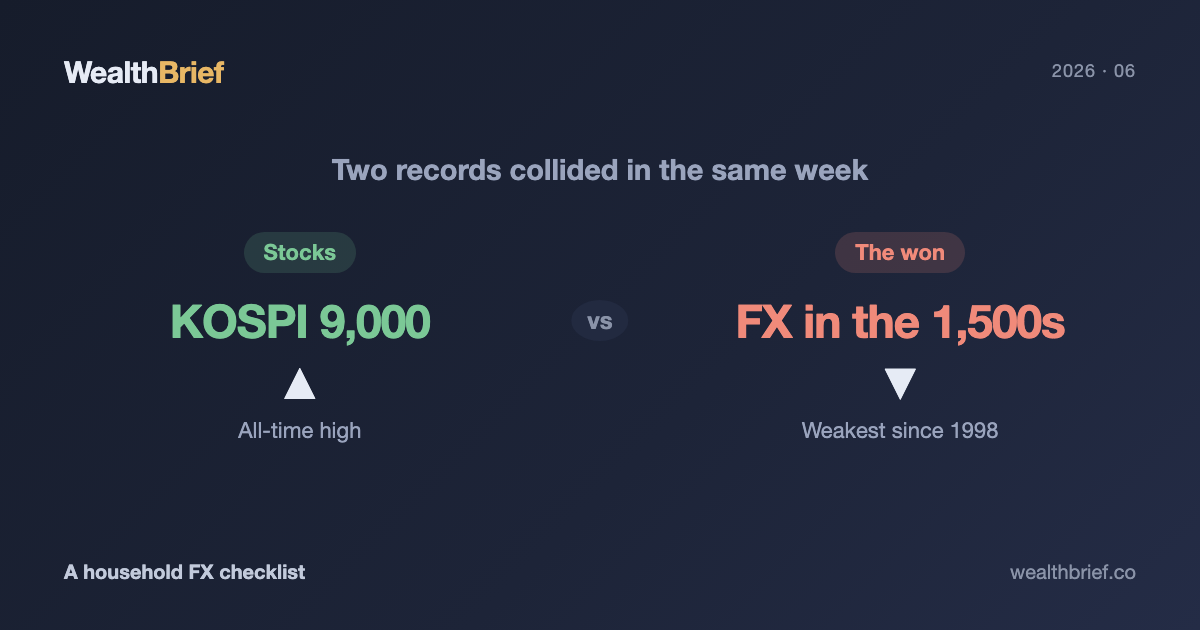
In June 2026, two Korean markets set opposite records in the same week. The KOSPI crossed 9,000 for the first time on June 18 — up 115% year-to-date (source: Hankyoreh, 2026/6/18). Days later, the won opened at 1,537 per dollar on June 19, up 10.3 won, as the dollar index touched its highest level in more than a year (source: Yonhap, 2026/6/19); in after-hours trading it weakened to 1,531 (source: Hankyoreh, 2026/6/20). The dollar index measures the greenback against a basket of six major currencies, so a rising reading means the dollar is strengthening broadly, not just against the won.
The duration is what stands out. As of June 19, the won had spent 24 straight trading sessions in the 1,500s — the longest stretch at that level since the 1998 Asian financial crisis (source: Daum breaking news, 2026/6/19). This is not a single spike that quickly reversed. For nearly a month, the 1,500 handle has behaved like a baseline rather than an outlier, which sets it apart from past short-lived jumps.
Why it won’t ease, even after the war ended and oil fell
Geopolitical risk and expensive oil are the usual suspects behind a weak currency. This time both eased — and the won still couldn’t recover. Even as expectations of a US–Iran ceasefire formed and crude prices dropped sharply, the rate stayed lodged in the 1,500s (source: Hankyoreh and Newspim, 2026/6/19). Market commentary points to three overlapping drivers: a Federal Reserve in no hurry to cut, keeping the dollar firm; the fading of the oil factor; and structural domestic demand to buy dollars (source: News1 and Herald Economy, 2026/6/19–20).
That third driver — Korean investors converting won into dollars to move money into US assets — is the defining feature this round. Citing Bank of Korea data, reporting noted that May import prices fell 0.3% month-on-month thanks to cheaper oil (source: Yonhap and BOK, 2026/6/16), yet were up 24.8% from a year earlier, the steepest annual rise since the pandemic (source: Dong-A Ilbo, 2026/6/16). With oil falling, the currency is doing much of the work behind that year-over-year jump in import costs.
How a record stock market and a weak won coexist
An all-time-high equity market alongside a soft currency looks contradictory, since foreign inflows usually lift the won. But this rally has been driven more by domestic money than foreign buying, and at the same time, local investors’ purchases of overseas stocks have fueled dollar demand. The so-called seohak-gae-mi — Korean retail investors who buy US and other foreign equities — have bet aggressively. On the SpaceX listing day in mid-June, domestic investors net-bought 1.2 trillion won worth in a single session (source: Yonhap, 2026/6/16).
One report cited an estimate that a 3% rise in outbound investment lifts the exchange rate by about 0.7 percentage points (source: report cited via Nate, 2026/6/18). That is a single estimate, though, and pinning the spike on retail investors as the lone culprit is a stretch; outlets such as Dailian questioned that framing during the same period (source: Dailian, 2026/6/18). An exchange rate is the joint product of Fed policy, the dollar index, the trade balance, and capital flows — not any one of them. What is clear is that a money-move is underway: domestic capital selling won and buying dollar assets.
Where a weak won lands in household budgets — four channels
A won stuck in the 1,500s isn’t just macro news. It reaches four parts of a household’s wallet directly.
- Overseas equity investors: Buying dollar assets when the won is weak means fewer shares for the same amount of cash. Even if a stock rises, a later strengthening of the won can erode the gain through currency losses — while further won weakness would add a currency gain. You carry two variables, the stock and the rate, at once.
- Travel, tuition, and remittances: Sending the same US$10,000 costs more than 2 million won extra at 1,500 versus 1,300. For families with recurring tuition or living-abroad expenses, the bite is tangible.
- Import prices and the cost of living: A weak won tends to raise the price of imported commodities, energy, and food, which feeds into consumer prices with a lag. The 24.8% year-on-year rise in import prices (Dong-A Ilbo, 2026/6/16) shows that pressure building.
- Dollar-asset holders: If you already hold dollar deposits, dollar-denominated insurance, or foreign assets, their won value has risen. But accumulating fresh dollars now, when the rate is already high, carries the risk of buying expensive.
A household checklist for a strong-dollar phase
A list is clearer than prose here. None of this argues for betting on a single forecast; it’s about reducing the jolt whichever way the rate moves.
- Map your FX exposure: Start by tallying how much of your assets and spending is tied to the dollar. If you hold foreign stocks, separate your paper gain into “price move” and “currency move.”
- Convert in tranches: If you have recurring dollar outflows (tuition, remittances), spreading conversions over time is one approach, rather than swapping a lump sum at a high rate. The goal is smoothing your average cost, not timing the top or bottom.
- Beware chasing the dollar: With the rate at its longest stretch this high since 1998, piling into dollars out of FOMO raises the odds of buying expensive. The general principle in currency saving is to accumulate in tranches when the rate is low.
- Prepare for the import-price lag: A prolonged weak won can show up in everyday prices with a delay. Reviewing fixed expenses and holding a cash buffer beats vague worry.
KOSPI 9,000 and a 1,500-won dollar are two records stamped at the same moment — one pointing to rising asset prices, the other to a weakening currency. The more these signals clash, the more it favors a defensive review over a one-way bet: count your FX exposure precisely, split the timing of your conversions, and resist chasing. The won’s next move will be set jointly by the Fed, oil, and capital flows — and none of those is a settled outcome.
This article is general commentary for information purposes only and is not investment advice or a recommendation to buy any currency or financial product. Figures are as of the dates and sources cited and may change. All financial decisions are your own responsibility.
Leave a Reply